

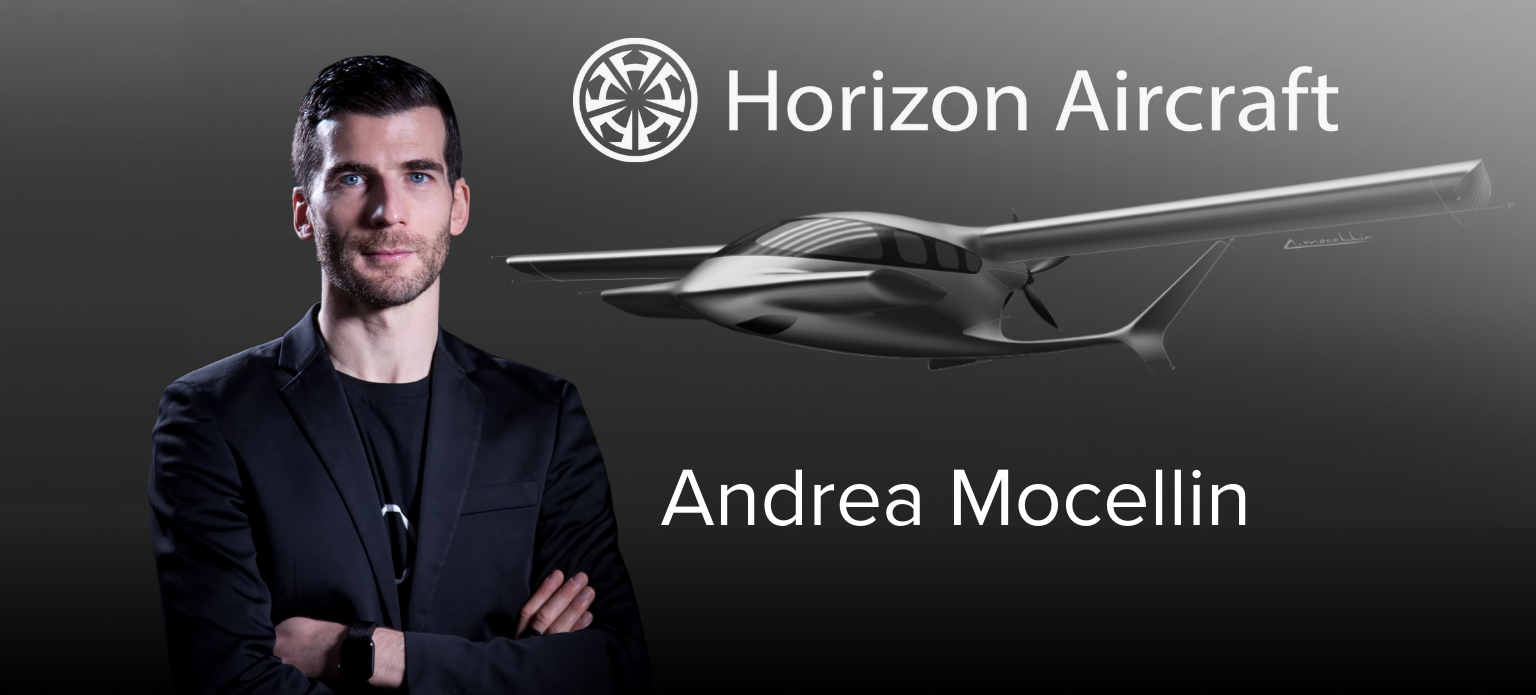
The Art of Design
Art has constraints, whether through the characteristics of the medium, influence from patrons, resources, time, physical, mental, or emotional state of the artist. Art can be influenced not just by factors that affect the execution of the art, but also by factors that influence the concept of the art itself. With design, art is applied to create shape and form to achieve a function in an aesthetically pleasing way.
Art historically, wasn’t just for arts sake. Rather it served a function. Whether to inspire people, educate them through imagery, communicate ideas and emotion across time and generations, or make life more tolerable and beautiful, art has many functions and purposes.


Putting Emotion into Motion
Art can also move us. Whereas art has historically communicated ideas and inspired people, mobility design carries forward those intentions in a functional, problem-solving way combining creativity, aesthetics, and engineering to create solutions that move people both literally and emotionally! ✈️ Moving people forward, across the horizon through innovative design is exactly what great mobility designers do.
This article focuses on Canadian regional air mobility hybrid eVTOL manufacturer Horizon Aircraft, and Italian designer Andrea Mocellin, who is responsible for the Cavorite X7’s fusion of creativity, aesthetics, and engineering. Andrea has dedicated his professional career to design, particularly mobility design. From micro-mobility to regional air mobility (RAM), he hasn’t confined himself to just one part of the journey. He is involved in the entire travel experience, taking tremendous care to ensure that people with mobility challenges not only have greater opportunities to travel efficiently and comfortably, but also do so in style and with elegance. We will explore how Mr. Mocellin’s noble mission in improving mobility for all, including his micro-mobility invention, the Revolve Air wheelchair, as well as his automotive and aerospace design experience, culminates in his vision for the long-range hybrid-electric Horizon Cavorite X7 eVTOL.
Horizon Aircraft is an Ontario-based company that designs, engineers, and builds hybrid electric eVTOLs. They are currently building their full-scale prototype of the Cavorite X7, an eVTOL aircraft that seats 6 passengers and 1 pilot. Horizon’s half-scale prototype made its historic full-transition flight in the summer of 2025.

Horizon Aircraft
- Established in 2013
- Founded by Brian Robinson and Brandon Robinson
- CEO: Brandon Robinson
- Headquartered in Lindsay, Ontario, Canada
- Manufacturer of the Cavorite X7
- Hybrid-electric
- Unique Fan-in-Wing design
- Range: 800 km (500 miles) plus AAR
- Max cruise speed: 450 km/hr (280 mph)
- 7 seater (1 pilot plus 6 passengers)
- Max ferry range: 1,450 km (900 miles)
- Max gross weight: 2,500 kg (5,000 lbs)
What is Transition Flight?
Horizon’s hybrid-electric Cavorite X7 has the ability to fly like a conventional fixed-wing airplane, taking off and landing horizontally. In fact during most of the duration of the Cavorite X7’s flight, it flies like a conventional fixed-wing aircraft. However, it can also takeoff and land vertically like a helicopter. This allows great flexibility when deciding where and how to takeoff and land. One of the great and most unique engineering features of the Cavorite X7 is its HOVR wing system.
HOVR wing system
Horizon Aircraft developed an ingenious and patented fan-in-wing design. The profound, yet “simplicity” in Horizon’s design is a true engineering marvel. Unlike the quadcopter-style vehicles aimed at short urban hops, the Cavorite X7 is a hybrid-electric aircraft with fixed wings, a rear propeller, and 12 electric ducted fans embedded in its wings for vertical takeoff and landing. Once airborne, the fans are sealed by closing panels, allowing the aircraft to transition into efficient forward flight.
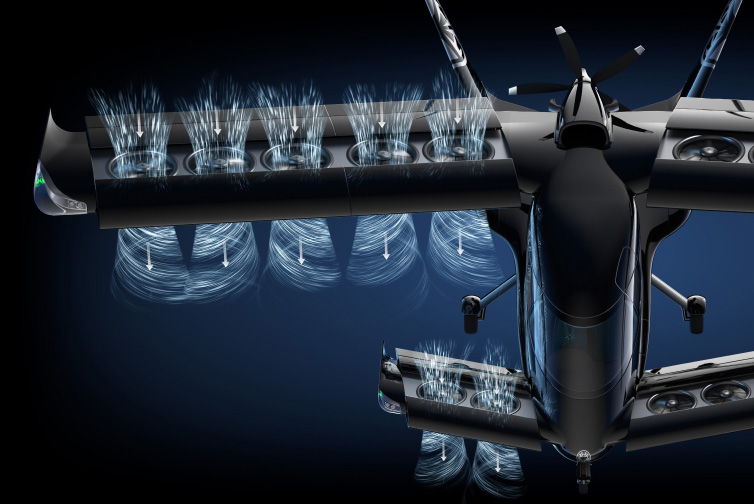
The Cavorite X7 features a revolutionary fan-in-wing design that blends the flexibility of a helicopter with the performance and speed of a traditional aircraft.
Its transforming wings house 12 high-powered lift fans, delivering the vertical thrust needed for smooth and efficient takeoff.
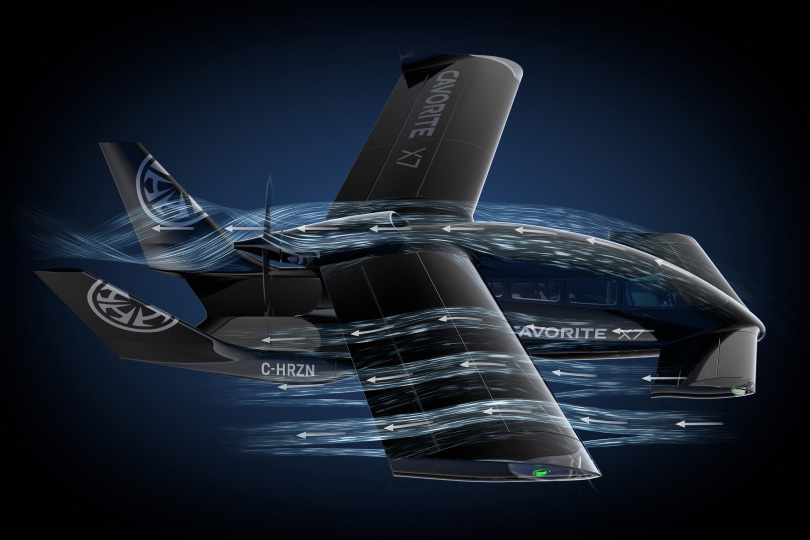
Once the Cavorite X7 reaches a safe altitude and speed, sliding panels conceal the lift fans, allowing it to transition into conventional airplane flight. For landing, it can use a standard runway, or redeploy the fans to touch down on a helipad. Horizon Aircraft claims the Cavorite X7 can even land in a space as small as a tennis court!
On the 15th of May 2025, a large scale prototype of the Cavorite X7 was the first large scale eVTOL in the world to transition from vertical takeoff to wingborn cruise with a fan-in-wing design.
Design Taking Shape
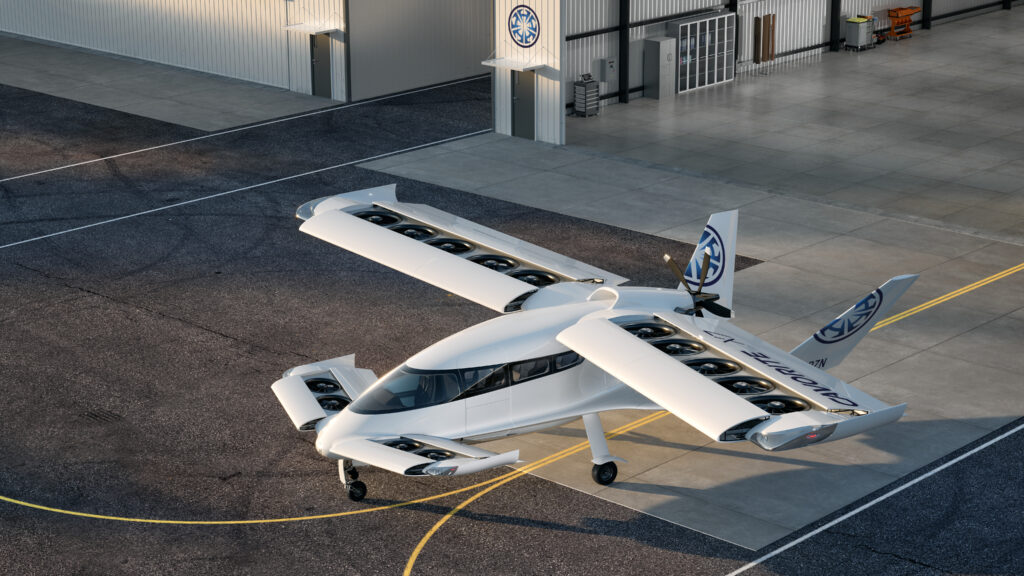
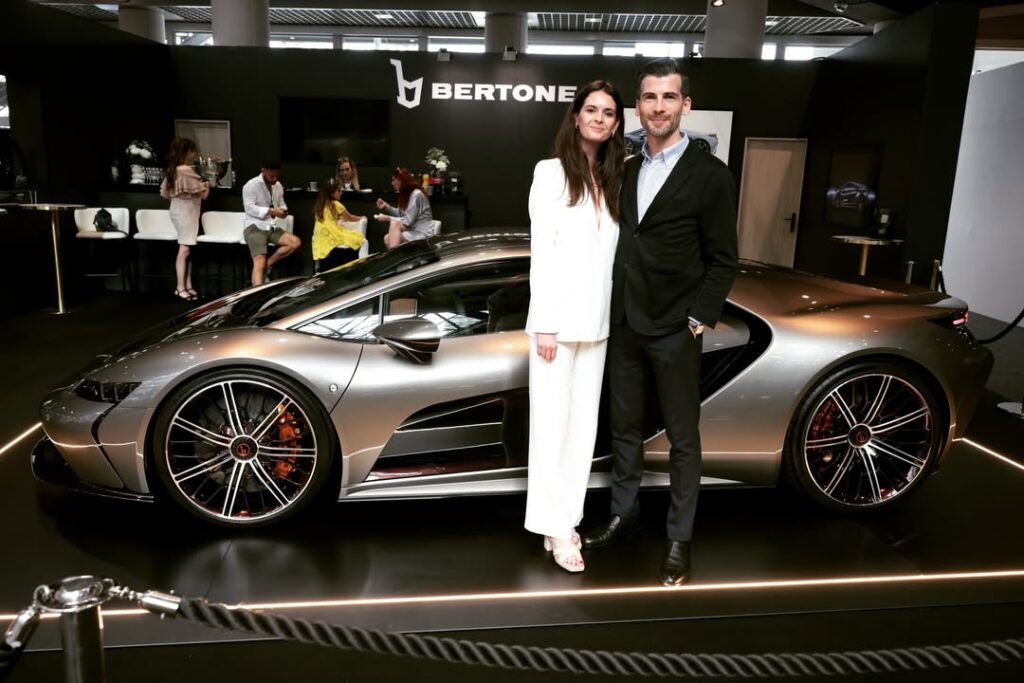
Horizon’s Cavorite X7 was already a great design. If Horizon Aircraft wanted to make the Cavorite X7 look more sleek and refined, this would be no easy task (to say the least). Nevertheless in their stubborn pursuit of perfection, Horizon got award-winning designer Andrea Mocellin on board for such a purpose. Not a stranger to aircraft design, Andrea Mocellin was on the design team for Lilium’s eVTOL as Lead Product Designer. He also designed the seats for Air France subsidiary HOP!, and their fleet of Embraer 190 narrow body aircraft while working with Expliseat. Besides Lilium and Air France, Andrea Mocellin has worked with Ferrari, Maserati, Alfa Romeo, Bertone, Audi, Nike, Pininfarina, and GranStudio (companies that are synonymous with aesthetically pleasing designs).

Andrea Mocellin
Award-Winning Innovator, Automotive and Aviation designer
- Former Lead Product Designer at Lilium
- Senior Designer at NIO, Alfa Romeo / Maserati
- Chief Designer at Granstudio
- Creative Designer for Ferrari, Bertone, Audi, Pininfarina, Nike, and Cleto Munari
- Invented and designed Revolve Air wheelchair (Listed as one of “The Best Inventions of 2021” by Time Magazine)
- Work displayed at Beijing Auto Show, Geneva International Motor Show (GIMS), EVER Monaco, MART in Rovereto and the London Transport museum


“As we push forward with the next phase of the Cavorite X7’s development, partnering with Andrea allows us to elevate the aircraft’s design and reinforce our commitment to world-class innovation in eVTOL technology.” – Brandon Robinson, CEO and Co-founder at Horizon Aircraft (June 25, 2025)
“It is a unique opportunity to collaborate with Horizon Aircraft on this groundbreaking project.” ….“Bringing together my experience in transportation design and mobility innovation, our goal is to create an aircraft that is both performance-driven and instantly recognizable, setting a new benchmark in the industry.” – Andrea Mocellin (June 25, 2025)
Education: Where Thoughts and Ideas Travel
Andrea Mocellin earned his bachelor’s with honours in transportation design at the Istituto Europeo di Design (IED) in Turin, and a master’s degree in vehicle design at the Royal College of Art in London.
Turin to Touring Supercars
Turin was the city that formed the initial framework of Andrea Mocellin’s post-secondary education, where he graduated and received a bachelor’s with honors in Transportation Design at Istituto Europeo di Design (IED). Turin would eventually become the city where he demonstrated to the automotive world, the brilliance of his creativity and pursuit for beautiful and meaningful design.
In an interview with Istituto Europeo di Design (IED), Andrea explained the opportunities he received during his studies:
“Meeting design legends like Giugiaro, Pininfarina and Bertone was a dream come true, feeling so close to their brilliant work and vision pushed me to work as hard as I could to get my first job as a Car Designer. During my studies, the most important aspect of my personal growth was starting to work in an international environment, knowing that the world was smaller than I thought” – Andrea Mocellin, innovator and mobility designer, as well as graduate with honors in Transportation Design from Istituto Europeo di Design (in an interview with Istituto Europeo di Design)

Istituto Europeo di Design
- Cities:
- Milan, Turin, Venice, Cagliari, Como, Florence, Rome, Barcelona, Madrid, São Paulo, Beijing, Rio de Janeiro, and Shanghai
- Degree: Bachelor of Arts
- Four disciplines
- Design
- Fashion
- Visual Communication and Management
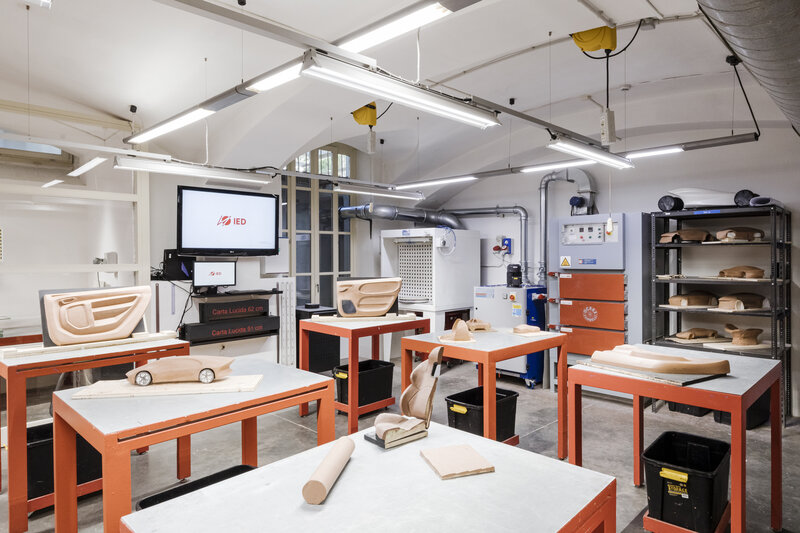
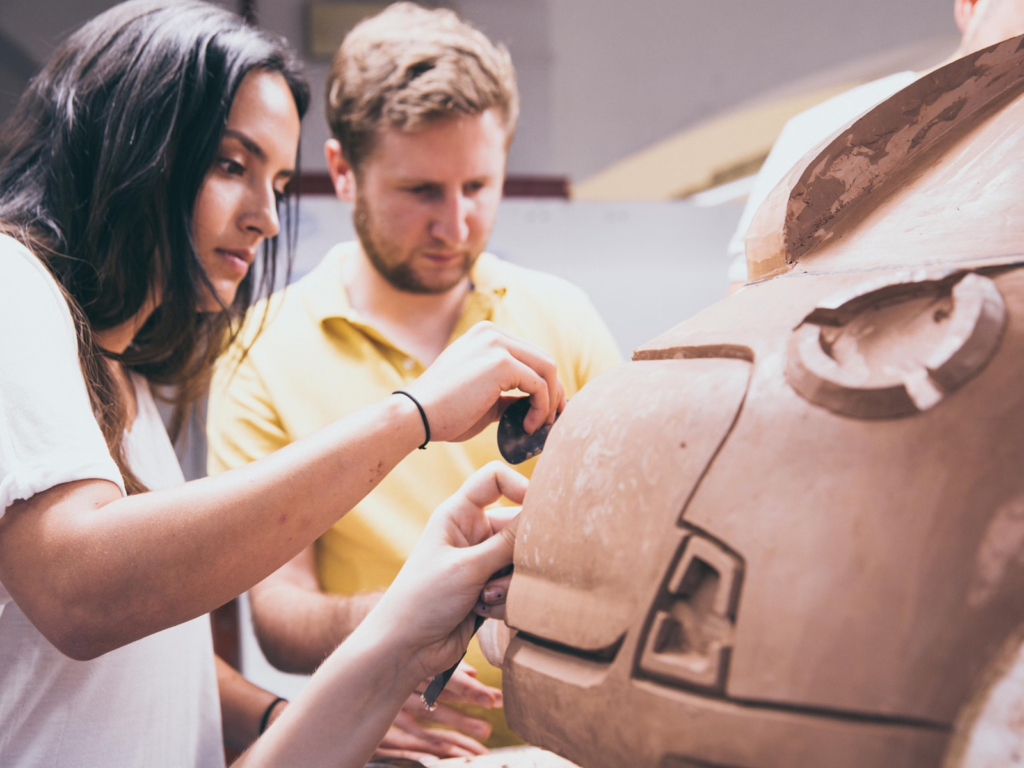
“We are the only school in the world, which every year launches a show car in 1:1 scale in an international show.” – Davide Tealdi (speaking in 2019 as faculty member of IED Torino)
Kensington Gardens, Where Andrea Mocellin’s Skills Further Cultivated and Blossomed 🪴🌹
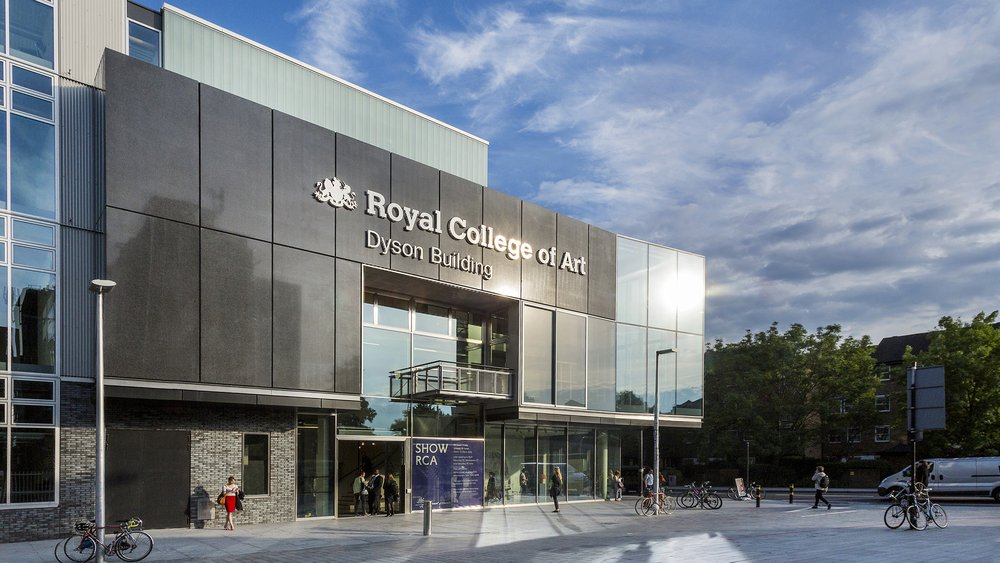
Andrea Mocellin traveled to London to study at the Royal College of Art’s Kensington campus, earning his master’s degree in Vehicle Design. The rainy London weather 🌦️ ensured that the education he received, along with the ideas Andrea planted in his mind, was well watered,☔ creating fertile ground for learning and growth. 🌿

Royal College of Art
- Founded in 1837 as the Government School of Design
- Granted a Royal Charter in 1967
- Offers degrees in:
- Architecture
- Applied Arts
- Business
- Communication
- Contemporary Art & Culture
- Design
- Education
- Environment
- Experience design
- Fashion
- Fine arts
- Graphic Design
- Humanities
- Illustration
- Industrial design
- Moving Image
- Product design
- Textiles

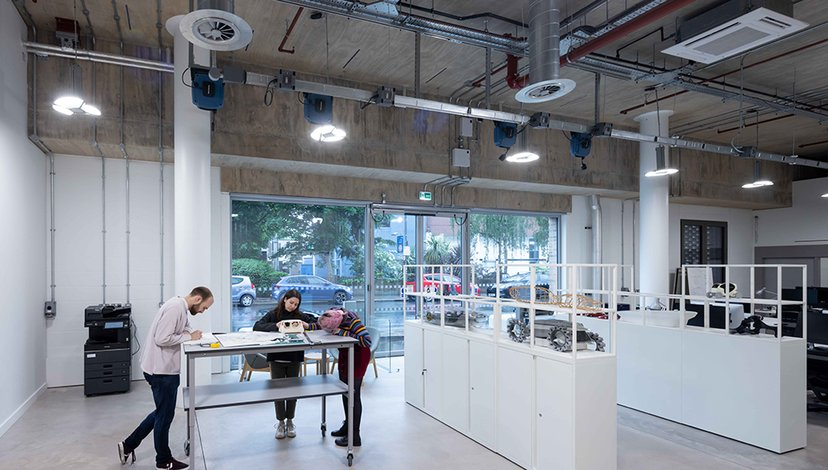
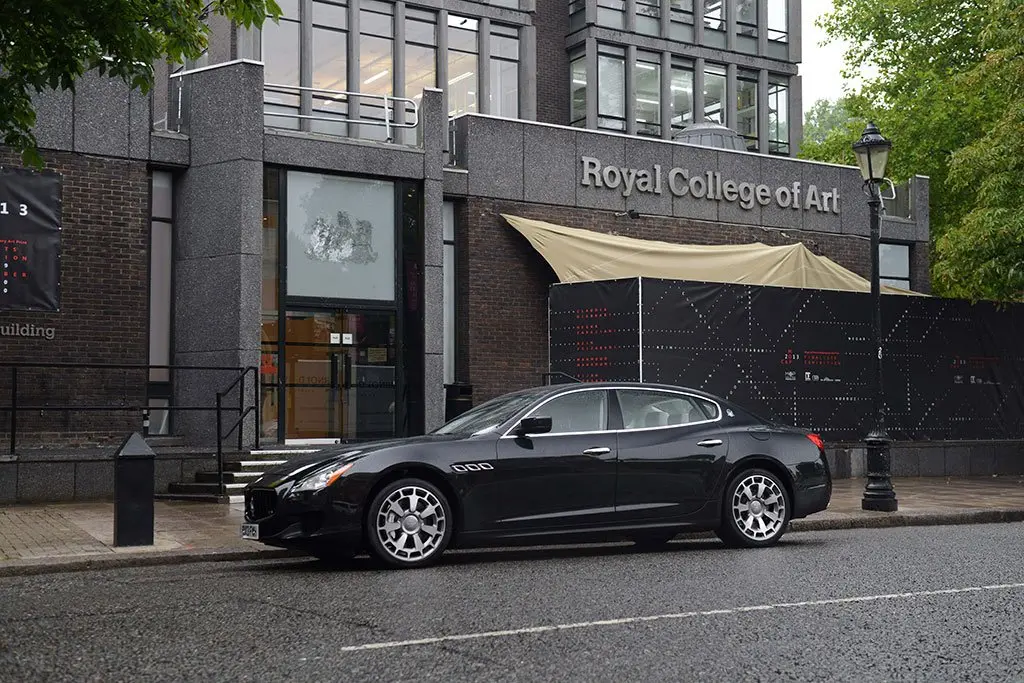
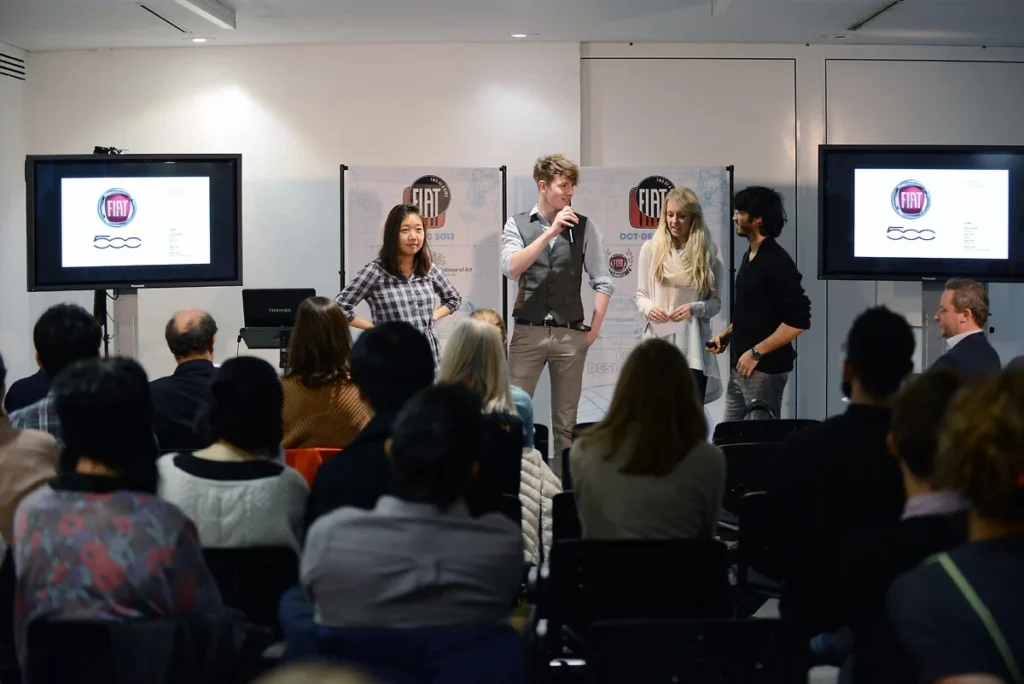
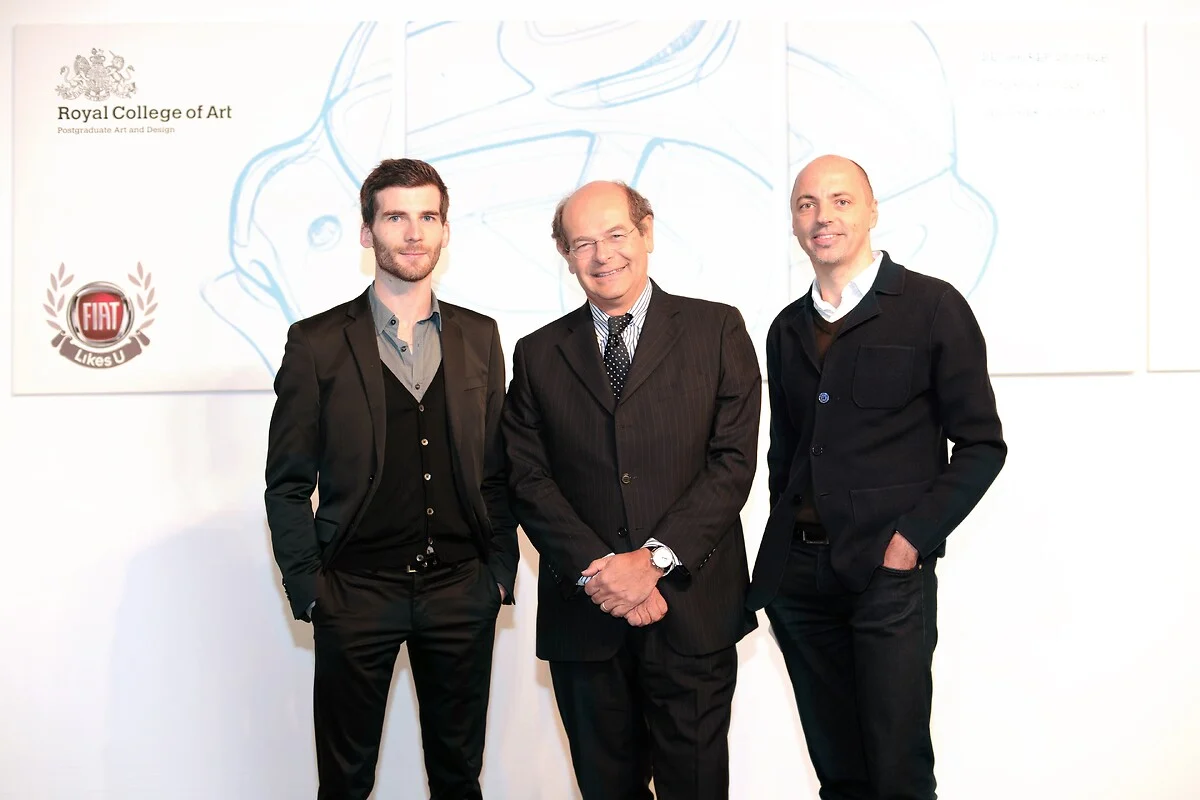
The Royal College of Art’s Intelligent Mobility Design Centre (IMDC)
Turin, Where Mocellin’s Wheels Keep Spinning
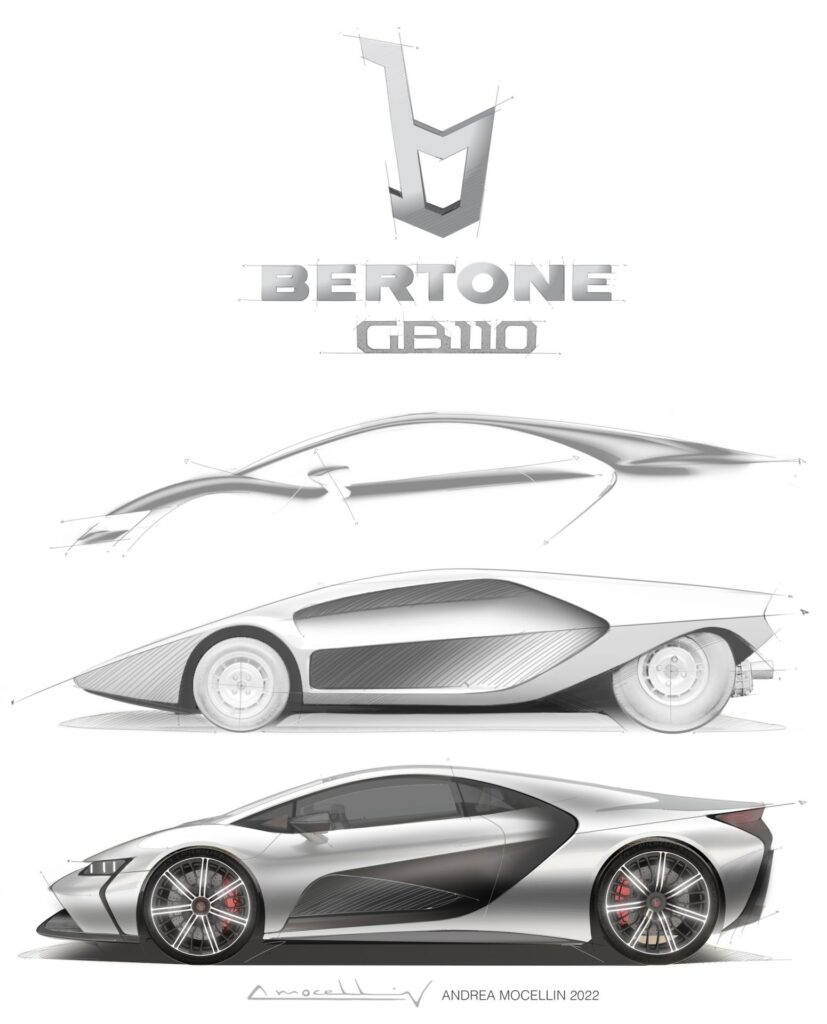
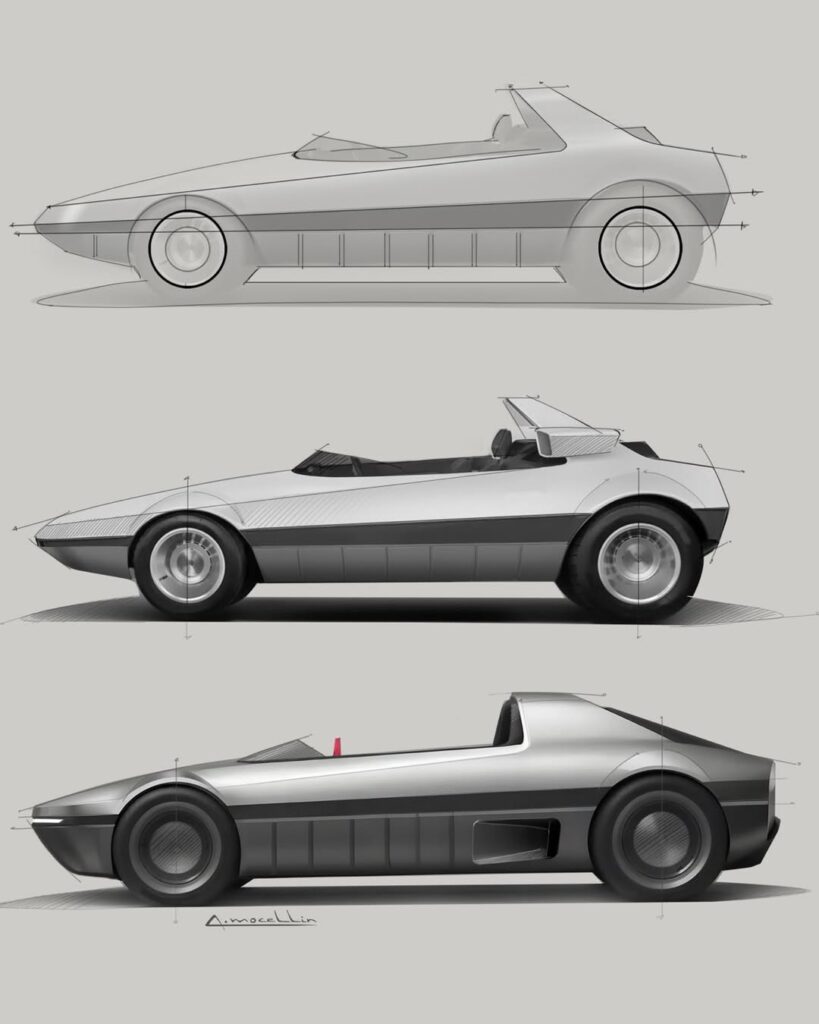
Below: Sketches of the Bertone GB110 and Bertone Runabout designed by Andrea Mocellin (Images courtesy of Andrea Mocellin)


Air France and Expliseat
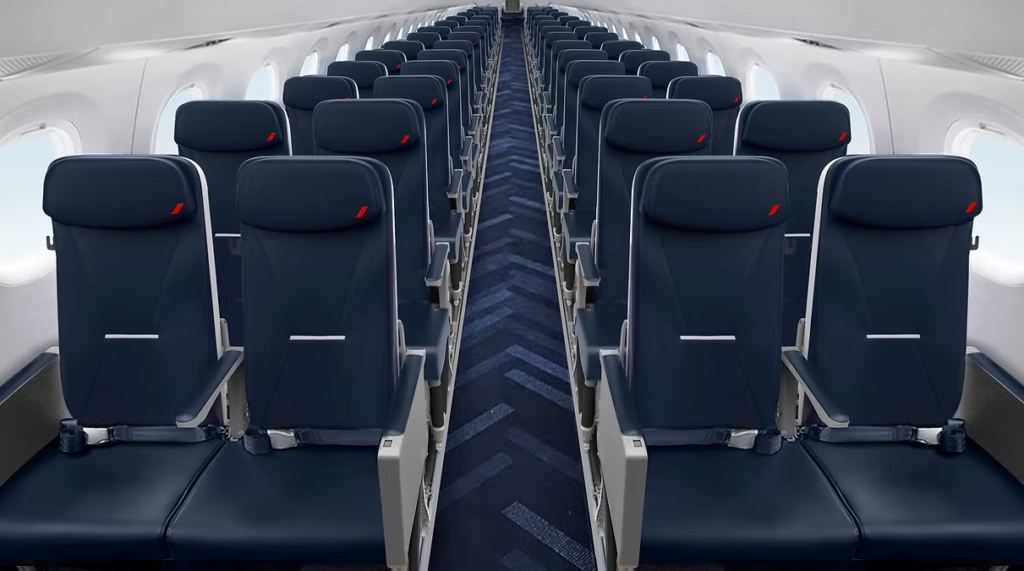
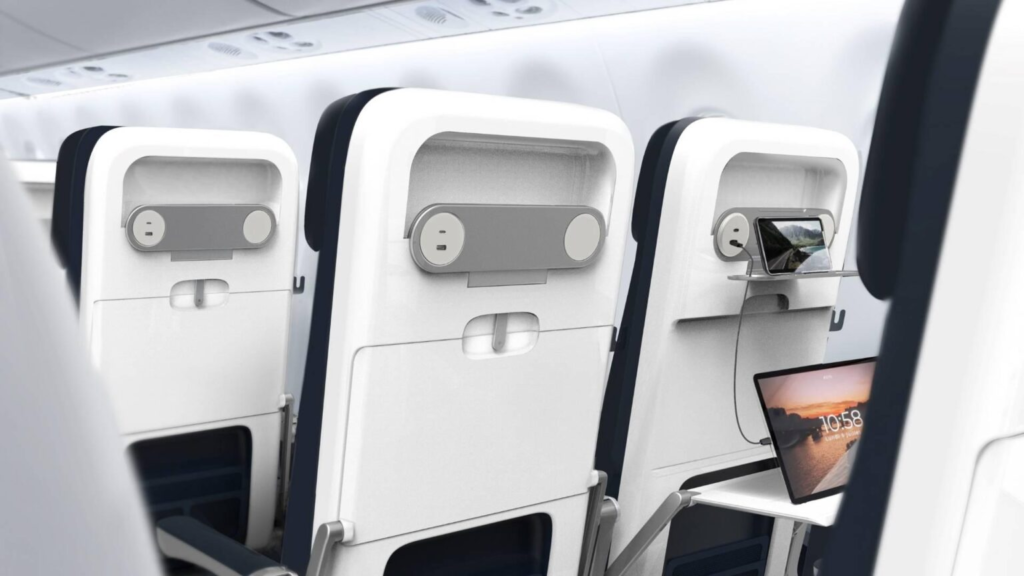
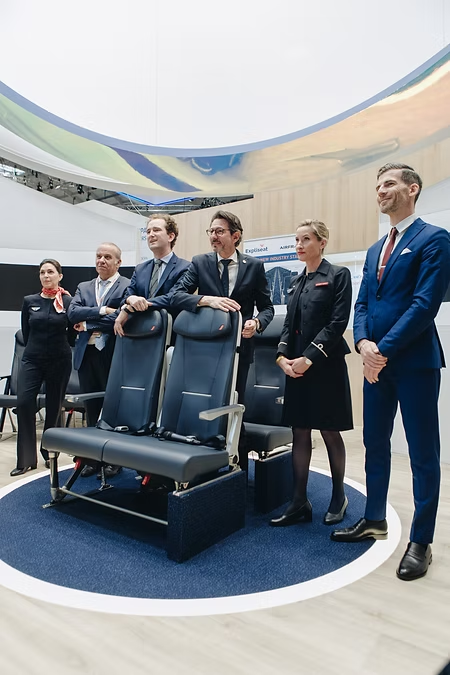
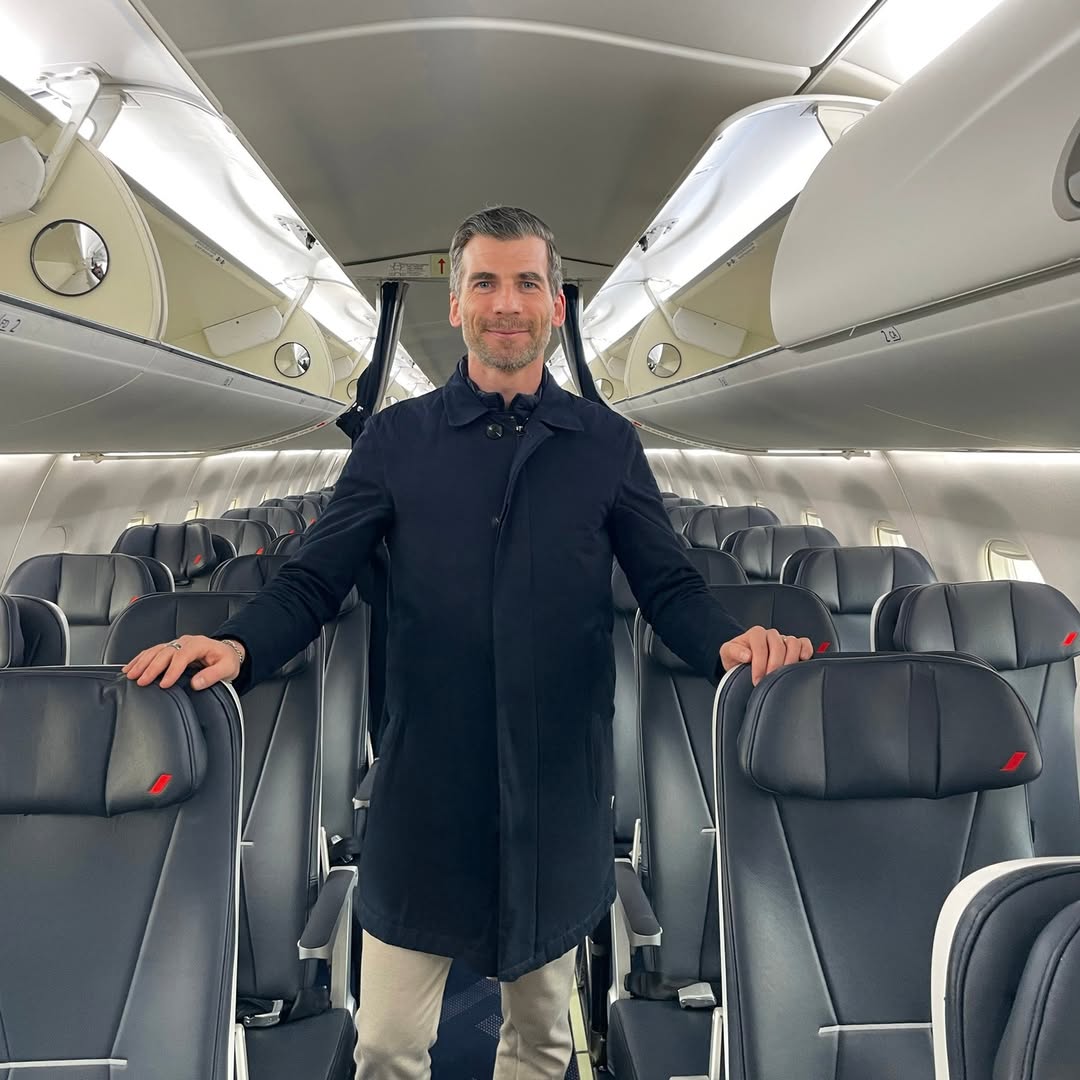
Left image: Andrea Mocellin (far right) with Fabien Pelous, VP of Customer Experience, Air France (centre right), and Amaury Barberot, CEO of Expliseat (centre left) at Aircraft Interiors Expo (AIX) in Hamburg. Right image: Andrea Mocellin experiencing the seats he designed for the first time as a passenger of an Air France HOP! flight (Image courtesy of Andrea Mocellin)
From Concept to Cavorite
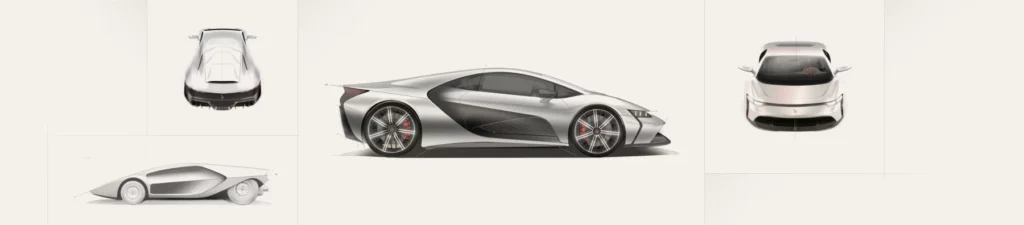
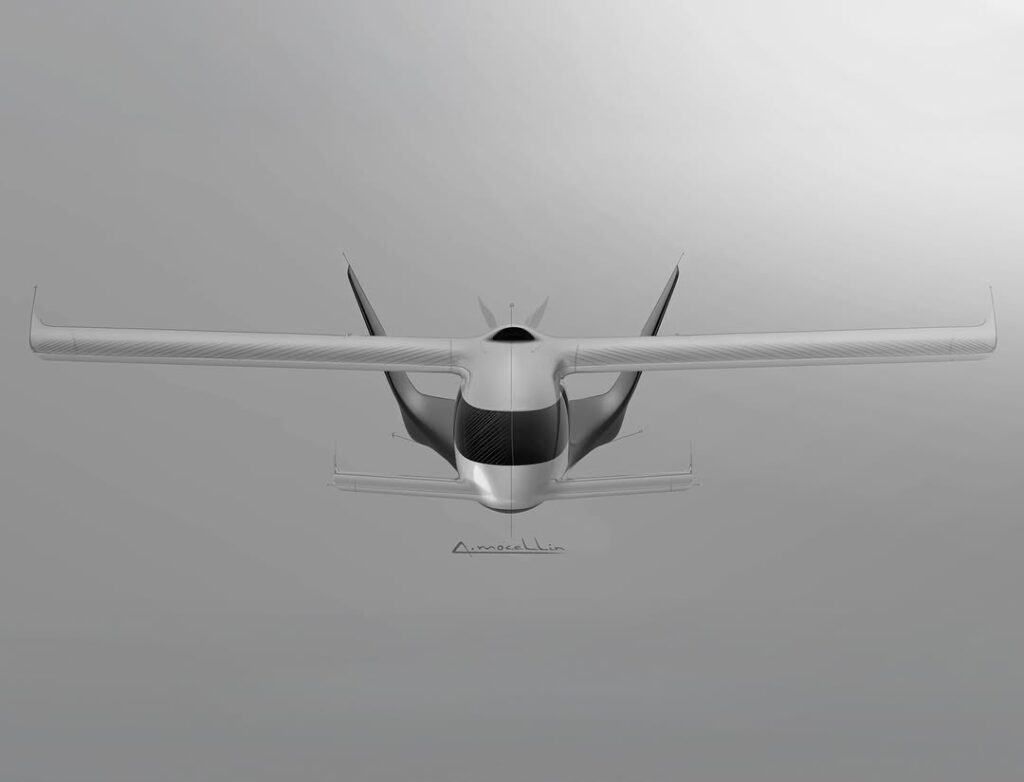
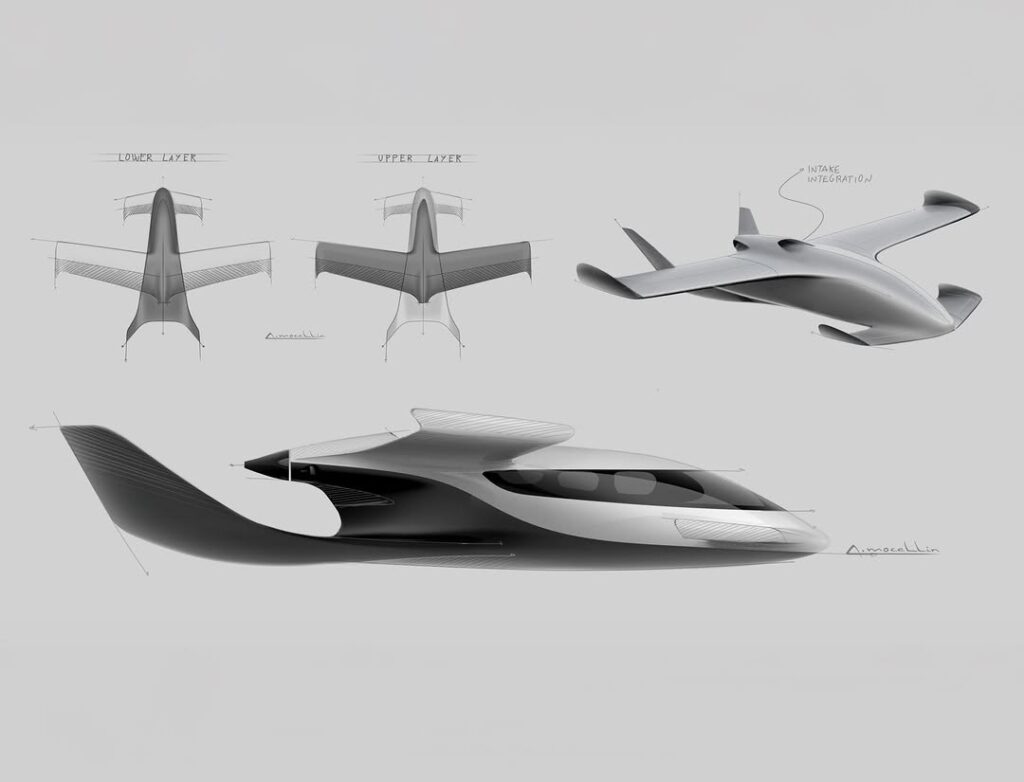
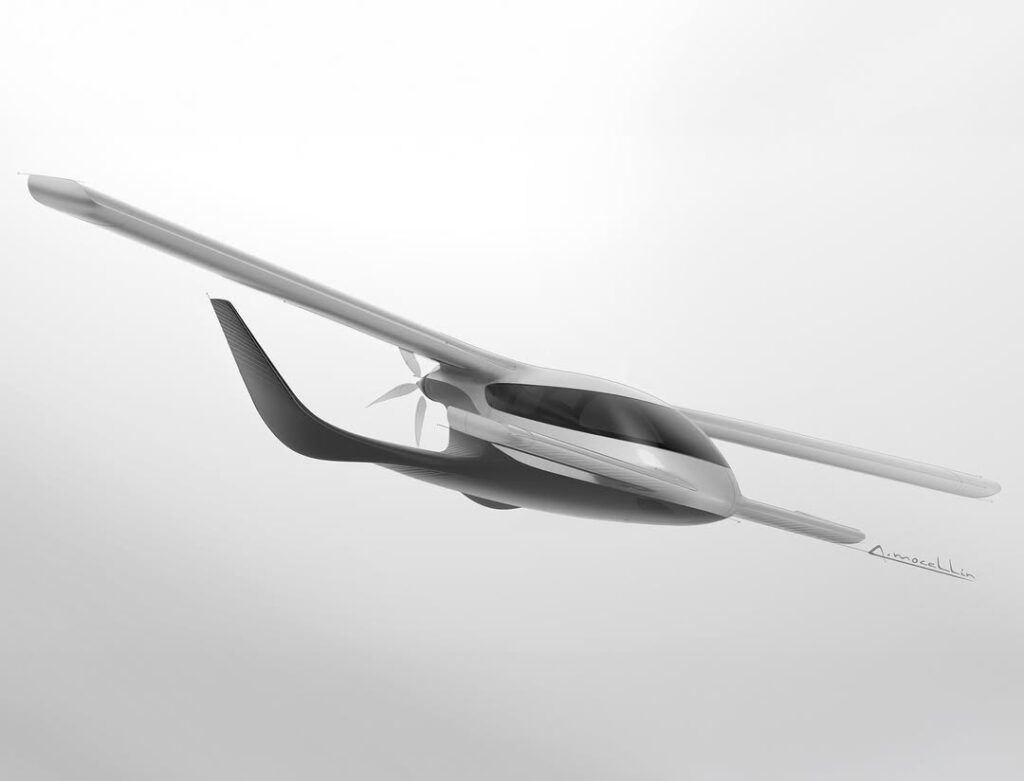
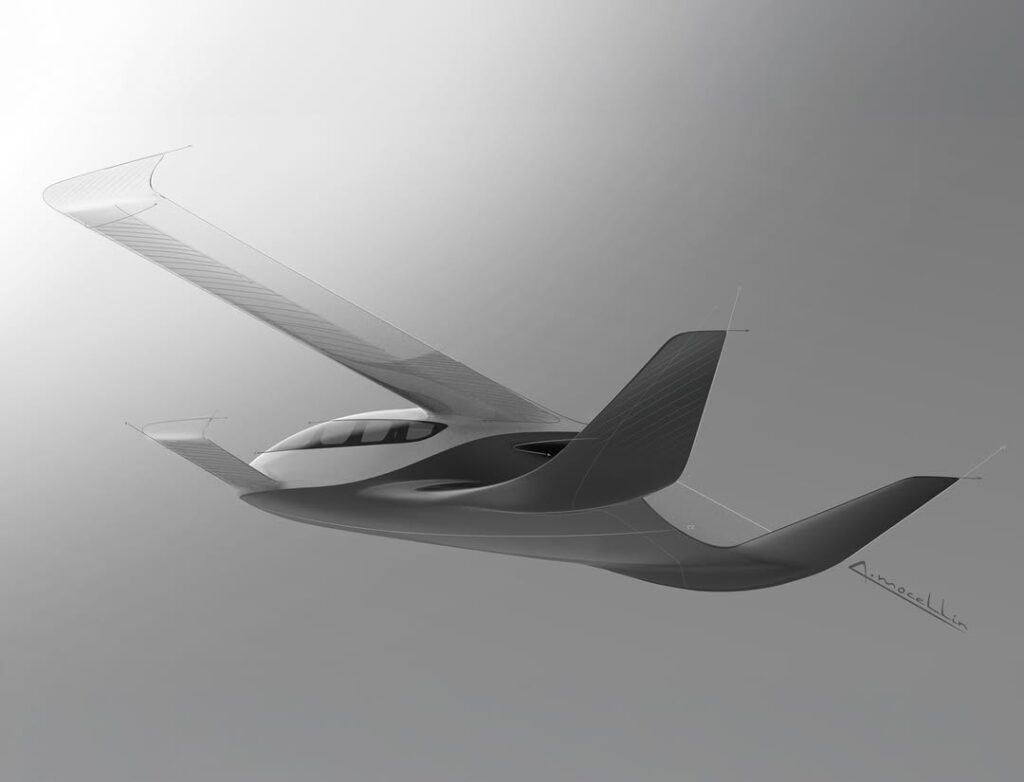
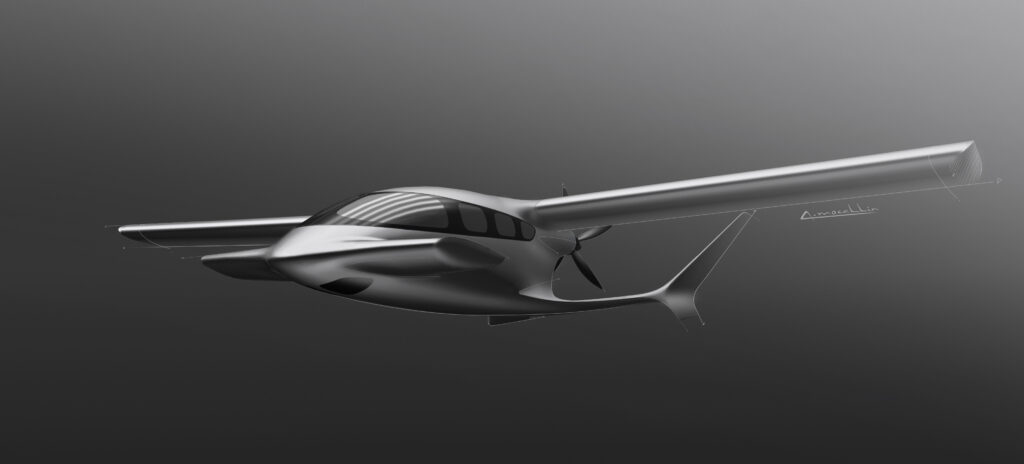
Cavorite X7 exterior concept designed by Andrea Mocellin:
Performance and Aesthetics: All by Design
Julian Orkisz, Editor-in-Chief, eVTOL buzz: “Considering your extensive experience and expertise in high-performance vehicle design, how does the fusion of performance and aesthetics shape your goals and design vision for the Cavorite X7 as a high-performance hybrid-electric eVTOL?”
Andrea Mocellin, Designer and Innovator:
“Great question and honestly, it goes right to the heart of how I see design across any form of mobility. When you’ve worked across aviation, high-performance cars, autonomous vehicles and micro-mobility you start to realize that performance and aesthetics are never separate conversations. They are different expressions of the same intent: purpose made visible.
In automotive and mobility design, there’s a well-established culture of aligning engineering, design, and brand vision from day one. That same mindset is essential in advanced aviation, especially on a project like the Cavorite X7. With Horizon, we approached the aircraft not as a collection of systems, but as a single, coherent idea. Very early on, together with the engineering team, we defined a common vision where technology, performance targets, and the aircraft’s unique architecture were not just technical constraints, but creative drivers.
The hybrid-electric propulsion system, the fan-in-wing concept, and the transition between vertical and conventional flight are not hidden stories, they are the story. My role as a designer is to translate that technological uniqueness into a clear and legible design language. Fluidity, aerodynamic efficiency, and controlled tension in the surfacing became the key themes. Every line, every surface transition, and every proportion decision was guided by the logic of airflow, structural efficiency, and system integration.
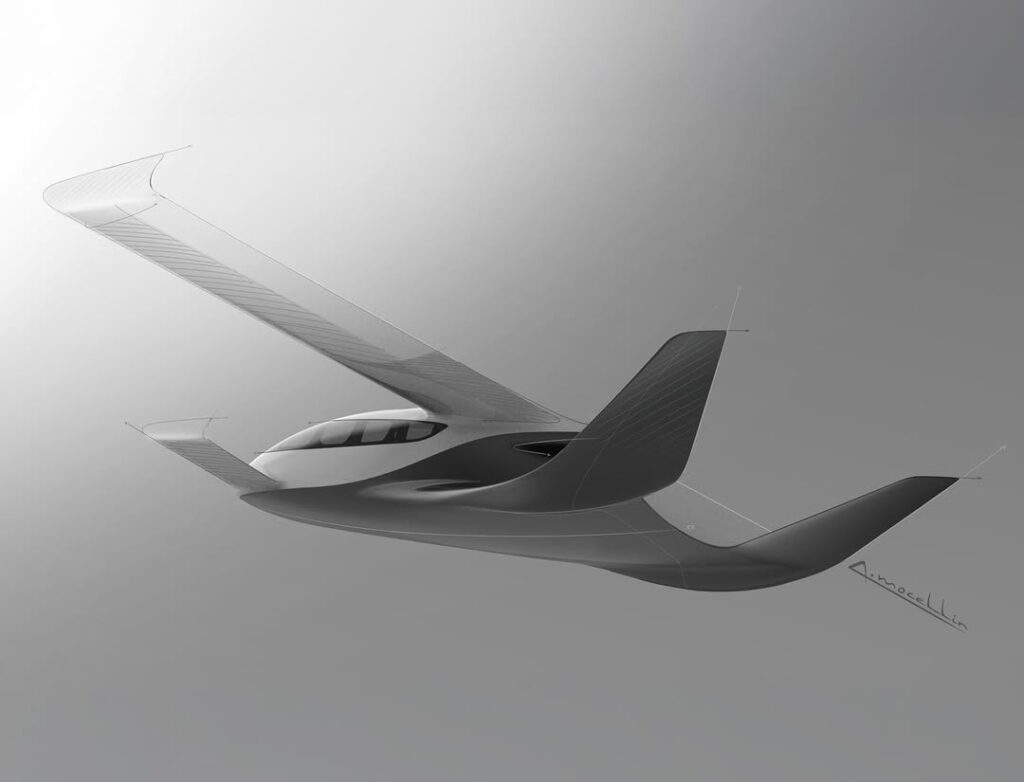
The canard, main wing, and tail are not visually independent elements; they are composed as one continuous aerodynamic gesture, all converging into a sleek, highly optimized fuselage. That integration became our north star. It allowed us to work with engineering to achieve extremely efficient packaging while also creating an aircraft that feels sculpted by function rather than styled on top of it.
For me, timelessness in design comes from this balance. A design feels dated when it chases trends. It feels enduring when it expresses fundamentals, physics, proportion, and purpose. The more an aircraft is truly efficient and perfectly packaged for its mission, the more the design “falls into place” naturally. Aerodynamics and physics are the best teachers we have; they constantly push us toward clarity, harmony, and reduction.
What made the Cavorite X7 especially rewarding was the level of dialogue between disciplines. This kind of fusion between performance and aesthetics only happens when you have a deeply driven engineering team and leadership that value design as a strategic partner, not a cosmetic step. It was a continuous exchange between aerodynamics, structures, propulsion, and design refining, challenging, and improving each other’s work until technology and form spoke the same language.
Ultimately, my goal is always the same, whether it’s a supercar or an eVTOL: to create a seamless balance between emotion and logic, between beauty and function. When that balance is achieved, the object feels inevitable and that’s when you know the design is not just attractive, but right.”
The Art of an Arrangement: Compose it with Composites
Fuselage on the RAMPF

Horizon Aircraft and fellow Ontario-based RAMPF Composite Solutions announced on the 29th of January 2026, that RAMPF will manufacture the composite fuselage for the Cavorite X7.

RAMPF Composite Solutions
- Based in Burlington, Ontario
- 73,400 sq. ft. facility (moved into new facility in 2020)
- CEO: Larry Fitzgerald
- Capabilities:
- Resin Infusion for High-Quality Composites
- Vacuum Assisted Resin Transfer Molding (VARTM)
- Vacuum Infusion
- Out of Autoclave Pre-pregs
- Tailored Fiber Placement (TFP)
- Hand Layup
- Metallization & Finishing
- Metal plating
- Value-added assembly
- Complete Subassembly & Kitting
- Project management
- Product development
- Tool design and manufacturing
- Precision Tooling & Prototyping
- Resin Infusion for High-Quality Composites
Wings from North on the Horizon

North Aircraft Industries
- Located in London, Ontario
- Near London International Airport (YXU)
- Manufactures composite aircraft structural components
- Services for wing structures, empennages and fuselages:
- Design
- Manufacture
- Assembly
- System installation
- Testing
- Finishing
- Landing gear and other systems integration into airframes
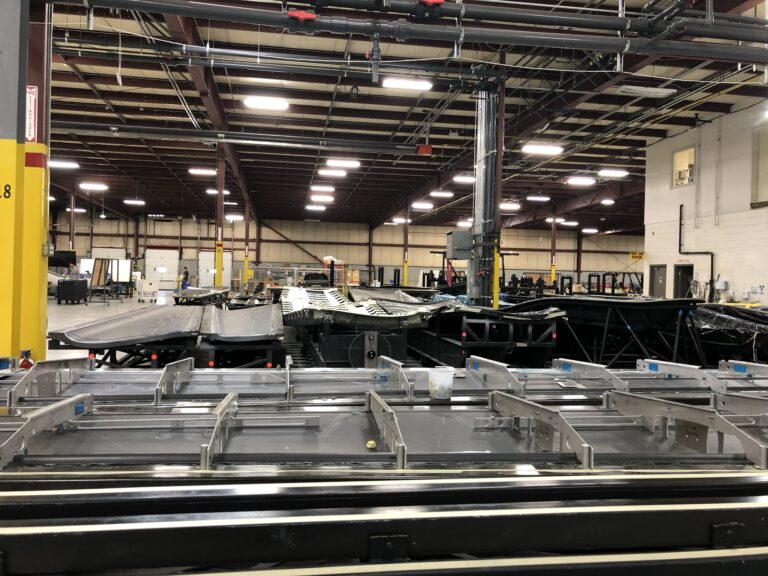
“The Cavorite X7’s design represents a genuinely new approach to VTOL aircraft performance and operational flexibility. It aligns perfectly with our strengths in advanced composite structures and integrated aerospace component development. We consider it a privilege to collaborate on a critical primary structure such as the wing, contributing our engineering, manufacturing, and testing expertise to help bring this groundbreaking aircraft closer to flight.” – Joost List, CEO of North Aircraft Industries (10 of February 2026)
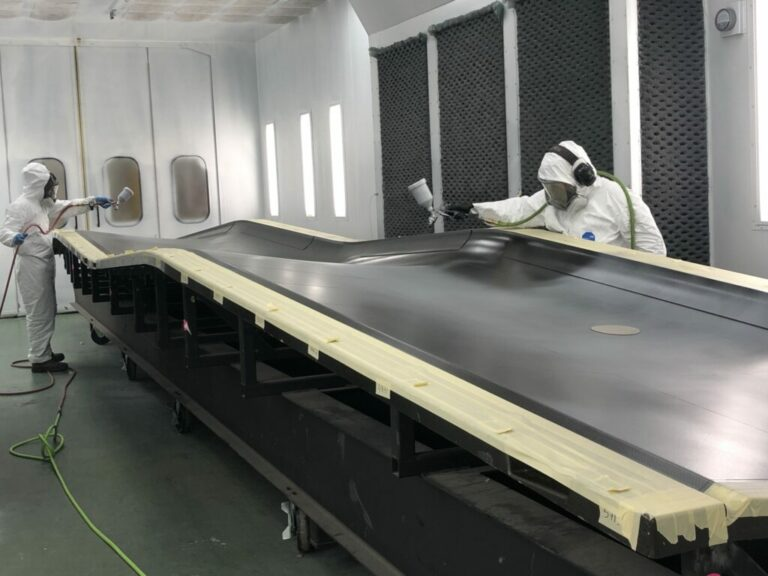
“Building our proprietary wing demands an exceptional composite manufacturing team with deep experience in complex structures. North Aircraft Industries has the experience, skill, and agility to keep our production of the Cavorite X7 on track. We are proud to partner once again with a leading Canadian aerospace company that will play a critical role in completing the X7 and prepare it for testing in 2027.” – Brandon Robinson, Co-Founder and CEO, Horizon Aircraft (10 of February 2026)
New Materials: New Possiblities in Design
As composite materials fundamentally alter the properties of aerostructures, eVTOL buzz’s Deputy Editor, Jessica Bilewski, interviewed Andrea Mocellin to explore how composites influence his design approach when compared with traditional materials.
Jessica Bilewski, Deputy Editor, eVTOL buzz: “Andrea, both as a designer and an innovator, does working with composites in high-performance automotive and aircraft design allow you to translate the possibilities of materials and structure into creative forms more freely than with traditional materials? In particular, when designing integrated structures like the “continuous aerodynamic gesture” you mentioned before on the Cavorite X7 (where the canard, main wing, and tail flow as one unified form), do composites help you achieve fluidity, aerodynamic efficiency, and controlled tension in the surfacing, overcome the limitations of traditional materials, and bring the designs closer to the vision you originally formed in your mind?”
Andrea Mocellin, Mobility Designer, and Innovator:
“Yes, very much so. Composites fundamentally change the relationship between structure and form. In traditional materials, you often design around manufacturing or structural constraints that force visual breaks, added joints, or abrupt transitions. With advanced composites, those constraints are reduced, which allows the design to evolve in a much more fluid and holistic way. In both hypercars and aircraft, I see composites not just as a lightweight solution, but as an enabler of continuity. They allow surfaces to blend smoothly from one functional zone to another. For example, from lifting surface to control surface, or from fuselage to aerodynamic appendage. That’s crucial when pursuing what I call a continuous aerodynamic gesture, like on the Cavorite X7, where the canard, main wing, and tail are conceived as one flowing system shaped by air movement rather than separate mechanical add-ons.
From an aerodynamic perspective, this improves efficiency because airflow prefers continuity, fewer interruptions and fewer abrupt changes in curvature. Structurally, composites allow loads to be distributed through complex shapes without needing heavy reinforcements that would otherwise dictate the geometry. But for me, there is also an emotional and visual dimension: the aircraft reads as a single, cohesive object. That sense of unity subtly communicates strength, precision, and safety.
Another important aspect is controlled tension in the surfacing. With composites, I can introduce very precise curvature changes, tight where performance demands it, softer where flow continuity is needed, without compromising structural integrity. That level of control brings the physical object much closer to the original design vision in my mind, where aerodynamics, structure, and sculpture are inseparable.
Finally, composites also support future adaptability. Because the surfaces are continuous and fluid, they provide a natural framework for integrated graphics and visual identities that follow the aerodynamic lines rather than sitting on top of them. That’s something I’ve explored extensively in automotive design, and it translates into aircraft.”
How Micro-mobility (Revolve wheelchair) and Regional Air Mobility (Cavorite X7) Can Help Those With Mobility Needs
Just in the year 2019, an approximate 27 MILLION passengers with disabilities traveled across the U.S. skies according to the US Department of Transportation. Together this important segment of the population is comparable to the entire population of some countries. To put it into perspective, the entire population of Canada is estimated to be roughly 41 million (2025 estimation).
According to a 2022 report titled Portrait of Travelers with Disabilities™: Mobility and Accessibility by MMGY Global, a travel marketing company, those with mobility needs spend US $58.2 billion on travel each year.
When thinking on a global scale, one can only imagine how large this population really is and the enormous amount of money they spend. Yet, we also need to think about each person individually, the particular challenges they face when traveling for business, medical treatment, tourism, or visiting loved ones. Equally important is how the money spent by those with disabilities affects their budgets, and the financial strain that can easily occur from traveling. Internal research conducted by Berkshire Hathaway Travel Protection found that those with disabilities spent more than $12,000 per person on travel in the year 2024.
Additionally Berkshire Hathaway Travel Protection found that in 2024:
- Approximately 60% of disabled individuals took part in domestic travel
- Approximately 10% of disabled individuals traveled internationally
- Over 50% of disabled travelers reported they’ve spent more on basic travel expenses like airfare and lodging in 2024 compared to years prior, and about the same percentage expected to spend even more in 2025
Hidden Cost of Traveling for Disabled: Damaged and Lost Wheelchairs and Extra Wait Time

GAO-23-106358 Published: Nov 17, 2022.
In the United States, The U.S. Department of Transportation requires airlines that operate at least one aircraft with more than 60 passenger seats to track and report complaints related to disabilities. Under the regulations outlined in 14 CFR Part 382, carriers must maintain records of these complaints and submit an annual report to the department. These record-keeping and reporting rules took effect on August 7, 2003, and airlines were required to submit their first annual reports by January 25, 2005. The purpose of this requirement is to monitor how airlines address accessibility issues and ensure compliance with disability protection standards in air travel.
1,394 disability-related complaints were filed with the The U.S. Department of Transportation DOT in 2021, which resulted in a 54 percent increase in complains compared to 2019.
“According to the Centers for Disease Control and Prevention (CDC), more than 61 million adults in the United States (1 in 4) have a mobility, cognitive, hearing, vision or other disability. The Department of Transportation (DOT) estimated that roughly 27 million passengers with disabilities traveled by air in 2019. In light of an aging population in the United States, travelers with disabilities will be a growing customer segment for airlines. Without effective accommodations—such as communication of essential flight information, accessible seats and lavatories, appropriate boarding assistance, and careful handling and stowage of wheelchairs and other assistive devices—passengers with disabilities may face challenges when flying on a commercial airline.“
Statement of Heather Krause, Director, Physical Infrastructure Testimony Before the Subcommittee on Aviation, Committee on Transportation and Infrastructure, House of Representatives: PASSENGERS WITH DISABILITIES Barriers to Accessible Air Travel Remain
“Passengers with disabilities may also face barriers in the airport screening process. Earlier this month we issued a report that found that TSA’s screening practices may result in certain populations being subjected to additional screening more frequently than others. Among those more likely to face additional screening are passengers with prosthetics or in wheelchairs. TSA agreed with our recommendations to undertake measures to, among other things, collect data on referrals for additional screening and assess whether TSA’s passenger screening practices comply with nondiscrimination policies, as well as to better inform the public as to how to file a complaint.”
Statement of Heather Krause, Director, Physical Infrastructure Testimony Before the Subcommittee on Aviation, Committee on Transportation and Infrastructure, House of Representatives: PASSENGERS WITH DISABILITIES Barriers to Accessible Air Travel Remain
GAO-23-106358 Published: Nov 17, 2022.
Wheelchair Assistance
“Wheelchair assistance. During our audit for that same 2021 report, selected airlines and contractors told us that a range of factors could affect the quality and timeliness of wheelchair service, such as difficulty predicting passenger requests for assistance and personnel turnover. A DOT review of disability-related complaints from 2015 through 2019 found that failure to provide timely wheelchair assistance was the number one disability complaint each year.”
Statement of Heather Krause, Director, Physical Infrastructure Testimony Before the Subcommittee on Aviation, Committee on Transportation and Infrastructure, House of Representatives: PASSENGERS WITH DISABILITIES Barriers to Accessible Air Travel Remain
Mishandled wheelchairs, scooters, and other mobility devices
The U.S. Department of Transportation defines a mishandled wheelchair or scooter as one that is lost, delayed, damaged, or stolen while in the airline’s custody, according to 14 CFR Part 382. A delayed return occurs when the mobility device is not provided to the passenger promptly after arrival, even if it eventually reaches them.
For travelers with disabilities, delays or damage to mobility devices can create serious challenges. Many passengers rely on wheelchairs or scooters for independence and safe movement, so not having immediate access to them can limit their ability to navigate the airport, reach transportation, or continue their travel plans. In some cases, it may even create health and safety concerns if travelers are left without the equipment they depend on daily. Because of these impacts, airlines are required to track and report these incidents to the DOT to help monitor accessibility and improve accountability in air travel.
Title 14 Chapter II Subchapter A Part 234 of the U.S. Code of Federal Regulations requires reporting of mishandled wheelchairs and scooters:
“The number of mishandled wheelchairs and scooters that were enplaned in the aircraft cargo compartment for any domestic nonstop scheduled passenger flight, including a mechanically delayed flight, operated by the carrier to or from any U.S. large, medium, small or non-hub airport as defined in 49 U.S.C. 41702 and separately for any domestic nonstop scheduled passenger flight, including a mechanically delayed flight, held out with only the carrier’s designator code to or from any U.S. large, medium, small, or non-hub airport as defined in 49 U.S.C. 47102 and operated by any code-share partner that is a certificated air carrier or commuter air carrier.”
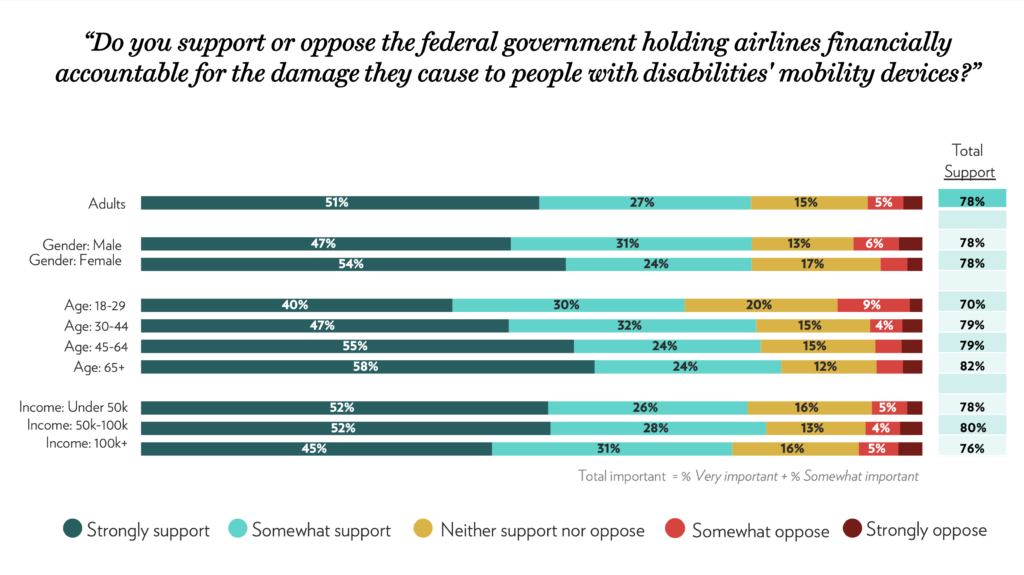
While the data below indicates that the percentage of mishandled wheelchairs and scooters may seem rather low, with the highest numbers reported since 2019 being just over 2 percent, if you happen to be one of the 11,277 people who experienced a mishandled wheelchair or mobility scooter, that is all the context you need to why this is a serious issue that needs to be addressed with multifaceted solutions.
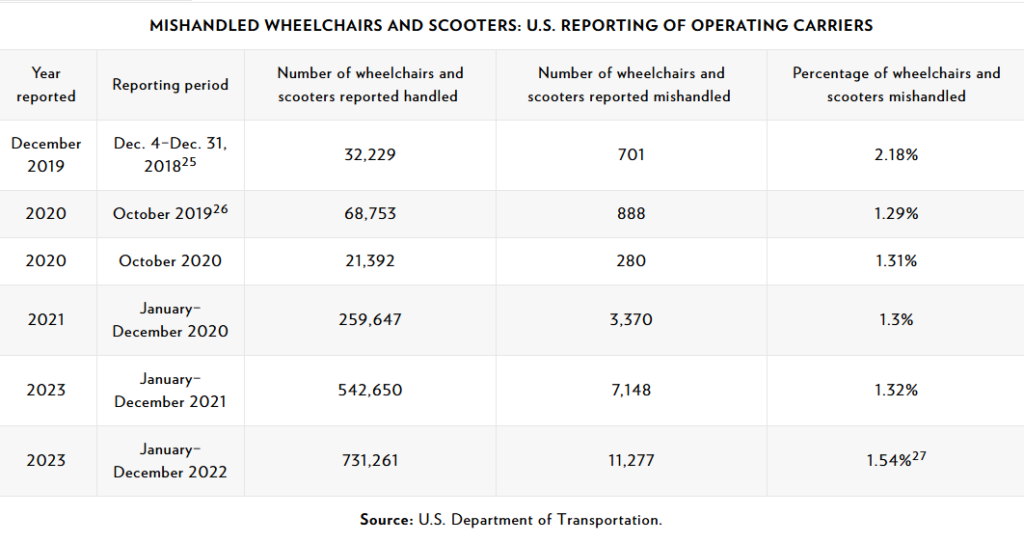
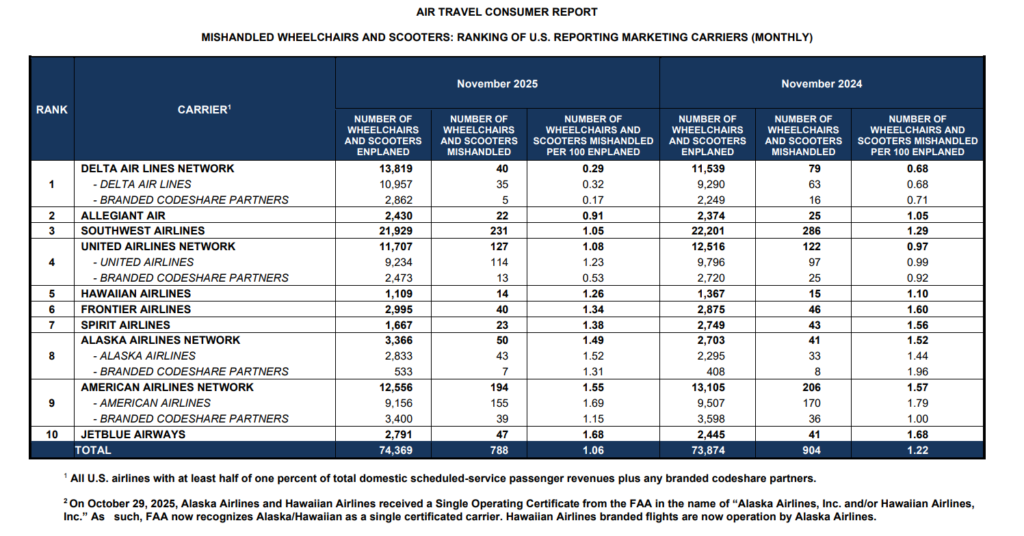
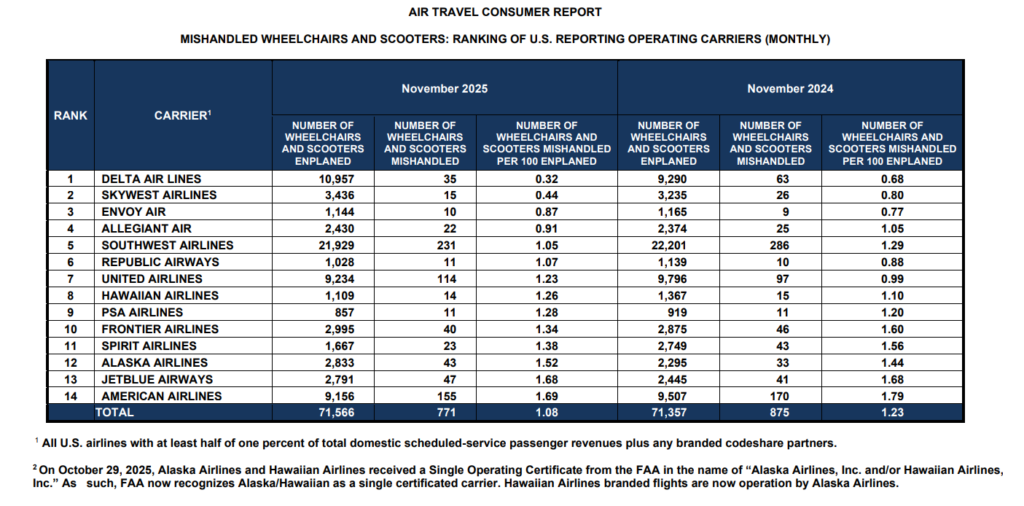
In 2023, an astonishing +10,000 wheelchairs were damaged by airlines according to testimony from Heather Krause, Director of Physical Infrastructure for the U.S. Governmental Accountability Office (GAO), given before the U.S. House of Representatives Aviation Subcommittee. Having a wheelchair that can fold and fit in an overhead bin in an airliner avoids the risk of the wheelchair getting damaged unintentionally during handling and stowage (more about that later in the article).
“Handling and stowage of devices. Damage to wheelchairs and other assistive devices in air travel remains a significant source of concern for passengers with mobility disabilities. Much of the damage to wheelchairs, particularly power wheelchairs and scooters, occurs when the devices are stowed in an aircraft’s cargo compartment, according to the 2022 ACAA Advisory Committee report. According to a DOT review of disability-related complaints, in 2019 [2023], over 10,000 wheelchairs were mishandled by airlines, roughly 1.5 percent of the total handled. While the percentage is small, when a wheelchair is lost or damaged, the consequences to a traveler can be devastating.”
Statement of Heather Krause, Director, Physical Infrastructure Testimony Before the Subcommittee on Aviation, Committee on Transportation and Infrastructure, House of Representatives: PASSENGERS WITH DISABILITIES Barriers to Accessible Air Travel Remain
Portrait of Travelers with Disabilities: Mobility & Accessibility by MMGY Global
- Four in 10 have had their mobility aid lost or damaged by an airline.
- Six in 10 have experienced extended wait times for mobility assistance at the airport before or after their flight.
Recent public opinion polling conducted by Morning Consult in partnership with The Century Foundation shows strong public support for improving accessibility in air travel. The survey found that about 88% of Americans believe airlines should do more to better accommodate passengers with disabilities. This widespread agreement highlights a growing awareness of the challenges many disabled travelers face when flying, such as difficulties with mobility devices, boarding, and airport navigation. The results suggest that many people view accessibility improvements not only as helpful but as an important step toward making air travel more inclusive and equitable for everyone.
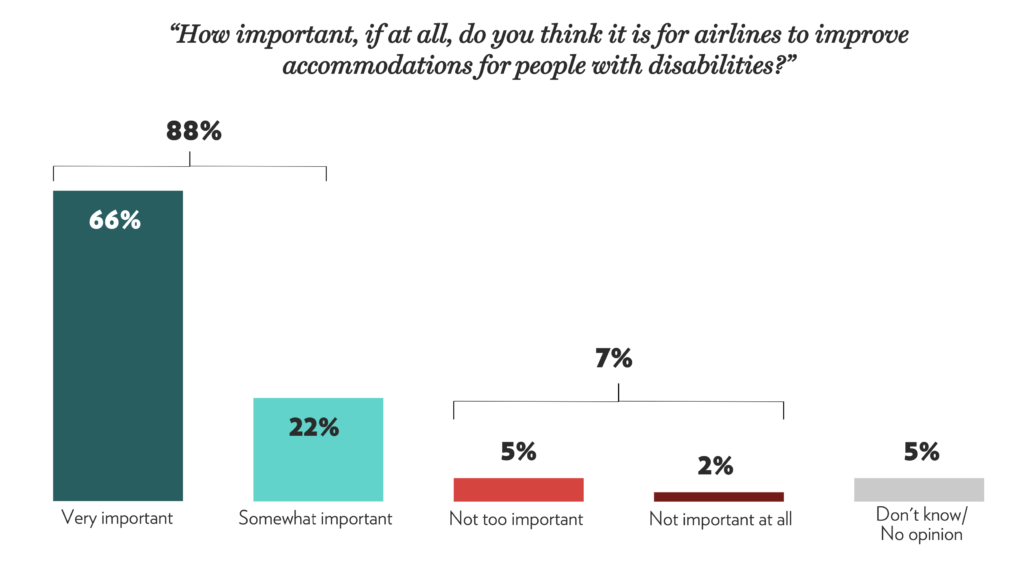
A major issue in accessible air travel echoed by The Century Foundation report was the frequent mishandling of wheelchairs and other mobility devices by airlines. The foundation’s research pointed out that many travelers with disabilities report incidents where their equipment is delayed, damaged, or otherwise improperly handled during flights. Despite these recurring problems appearing regularly in survey responses from affected passengers, the report suggests that the overall scope of the issue has not been fully documented. As a result, the lack of comprehensive data makes it harder to measure how widespread the problem is and to develop effective solutions that ensure safer and more reliable transportation for disabled travelers.
“Of particular concern is the pervasive trend of airlines’ poor handling of wheelchairs and mobility devices. As we will see, this was a frequently reported incident in this report’s survey data; but broader documentation of the trend has been insufficiently conducted.”
Article by Kings Floyd (2023). Trips not taken, money not made: Inaccessible air travel hurts disabled travelers and airlines alike. The Century Foundation.
Revolve on the Horizon: Where There’s a Wheel, There’s a Way!
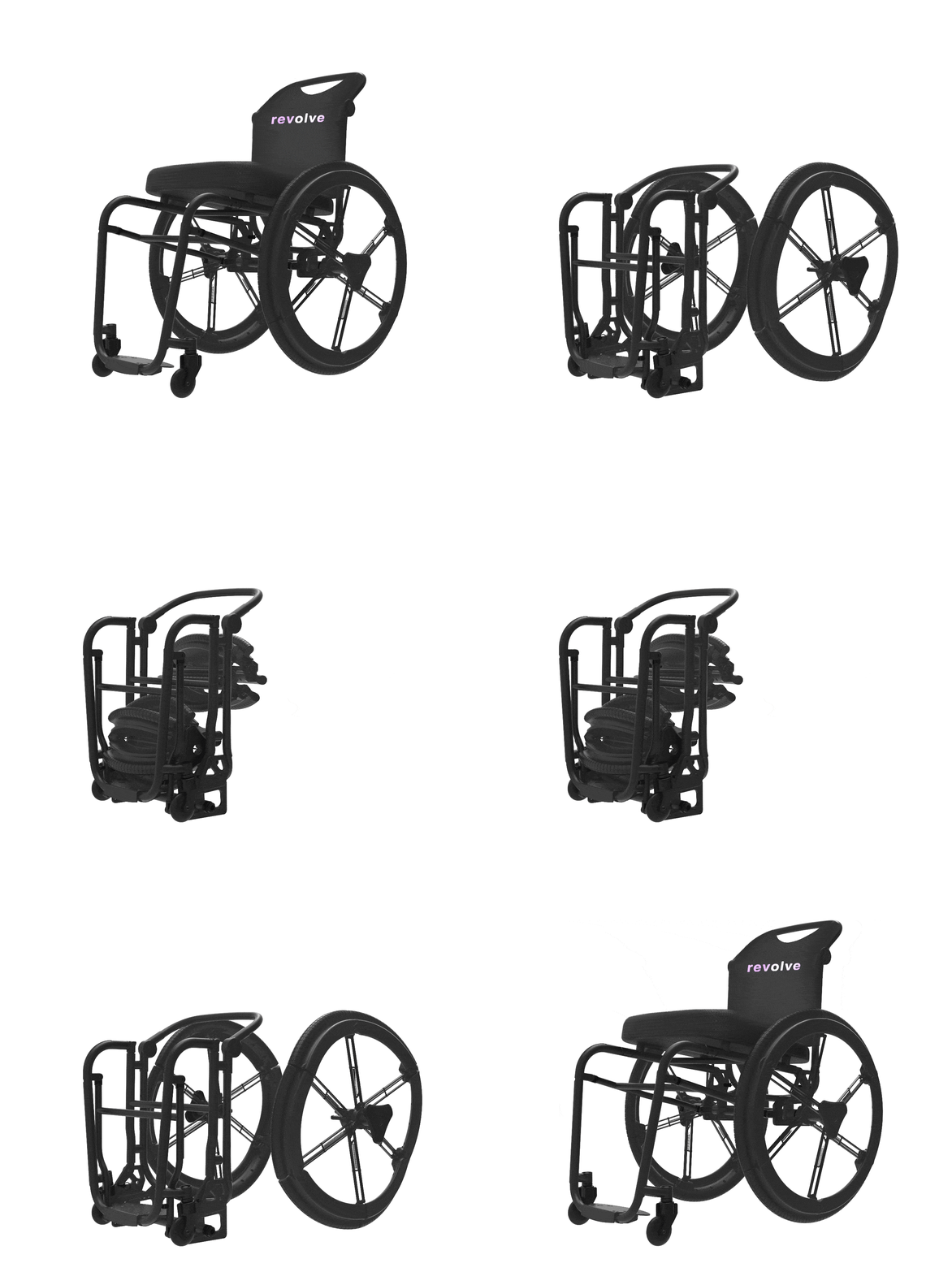

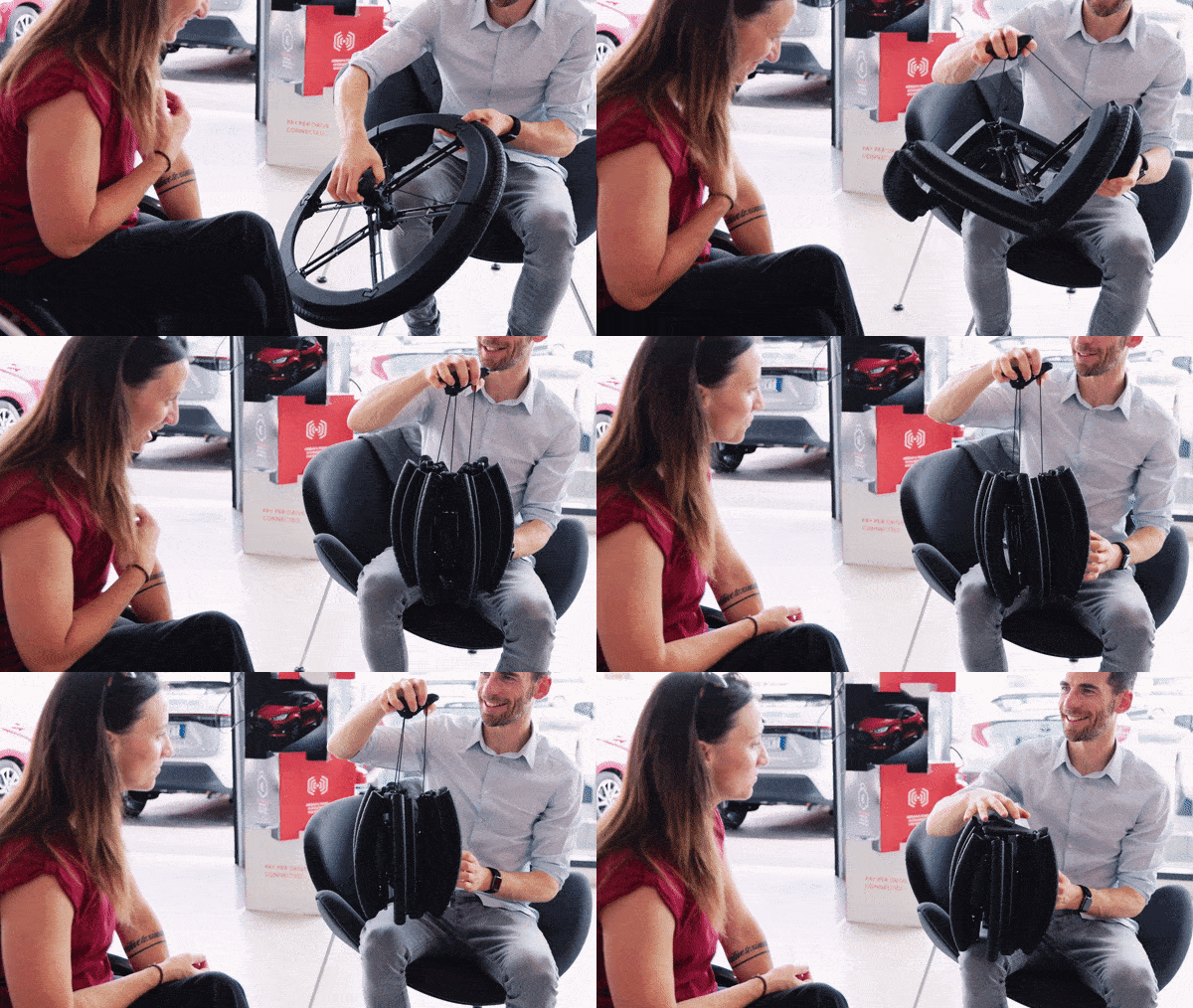
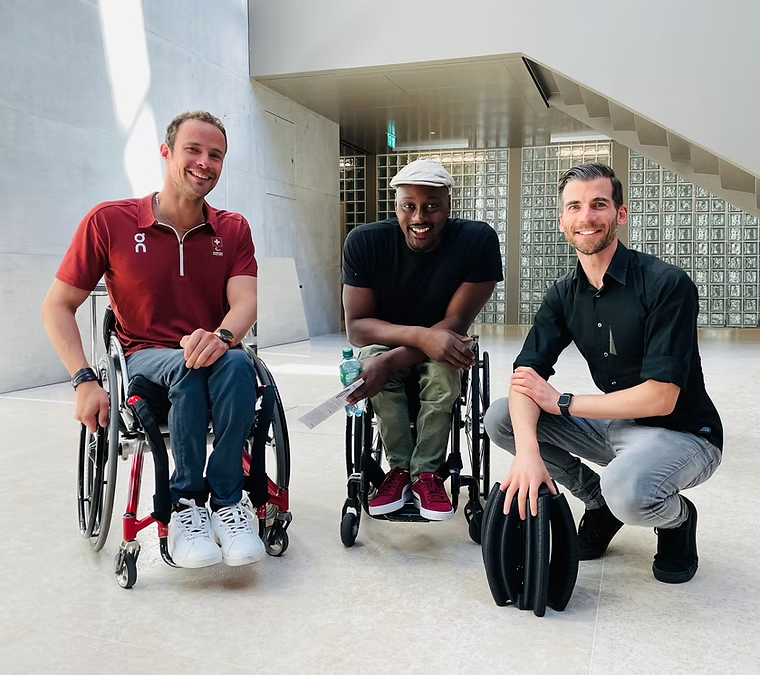
Demonstration of how easy the wheels and frame of the Revolve Air wheelchair fold into a compact unit (Multimedia courtesy of Andrea Mocellin)
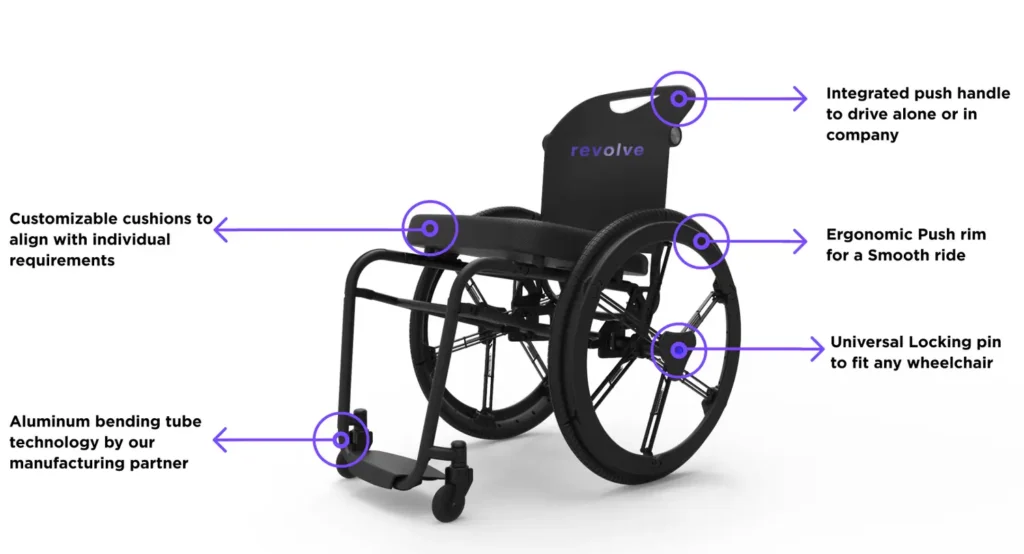

Revolve Air
- Inventor and Designer: Andrea Mocellin
- Specifications:
- Weight Limit: 100 kg (220 lb)
- Wheel Weight: 3.8 kg (8.4 lb) per wheel
- Chair Weight: 7 kg (15 lb)
- Locking Pin Size: 1/2 inch
- Size: Available with starting seat widths of 40 cm (15.75 inches) and above
REVOLVE AIR: World’s Most Compact Active Wheelchair (video below)
“Former Ferrari designer Andrea Mocellin knows how to make things move fast. Now he’s applying his skills to an even more gratifying project: building a better, more travel-friendly portable wheelchair.” – TIME magazine

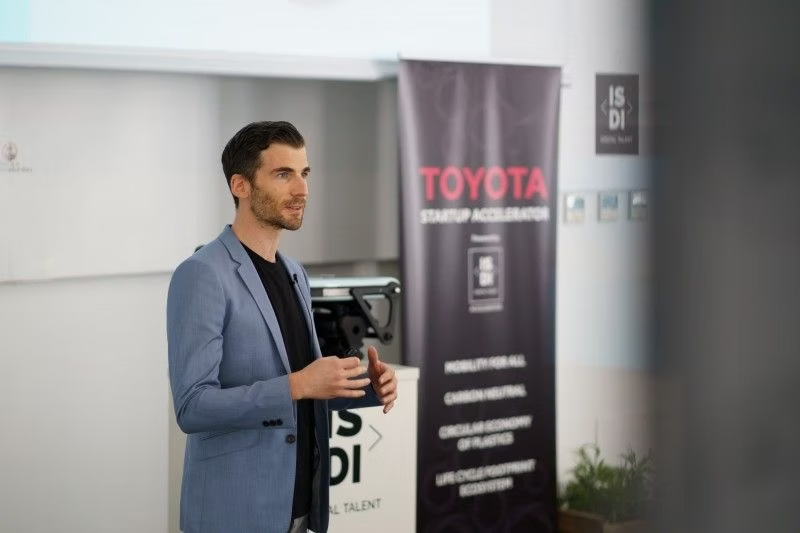
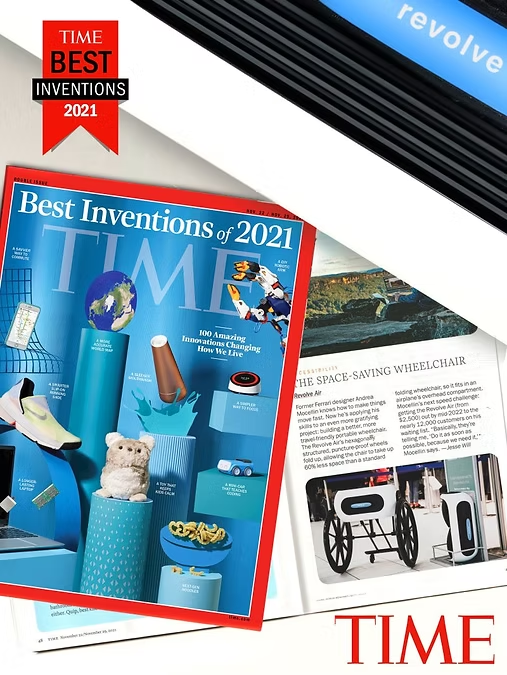
Left image – Andrea Mocellin at the The Toyota Startup Accelerator in Madrid, Spain held in June 2022 (Photo courtesy of Andrea Mocellin). Right image – Revolve Air wheelchair featured by TIME Magazine as one of “Best Inventions” for 2021
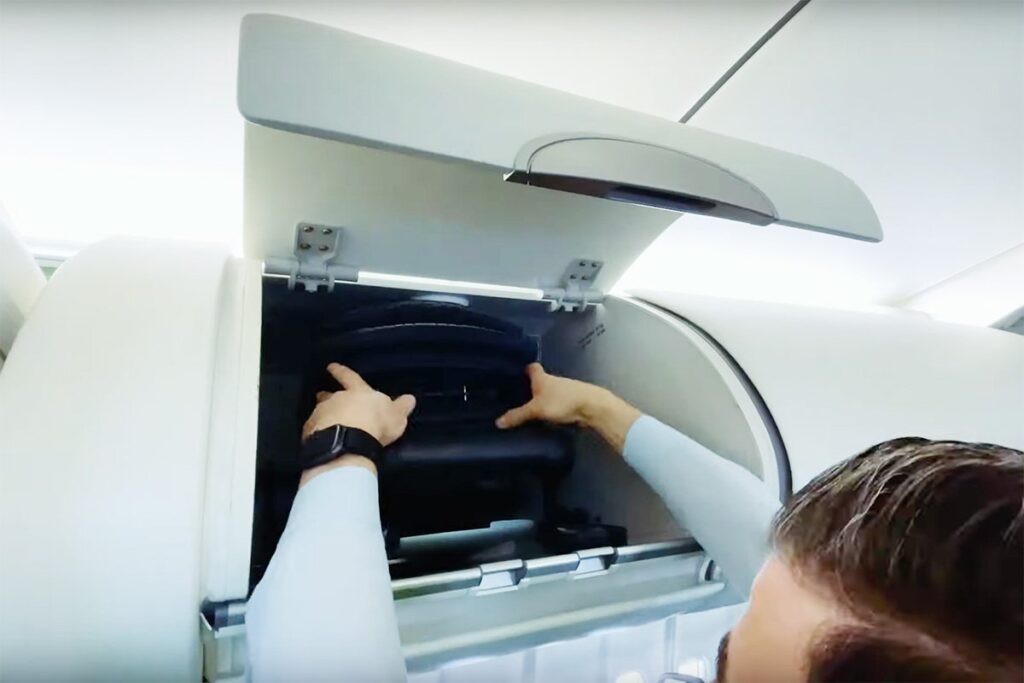
Basically, Andrea Mocellin’s Revolve Air wheelchair will provide the same accessibility and storage convenience as any other item placed in an overhead bin. This also significantly lowers the risk of damage or being lost, compared to a bulky conventional wheelchair handed to the flight crew tasked with trying to find space for it (and not accidentally damaging it in the process).
The Cavorite X7: Mobility for All on the Horizon!

Despite growing awareness of accessibility challenges in air travel, relatively few aircraft manufacturers are actively designing with passengers who have reduced mobility or hidden disabilities in mind. As Advanced Air Mobility evolves, however, the industry is beginning to recognize that accessibility must be considered from the earliest stages of aircraft design. Initiatives such as the Vertical Flight Society’s student design competition highlight this shift, encouraging the next generation of aerospace engineers and designers to integrate accessibility considerations directly into future aircraft concepts.
Designers like Andrea Mocellin represent this emerging mindset. Known for his work in micro-mobility as well as his design contributions to Horizon Aircraft’s regional air mobility Cavorite X7, Mocellin brings experience from personal mobility solutions into the aviation sector. By combining these fields, he offers a particularly unique perspective that could help the aviation industry better serve the roughly 20% of travelers who face mobility challenges. Efforts like these suggest that designing with accessibility in mind is not only socially responsible, but also strategically advantageous for aircraft manufacturers and operators alike.
“While a limited number of OEMs are presently addressing the needs of passengers with reduced mobility or hidden disabilities, the landscape is evolving. Notably, the Vertical Flight Society orchestrated a student design competition aimed at encouraging budding aircraft engineers to incorporate the requirements of such passengers into their future aircraft designs.
Considering that approximately 20% of the global travelling public faces some form of mobility challenge, it stands as a judicious approach for both OEMs and operators to integrate these considerations into their strategies.” – EA Maven in an interview with Royal Aeronautical Society
Accountability and Lavatories: We Can’t Wash Our Hands from Responsibility to Our Fellow Travelers
Another issue facing passengers with disabilities is that lavatories are often difficult to access aboard single-aisle jetliners. Although many single-aisle aircraft have manufacturer-sourced options for wheelchair-accessible lavatories that can be used with the smaller on-board wheelchair (OBW), numerous airlines have chosen not to include these configurations in their fleets. At the same time, single-aisle aircraft are increasingly being used on longer-distance routes than in the past. For example, single-aisle aircraft accounted for roughly 40% of long-distance flights in 1991, but that figure rose to approximately 86% by 2021. Not only do these aircraft now operate over greater distance (often between 1,500 and 3,000 miles), but the flights themselves can last several hours longer than traditional short-haul operations. When combined with the fact that many of these aircraft are not equipped with accessible lavatories, this trend significantly widens the accessibility gap for passengers with disabilities.
“Onboard assistance and lavatories. For passengers with disabilities, embarking and disembarking the aircraft can be a lengthy process and require assistance from personnel. After boarding, passengers with reduced mobility may need to access aircraft lavatories. While larger twin-aisle aircraft are required to provide at least one lavatory accessible to passengers using the aircraft’s onboard wheelchair, no such rule exists for single aisle aircraft. We found in 2020 that single-aisle aircraft are increasingly used for longer flights. We also found that the airlines we met with rarely elected to equip their single-aisle aircraft with an accessible lavatory, even though aircraft manufacturers offer this design configuration. Therefore, most lavatories on single-aisle aircraft are inaccessible to passengers relying on an onboard wheelchair designed to fit down narrow aircraft aisles unless they are able to stand and pivot from the wheelchair into the lavatory.”
Statement of Heather Krause, Director, Physical Infrastructure Testimony Before the Subcommittee on Aviation, Committee on Transportation and Infrastructure, House of Representatives: PASSENGERS WITH DISABILITIES Barriers to Accessible Air Travel Remain
In 2023, the U.S. Department of Transportation (DOT) announced a new rule under the Air Carrier Access Act requiring newly delivered single-aisle aircraft with 125 or more seats to include lavatories large enough for a passenger with a disability and an attendant to approach, enter, and maneuver in the space within the lavatory. Compliance will apply to aircraft ordered ten years or delivered twelve years after the rule’s effective date.
“It is an unfortunate reality that today, many air travelers with disabilities, knowing that they will not be able to use the lavatory during a flight, may dehydrate themselves or even withhold bodily functions so that they do not need to urinate. These actions can cause adverse health effects, including increased chances of urinary tract infections. Other passengers may use adult diapers or catheters, which they may find degrading and uncomfortable. Some wheelchair users avoid flying altogether. For example, a recent survey conducted by Paralyzed Veterans of America (PVA) and 11 other veterans’ and disability advocacy organizations found that 56% of respondents reported that inaccessible lavatories were reason enough to choose not to fly unless absolutely necessary. These are conditions that passengers without disabilities would justifiably consider intolerable.”
U.S. Department of Transportation, “Accessible Lavatories on Single-Aisle Aircraft,” 88 Fed. Reg. 50020 (Aug. 1, 2023) [Docket No. DOT-OST-2021-0137].
“Traveling can be stressful enough without worrying about being able to access a restroom; yet today, millions of wheelchair users are forced to choose between dehydrating themselves before boarding a plane or avoiding air travel altogether. We are proud to announce this rule that will make airplane bathrooms larger and more accessible, ensuring travelers in wheelchairs are afforded the same access and dignity as the rest of the traveling public.” – Pete Buttigieg, U.S. Transportation Secretary (July 26, 2023)
A hybrid-electric eVTOL such as the Cavorite X7 could help mitigate this challenge by reducing the amount of time passengers spend waiting at airports, standing in lines, and passing through security checkpoints. Shorter total travel times would mean shorter intervals between restroom access. In addition, if necessary, it would be far easier for a Cavorite X7 flight to make an intermediate stop for a restroom break than for a passenger to wait, often alongside several other passengers, to use a lavatory on an airliner that may not be wheelchair accessible.
The DOT has also begun laying the groundwork for potential future rules that could allow passengers to remain in their own wheelchairs during flights, while also developing improved training requirements for airline staff who assist passengers with disabilities or handle battery-powered wheelchairs and mobility devices. If trends point to a future where people will be given the opportunity to use their personal wheelchair during flights, it would naturally make sense that inventions like Andrea Mocellin’s Revolve Air wheelchair will become even more prevalent across the mobility landscape.
DOT has begun laying the preliminary groundwork for a potential future rule that would address passengers staying in their own wheelchairs when they fly.
U.S Dept. of Transportation press release: “U.S. Department of Transportation Requires Airline Lavatories to Be More Accessible for Wheelchair Users”
What about eVTOLs?
These efforts by the U.S. Department of Transportation are part of a broader initiative to ensure that future transportation technologies, including automated vehicles, electric vehicles, and other emerging mobility systems such as eVTOLs, are designed with accessibility in mind from the outset.
DOT is working with industry, academia, and Federal partners to ensure that the vehicles of the future – including automated vehicles, electric vehicles, and associated charging infrastructure – are designed inclusively.
U.S Dept. of Transportation press release: “U.S. Department of Transportation Requires Airline Lavatories to Be More Accessible for Wheelchair Users”
Horizon Aircraft, in collaboration with Andrea Mocellin, has strong potential to play a unique role in advancing the goal of true mobility for all. But does the Cavorite X7 represent a continuation of the same mission as the Revolve Air wheelchair, expanding mobility options for people with reduced mobility, by moving from micro-mobility into Regional Air Mobility (RAM)? eVTOL buzz asked Mr. Mocellin in order to find out.
Continuation of a Mission, From Micro-mobility to Regional Air Mobility (Title comes from Andrea Mocellin himself!)
Julian Orkisz: “You’ve spoken in past interviews about how growing up in a region with mobility limitations inspired your desire to innovate and design mobility solutions, as you have done with your invention, the Revolve Air wheelchair. Now, with the development of the Horizon Cavorite X7, do you see this as a continuation of that same mission, expanding mobility options for people with special mobility needs, but moving from micro-mobility to regional air mobility (RAM)?”
Andrea Mocellin, Mobility Designer, and Innovator:
“Yes, absolutely. Accessibility has always been at the center of my thinking as a designer. The Revolve Air wheelchair was born from observing how mobility limitations are often created not by people, but by systems that fail to adapt to them. My goal was to reduce friction between different stages of a journey, to make mobility continuous rather than fragmented. The Horizon Cavorite X7 represents a natural evolution of this same philosophy, expanding the concept from micro-mobility to regional air mobility. While the scale is dramatically different, the intention remains identical: improving transitions between modes of transport and enabling people to move more freely. The Cavorite X7’s ability to operate in diverse environments and configurations allows it to serve multiple missions: commercial, medical, and regional connectivity. Its flexibility enables access to locations that were previously difficult, slow, or inefficient to reach. In this sense, the aircraft fills a missing gap in aviation and mobility as a whole. Accessibility exists at different magnitudes. With Revolve, we addressed the individual journey. With Horizon, we address entire regions and communities.”
Julian Orkisz: “Both the Revolve Air wheelchair and the Cavorite X7 seem to challenge the idea that people must adapt to transportation systems. Instead, they allow transportation systems to adapt to people: reducing stress, wait times, and physical barriers. In the case of Revolve, the wheelchair becomes part of the entire journey. With the Cavorite X7, it unlocks direct aviation routes that were previously impossible or infeasible. Eventually, shaping and scaling to better connect entire communities with the rest of the world. The result, a world more accessible. What are your thoughts on how these designs can reshape the focus towards the passenger rather than the system?”
Andrea Mocellin:
“I strongly believe transportation must adapt to people, not the other way around. Generations today move differently. They book digitally, expect immediacy, and transition seamlessly between virtual and physical environments. These behavioral changes create new expectations for travel that traditional transportation systems were not designed to meet.
The Horizon Cavorite X7 responds to this shift by focusing on real operational scenarios rather than a single use case. Comfort, accessibility, and reduced stress are fundamental design drivers. By connecting areas previously limited by geography or infrastructure, the aircraft shortens not only travel time, but also the physical and emotional effort associated with travel.
When journeys become simpler and more direct, mobility becomes supportive rather than demanding. Innovation in mobility happens precisely at this intersection between evolving human expectations and technological possibility.”
Horizon Aircraft has been very vocal since its inception, about the Cavorite X7 opening access to communities such as the northern and remote communities in their home country of Canada. Horizon’s CEO and co-Founder Brandon Robinson has stressed this point in an interview with eVTOL buzz Editor-in-Chief, Julian Orkisz, last year at Verticon 2025 in Dallas.
“I think there are tons of missions right now, like EMS, organ transport, getting people to the hospital in a safer, faster manner, reaching out and delivering critical goods to remote communities, disaster relief. Rolling in and helping out with a hurricane, and you can deploy quicker and a much more economical fashion so it doesn’t cost as much…. some specific fire missions.. There are a lot of missions right now….. and again it comes down to the mission first. There’s a lot of very cool missions right now that these machines [Cavorite X7] can do. Those missions require economics, speed, payload, those sorts of things. But it does start with mission first.“ – Brandon Robinson, CEO and Co-founder of Horizon Aircraft (during Verticon 2025)
Recently Horizon Aircraft released a video featuring Brandon Robinson and Phil Kelly, Senior VP Business Development, explaining why there’s such a need for the Cavorite X7 in rural communities across North America. The same need hold true across the globe, and a Cavorite X7 will be a global player and lifeline to bring not only vital essential items, but also passengers such as medical/social welfare personnel that assist members of these communities.
A July 2024 white paper from the World Economic Forum and Kearney (the global management consulting firm), touched on the impact AAM will have on remote regions by improving their access and lowering their risk in transportation.
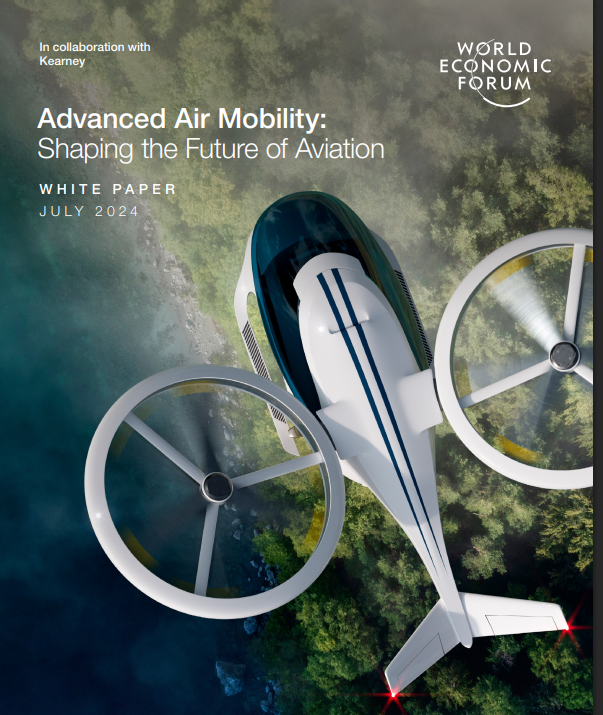
The World Economic Forum has launched AVIATE: Advanced Air Mobility initiative to support the integration of AAM technologies, and is part of the WEF’s Centre for the Fourth Industrial Revolution.
Key areas that the World Economic Forum has focused on related to AAM are:
- Healthcare
- Connecting Remote Locations
- Urban Transport
The OECD (Organisation for Economic Co-operation and Development) made a report regarding the challenges and trends faced by rural communities. The report investigated economic, demographic, technological, and other factors affecting the development and restoration of rural areas. Of particular interest, was their analysis of transportation and connectivity with urban areas. eVTOLs were mentioned as one of the means to achieve improved transportation and connectivity between rural communities and more populated areas.
Improving mobility is a central concern to ensure well-being in rural places. Compared to urban areas, rural areas experience longer commuting distances between work and home and limited public transit options. Often, this is referred to the “distance penalty”, a significant factor that affects service delivery and sustainable development. This penalty manifests in increased pollutant emissions and difficulties in implementing sustainable mobility solutions. Addressing rural mobility is therefore not just about connecting communities; it’s also a strategic approach to reducing overall transport sector emissions, while ensuring equitable access to markets and services (OECD, 2023). In highly dispersed settlements mobility is essential to ensure that the exchange of ideas can occur within and across the different population settlement. In rural areas closer to cities, a better mobility would help communities and business to reach a larger pool of workers, markets and amenities.
OECD (2025), Rural Innovation Pathways: Connecting People, Places and Ideas, OECD Rural Studies, OECD Publishing, Paris.
Mobility technologies are progressing fast, alleviating distance barriers and contributing to sustainability. The current technologies to improve people’s mobility in rural regions span from autonomous vehicles by land or flight to shared autonomous mobility. In addition to autonomous vehicles, other solutions that can change mobility patterns in rural regions include shared autonomous mobility, carpooling platforms and private mass transportation systems, mobility as a service and flying vehicle. From these technologies, the development of autonomous vehicles and shared autonomous mobility has progressed fast in recent years and led to major benefits for rural dwellers. For example, using autonomous vehicles in rural public transit can reduce cost of moving people and improve the efficiency of transport, with benefits for people’s psychological and physical well‑being. The higher passenger capacity of shared autonomous transport is key to enabling a more efficient and sustainable transportation model that addresses mobility pain points[e] in rural areas and cities alike. Some key benefits of autonomous shuttles and buses include greening public transportation, saving costs through optimal resource use (e.g. on-demand services), and increasing connectivity (e.g. intra-city and first/last mile commutes).
OECD (2025), Rural Innovation Pathways: Connecting People, Places and Ideas, OECD Rural Studies, OECD Publishing, Paris.
Layers of Beauty
Julian Orkisz:“I would also like to ask about beauty in design. Often, the public focuses on two layers of beauty:
First, the visual aesthetics. Then, beauty of performance and functional innovation: folding wheels and compactness in the Revolve wheelchair, speed and VTOL capability from the HOVR wing system in the Cavorite X7.
But is there a third layer of beauty? The outcome: a shorter, less stressful trip, more considerate for the needs of the passenger.
As an innovator and designer, do you see this emotional and experiential impact, especially for those with mobility needs, as a form of beauty in itself?”
Andrea Mocellin:
“Beyond visual aesthetics and performance, there is indeed a third layer of beauty: the emotional outcome of the experience.
True beauty in design emerges from how a journey feels. How rested you arrive. How smoothly the experience unfolds. How the transition from departure to destination becomes part of a positive memory rather than a source of stress.
Design should transform transportation from a mere movement between A and B into an experience that creates emotional value. When users genuinely enjoy and trust a form of mobility, they choose it again, and this is what ultimately validates technology.
Without emotional resonance, design risks remaining only aesthetic. Timeless design, especially in aviation, exists when functionality, performance, and emotional experience converge into one coherent system. This is precisely the ambition behind the Cavorite X7.”
Beauty in Everyday Life
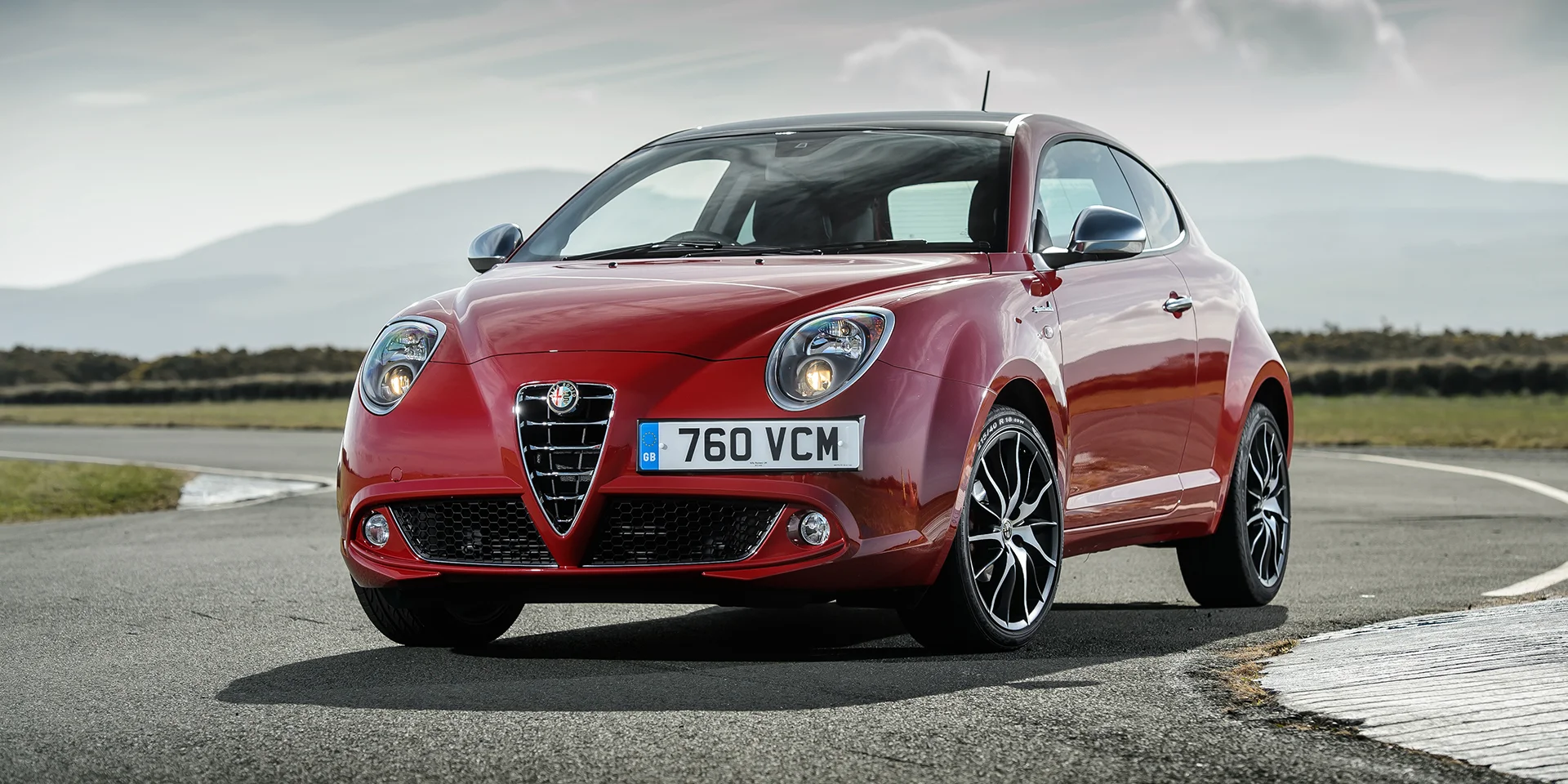
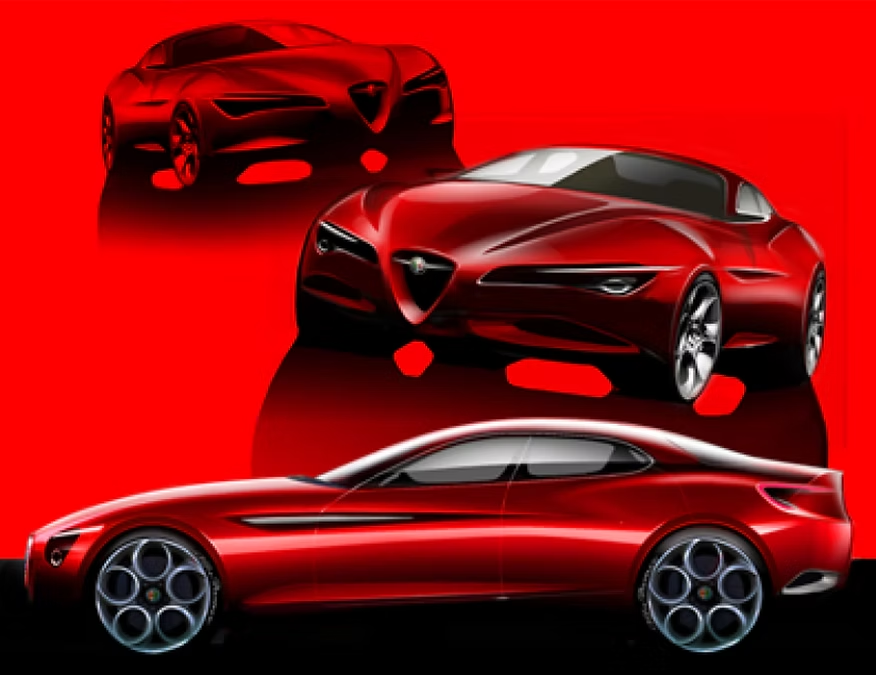
Left image: Alfa Romeo MiTo (Photo courtesy of Alfa Romeo / Stellantis). Right image: Alfa Romeo Giulia design concept created by Andrea Mocellin (Image courtesy of Andrea Mocellin)
Jessica Bilewski: “Working for some of the most recognized car brands in the industry, from starting as a junior designer at Pininfarina, and later as a lead exterior designer at Alfa Romeo, you’ve helped shape both legendary supercars and more accessible Italian performance vehicles. In particular, you played a key role in developing production proposals for the Alfa Romeo Giulia and the Mito My 2014.
Many of the most celebrated automotive designs, from iconic coachbuilt creations manufactured by Bertone to legendary Ferraris, have traditionally been reserved for a small, select clientele. They are admired by many, but experienced by few. By contrast, the Giulia brought Italian design emotion and performance into a form accessible to far more drivers.
With the Horizon Cavorite X7, you’ve helped shape a high-performance vehicle that can serve both executives and celebrities in elegant, luxurious air travel, as well as oil workers, engineers, and ranchers in more demanding, practical missions. Being involved in the petroleum industry, I can imagine how traveling with my dad to a site on the Cavorite X7, an eVTOL designed with your aesthetic vision, would positively affect our work environment and overall experience. People who may never sit in a supercar could still experience a vehicle shaped by the same design philosophy (obviously with different interiors depending on the mission and purpose) that you continue to implement throughout your impressive career.

Do you see this as part of a broader philosophy, that beauty and thoughtful design are not just about aesthetics or luxury in itself, but how it can influence and uplift our moods, inspire us, and help make the everyday routines of life a little more extraordinary and enriched?”
Andrea Mocellin:
“Yes, this is very much part of my philosophy.
The Cavorite X7 serves radically different missions, from executive transport to demanding industrial operations. Designing for such diversity requires creating an adaptable environment capable of supporting different passengers, expectations, and operational realities.
The cabin becomes a flexible architecture rather than a fixed luxury object. Configuration, materials, and spatial perception must communicate safety, reliability, and comfort regardless of mission profile.
For a designer, this carries significant responsibility: to create an environment that feels trustworthy and human, even when introducing entirely new technologies. High-level design should not belong only to exclusive contexts; it should elevate experiences wherever mobility exists.”
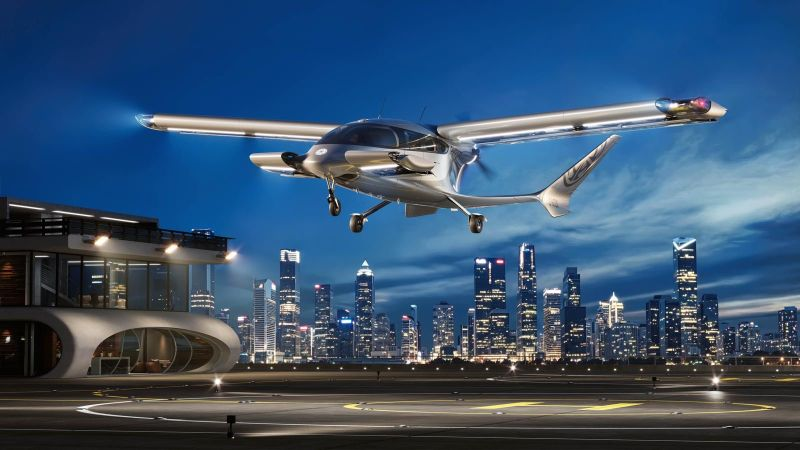
As CEO and Co-Founder Brandon Robinson said in a January 2026 conference call with investors, the Cavorite X7 interior configuration can be altered from business travel to cargo (and vice-versa). Therefore, this versatility of the Cavorite X7 platform demonstrates that the interior can be also modified to meet the needs of passengers that require room for a wheelchair, whether to be stored for a current passenger, or be ready for a future passenger. Wheelchairs are also useful to have on standby in situations where passengers have temporary mobility issues. For the most part, transporting a person by wheelchair is much safer than other modes of carrying a patient/passenger who cannot walk.
“We’ve created a kind of “Swiss army knife” in the interior cabin volume so that we can quickly switch it from cargo. Maybe it runs cargo missions at night and then you can flip it into a business travel. You could snap in some seats in business travel during the day.” – Brandon Robinson, Co-Founder and CEO of Horizon Aircraft (16th of January 2026 conference call)

Multi-Role Capability of the Cavorite X7
- Passenger services
- Private / VIP
- Commercial
- Commuter (UAM)
- Regional Air Mobility (RAM)
- Tourism
- Air Ambulance / MEDEVAC
- Organ transplant transportation
- Cargo
- Military (Personel, Cargo, Surveillance, MEDEVAC, Maritime warfare)
- Oil and Gas (offshore and onshore)
- Ranching / Agriculture / Wildlife Management
- Windmill / Powerline maintenance & monitoring
Just like a Swiss army knife, it has been the Editor-in-Chief’s own experience that a wheelchair can come in handy during various types of emergencies.
Jessica Bilewski: “Speaking about the emotions of the passengers reminds me of what Nuccio Bertone famously said:
“A car is the product of a feeling, or rather, a series of feelings.”
Can an eVTOL like the Horizon Cavorite X7 be the product of a feeling? And could the emotions that inspire its design, in turn, generate new emotions in the people who experience the aircraft, forming a kind of circle or spiral, where feeling inspires design, which then inspires feeling again for both pilots and passengers?”
Andrea Mocellin:
“Absolutely. Every meaningful vehicle begins with a feeling, an intention about how people should experience movement.
The Cavorite X7 is an engineering achievement, but design gives emotional meaning to that technology. Because this aircraft introduces new flight behaviors, silent vertical takeoff, new travel patterns, unfamiliar operational concepts, and the first emotion it must create is trust.
Trust in technology. Trust in safety. Trust in innovation.
This emotional layer is expressed through proportions, materials, lighting, comfort, and the visual language of the aircraft itself. When passengers feel confident and inspired, the experience becomes memorable.
In this way, design creates a cycle: feeling inspires design, and design generates new feelings in those who experience it. That continuous exchange is what makes mobility meaningful rather than purely mechanical.”
Andrea Mocellin’s work exemplifies the power of ingenious design to improve mobility and enrich everyday life. From his dedication to micro-mobility (Revolve Air wheelchair) to his work designing the Horizon Aircraft’s Cavorite X7‘s appearance, Andrea blends technical innovation with a passionate human-centered approach that prioritizes accessibility, comfort, practicality, and beauty. His commitment extends beyond cold engineering efficiency. He seeks to make travel more inclusive for people with disabilities, reduce barriers for rural and underserved communities, and bring thoughtful, elegant design into everyday experiences. By uniting beauty, function, and accessibility, Mr. Mocellin demonstrates that mobility solutions can be both innovative and equitable, demonstrating that thoughtful design can truly transform how people move through the world, and do so in style. With the Horizon Aircraft’s Cavorite X7 being hybrid-electric, and estimated to cost 75% less to operate than a helicopter and an expected operating cost of just $0.97 USD per available seat mile, combined with Andrea Mocellin’s gorgeous and luxurious design, it further goes to show that beauty is a luxury in life we can all afford!
Both eVTOL buzz’s Editor-in-Chief Julian Orkisz, and Deputy Editor Jessica Bilewski would like to thank Andrea Mocellin for most generously and graciously agreeing to an interview. We dedicate this article to Jessica’s grandmother Barbara Bilewska, and all those experiencing mobility issues.
Stay tuned to eVTOL buzz for more in-depth articles about eVTOLs and Advanced Air Mobility that you won’t be able to get anywhere else; where the “buzz” takes you further than press releases and into the deep topics that matter most in the eVTOL industry.
More Info:
Horizon Aircraft (official website): click here
Andrea Mocellin’s website: click here
Revolve Air wheelchair (official website): click here
Why Horizon Aircraft’s ultra-dependable Cavorite X7 will be the “go to” long distance eVTOL: click here
The Space-Saving Wheelchair (TIME Magazine’s best inventions for 2021): click here
Andrea’s biography and interview with Istituto Europeo di Design : click here
Royal College of Art: click here
Maserati Collaborates With The Royal College Of Art And Fiat’s “Two Of A Kind” Project: click here
Ramaciotti presents “The Roots of Italian Car Design” to RCA students: click here
Maserati collaborates with the Royal College of Art and Fiat’s project: click here
The high-flying industry: Urban Air Mobility takes off: click here
Urban Air Mobility Has the Power to Transform the Lives of Millions… But Only if We Make it Inclusive and Accessible: click here
Darrel Swanson and Jarek Zych from EA Maven: click here
Dynamics in Travel Constraints of People With Mobility Impairments: click here
Insights: Accessibility challenges in travel: click here
Trips Not Taken, Money Not Made: Inaccessible Air Travel Hurts Disabled Travelers and Airlines Alike: click here
Americans Agree: Air Travel Should Be More Accessible for Disabled Passengers: click here
Passengers with Disabilities: Barriers to Accessible Air Travel Remain: click here
Portrait of Travelers with Disabilities: Mobility & Accessibility: click here
The Top 2 Challenges Facing Travelers With Mobility Disabilities: click here
Trips Not Taken, Money Not Made: Inaccessible Air Travel Hurts Disabled Travelers and Airlines Alike: click here
Portrait of Travelers with Disabilities: Mobility & Accessibility: click here
Flying the Unfriendly Skies: click here
New federal requirements show airlines damage thousands of wheelchairs each year: click here
U.S. Department of Transportation Requires Airline Lavatories to Be More Accessible for Wheelchair Users: click here
Accessible Lavatories on Single-Aisle Aircraft (US DOT rule): click here
Introducing the Next Generation of Airline Seating: The Evolution of the TiSeat for Embraer Aircraft: click here
Andrea Mocellin’s work for Expliseat and Air France: click here
Bertone Runabout: the retro roadster inspired by a 1969 concept car: click here
Horizon Aircraft Partners with RAMPF to Manufacture the Fuselage for its Aircraft: click here
Horizon Aircraft Partners with North Aircraft Industries to Manufacture the Wings for the Cavorite X7: click here
Andrea Mocellin biography at Istituto Europeo di Design: click here
Notre nouveau siège dévoilé à Hambourg: click here
Connecting Communities Equitably with Scalable Vertiports: click here
Rural Communities Are Leading the Way in the Vertiport Revolution: click here
Despite calls to improve, air travel is still a nightmare for many with disabilities: click here
Berkshire Hathaway Travel Protection: Traveling With a Disability: Where to Go, How to Get There, and How to Plan Your Trip: click here
OECD (2025), Rural Innovation Pathways: Connecting People, Places and Ideas, OECD Rural Studies: click here
Car Design – An introduction | IED Torino: click here
Royal College of Art announces ambitious plans for the renewal of its Kensington site: click here