


Imagine wanting to travel far beyond the 100 to 150 km an all-electric eVTOL can fly. Sure, you could fly in a commercial airliner, take a train (depending on where you’re going), or maybe drive if you were that dedicated. You could choose whether to wait in road traffic, sit in a crowded airport terminal, or a crowded train terminal. However, knowing the benefits of avoiding frustration and time wasted in conventional modes of transportation by flying in an all-electric eVTOL for short distances, one cannot help but wish you could obtain the same benefits of air travel of an all-electric eVTOL without sacrificing on range. The answer to this limitation in eVTOLs has been contemplated years ago. One of the pioneers and forward-thinkers in Regional Air Mobility (RAM) has been serial entrepreneur Michal Illich from the Czech Republic. Mr. Illich has founded many companies, such as search engine Jyxo, Testomato (a website monitoring service), and WebExpo, one of the leading tech conferences in Europe (Central Europe’s largest). This article aims to explain how Michal Illich’s company, which is based in Prague, Czechia 🇨🇿 will help change the reality, applications and range of green transportation through hybrid-electric eVTOLs.

- Founded in 2017 by CEO Michal Illich
- Headquartered in Prague, Czechia 🇨🇿
- Manufacturer of Zuri eVTOL
- Hybrid-electric propulsion
- 700 km (435 miles) range
- 350km/h (217 mph) speed to rescue patients quickly
- Tourism, regional air travel/commutes
- Use in civilian and military SAR & MEDEVAC
- Cargo/logistics support
- Runs on aviation fuel, SAF-compatible from day one
- 4 passenger plus 1 pilot (passenger configuration)
- 1 reclining patient, up to 2 medical personnel plus 1 pilot (MEDEVAC & SAR configuration)
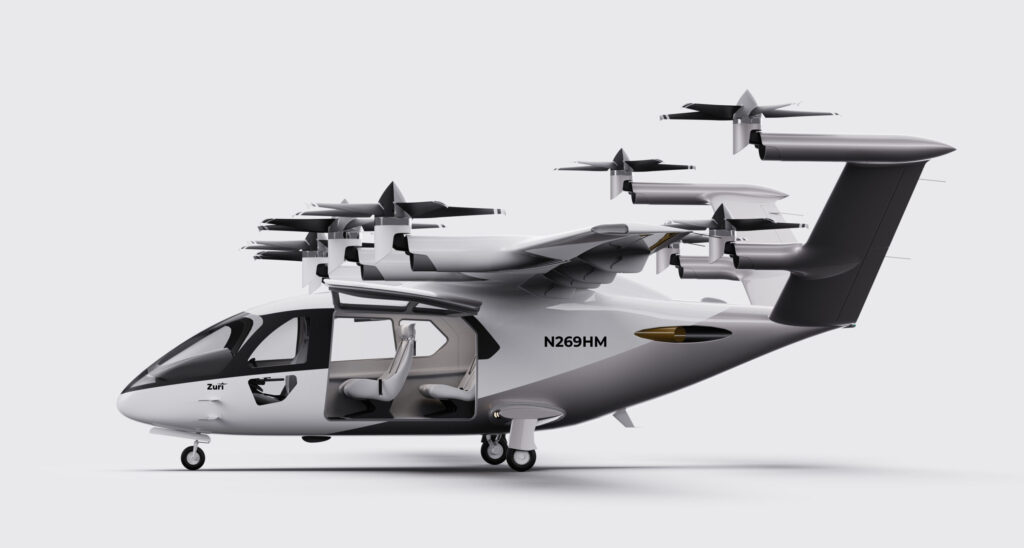
At the heart of Zuri’s business model is passenger transportation, and that’s a good thing! While there are other many important and even life-saving applications of the Zuri aircraft such as search and rescue, fortunately most passengers will experience the beautiful Zuri hybrid-electric transporting them to work or on a weekend getaway. Zuri’s design features large windows which provide generous views of the cities, mountains, beaches, forests, deserts, and fields below. Flying on the Zuri hybrid eVTOL will give you plenty of reasons for keeping your phone down or monitor away and instead gaze into the surroundings for a bird’s eye view.
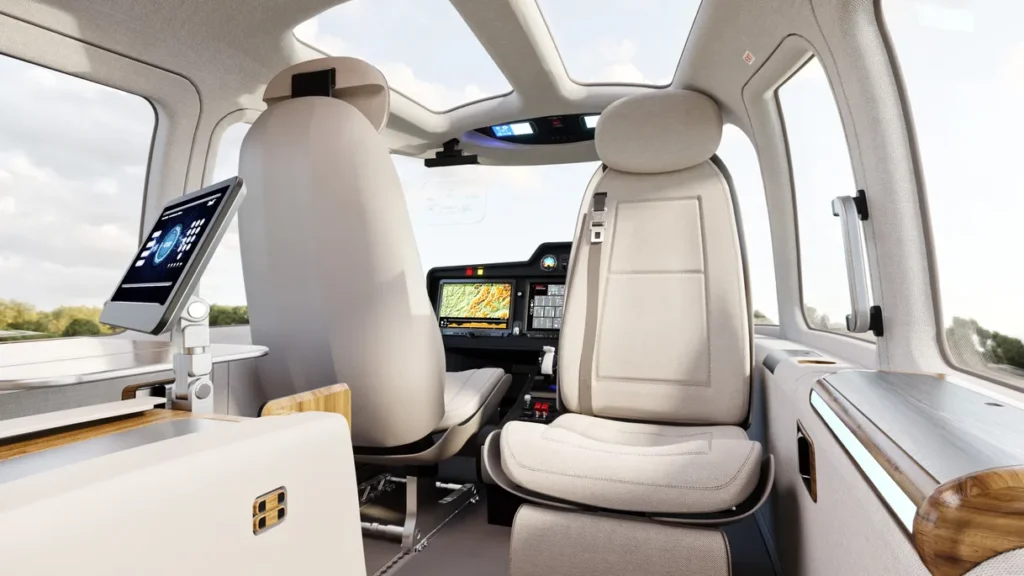
Zuri’s eVTOL features exquisite styling and refinement to be expected from a European luxurious eVTOL aircraft.


Minimize the time waiting in an airport lounge or lobby, as well as the driving distance to and from the airport, by flying directly to your destination. Spend more time at your destination, which is the place you actually intended to be in the first place. Zuri’s founder Michal Illich had this vision and purpose in mind when he founded his company in 2017, to bring Advanced Air Mobility (AAM) to the forefront of aviation and transportation as whole.
Why Hybrid is the King of the Range
Zuri has an interactive map on their website, which allows you to click on a European city and see the range of their hybrid-electric eVTOL from that location.

Taking off from a Zuri eVTOL in Prague 🇨🇿, puts you within range of Amsterdam 🇳🇱, Brussels 🇧🇪, Copenhagen 🇩🇰, Warsaw 🇵🇱, Zagreb 🇭🇷, Milan 🇮🇹, and Venice 🇮🇹.


If you start your journey in Paris 🇫🇷, a Zuri aircraft can take you to destinations such as London 🇬🇧, Manchester 🇬🇧, Liverpool 🇬🇧, Amsterdam 🇳🇱, Zurich 🇨🇭, Munich 🇩🇪, Toulouse 🇫🇷, Milan 🇮🇹, Monaco 🇲🇨, Cannes 🇫🇷, and even San Tropez 🇫🇷.
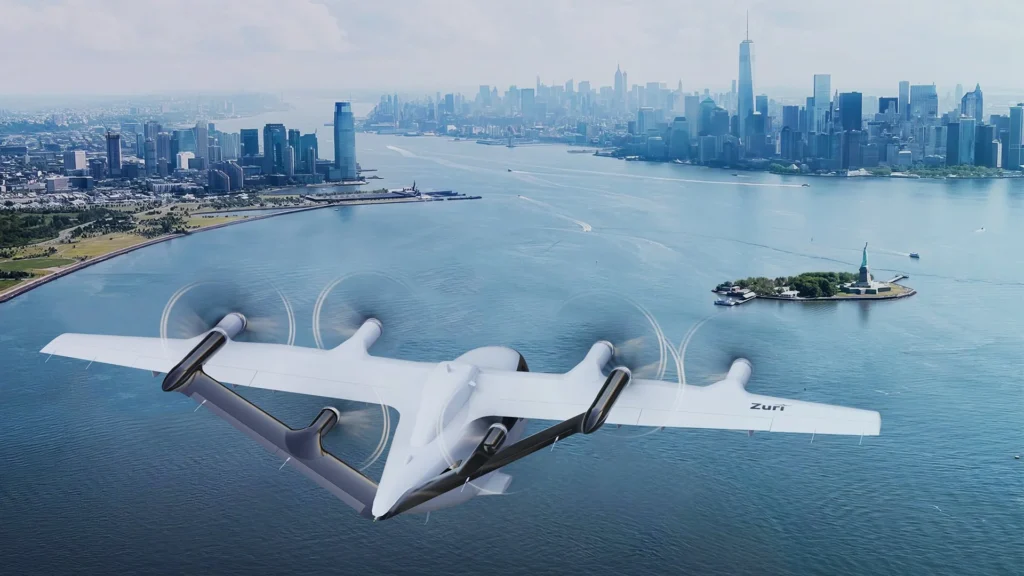
Animated video of a Zuri hybrid eVTOL flying over London 🏴🇬🇧
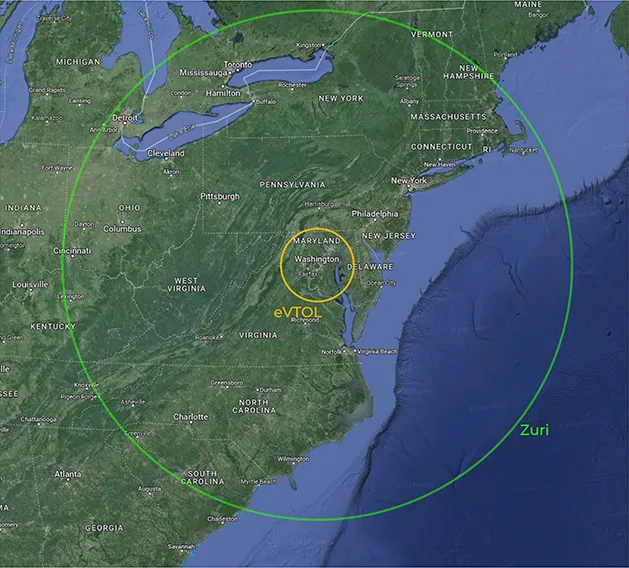
With a Zuri eVTOL, you can take off from Washington D.C. 🇺🇸 and land not just in Virginia Beach 🇺🇸, but also in Myrtle Beach 🇺🇸, or even The Hamptons! 🇺🇸
Cincinnati 🇺🇸, Detroit 🇺🇸, Toronto 🇨🇦, NYC 🇺🇸, and Boston 🇺🇸 are all within reach.
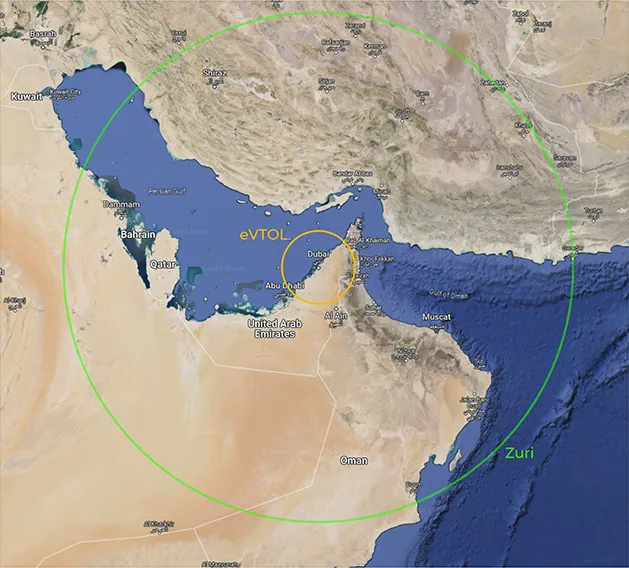
Trips from Dubai 🇦🇪 to Doha 🇶🇦, Dammam 🇸🇦, Al Jubail 🇸🇦, Muscat 🇴🇲, and Shiraz 🇮🇷 are all possible thanks to the hybrid-electric propulsion of Zuri’s eVTOL.

Another cool feature of Zuri’s website, is the interactive globe that lets you scroll the entire earth and get a visual of the range of a Zuri eVTOL from virtually any location in the world: link here
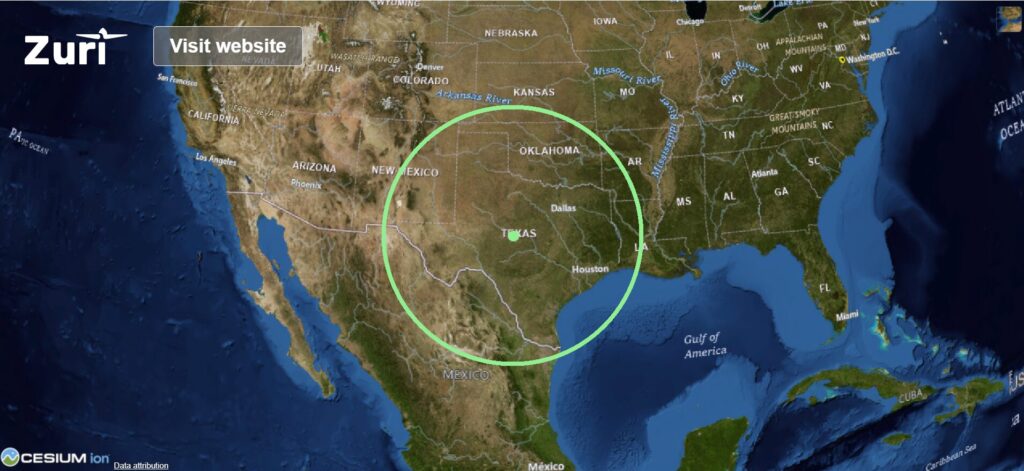
After having some fun with the interactive globe on Zuri’s website, you can visualize the range of the Zuri hybrid-electric aircraft in Texas. Fellow Texans would agree, it’s quite awesome to see that a Zuri eVTOL can reach every part of Texas if taking off from its center! Fun Fact: According to the 2020 US Census, there are 193,058 Czech-Americans living in Texas, making Texas #1 for population of Czech-Americans out of the 50 states. Texans will love seeing Zuri eVTOLs flying in the big Texas skies!

None of those routes that have been mentioned are currently possible with an all-electric eVTOL, and are unlikely to be viable in the near term.
A growing majority of the eVTOL companies that have been spending incredible amounts of R&D resources on all-electric propulsion, have recently began working on the development of hybrid-electric versions for military/defense contracts, which require eVTOLs that can go faster and further on missions than what all-electric eVTOLs can currently offer.
eVTOL buzz has been most fortunate, to have Robert Demmer, Zuri’s Chief Marketing Officer, graciously elaborate on this fact and answer many questions that we at eVTOL buzz, and our readers would like to know.
Robert Demmer:
“The broader industry trend is clear. Several leading eVTOL developers that began with all electric concepts are now exploring hybrid systems, particularly in defense and government markets where range, endurance, and continuous operations are essential. This reflects the same reality that guided Zuri’s strategy from the beginning: today’s batteries cannot deliver the mission profiles required for regional mobility, emergency response, or longer range defense applications.“
Robert Demmer, Chief Marketing Officer at Zuri
Drawn to hybrid electric eVTOLs
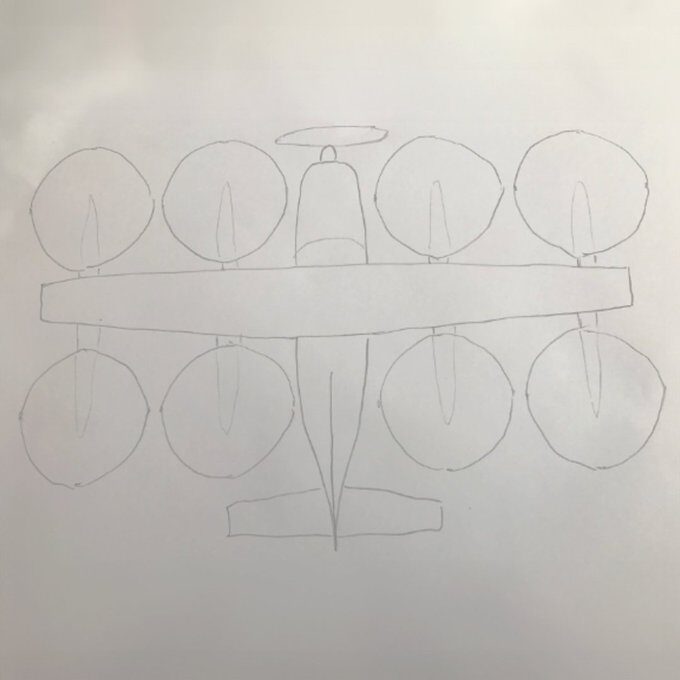

Rough sketches made by Zuri’s Founder and CEO Michal Illich
Knowing the benefits of hybrid-electric propulsion since 2017, when Michal Illich began his first sketch of an eVTOL using the nearest writing utensils at his disposal (his children’s crayons), Mr. Illich drew a rough draft that later, with help from an aerospace designer, became an idea on paper that would eventually help transform AAM from urban to regional air mobility (RAM).
eVTOL buzz: “Seeing the benefits of a hybrid-electric system, as well as being focused on hybrid-electric systems from the very beginning of your company, how will that help Zuri reach milestones and eventually enter the market and start generating revenue?”
Robert Demmer:
“Zuri’s advantage is that our aircraft has been hybrid from day one. We are not retrofitting an electric design to add hybrid capability, which in practice means creating an entirely new aircraft. Every aspect of our platform, from the hybrid electric propulsion system to the eight tiltrotor redundancy and in flight battery recharge, was engineered for range, reliability, and flexibility. Because Zuri solved those integration challenges at the start, we are positioned to move faster toward certification and market entry.“
“Why hybrid leads today. Current batteries provide around 230 to 280 Wh/kg. Zuri’s hybrid powertrain delivers approximately 1360 Wh/kg, giving it more than five times the usable energy. This is why Zuri can achieve up to 700 kilometers plus reserves, while most all electric eVTOLs are limited to about 100 to 150 kilometers once reserves are included. Even with steady improvements of 15 percent every five years, electric only eVTOLs will remain far behind hybrid aircraft well into the 2040s.”
“In passenger configuration, the aircraft carries a pilot and four passengers, offering a practical alternative to both cars and regional jets. The aircraft is tailored to the segment of travel where hybrid VTOL delivers the greatest value: trips over 200 kilometers where cars are inefficient, and under 700 kilometers where conventional air travel becomes slower and less practical. In Europe, most regional airline and business aviation flights fall between 300 and 600 kilometers, directly within the range. In the United States, roughly half of domestic flights are under 800 kilometers, including high frequency routes such as New York to Washington DC or Dallas to Houston. Beyond these corridors, Zuri can also make thin routes viable, enabling point to point service where demand is too limited for regional jets but ideal for smaller, flexible aircraft.“
Robert Demmer, Chief Marketing Officer at Zuri
How is it possible? Hybrid-electric vs Battery-only (all-electric) systems
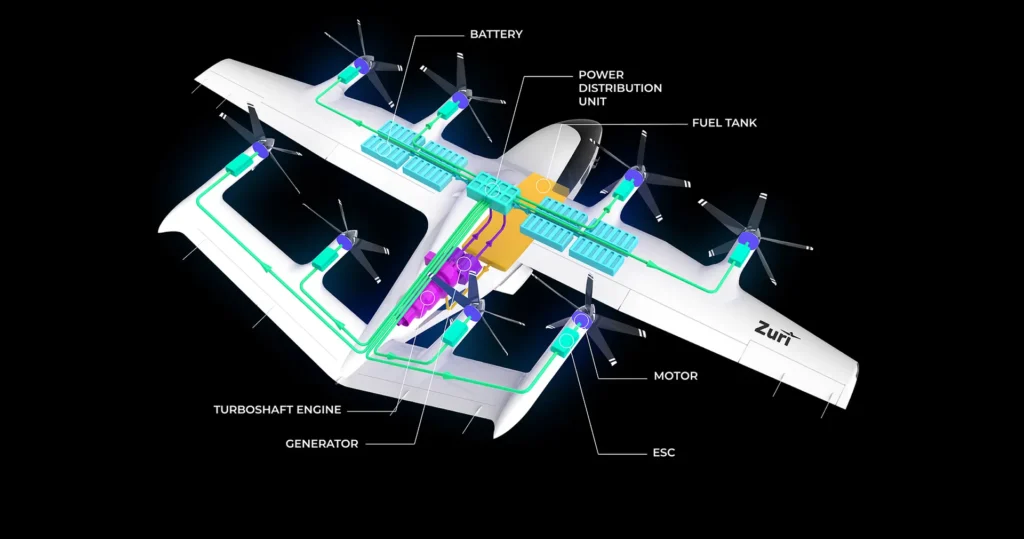
A turboshaft engine, which can be powered by SAF fuel provides power for the propulsion system, and charges the batteries en route. Having a turboshaft engine, allows the eVTOL to run with smaller batteries. Zuri uses not just smaller batteries, but batteries that are 1/3 of the size of an all-electric eVTOL. This is of great importance due to the huge mass electric batteries have. By reducing the size by 1/3 and therefore weight of batteries, the Zuri eVTOL can have an optimal power to weight ratio.
Something very informative, that was mentioned by Mr. Demmer, and provides a great benefit to the hybrid-electric propulsion system, is the longer lifespan of the batteries in the eVTOL:
“Why this matters for sustainability: the hybrid system requires three times smaller batteries than a comparable eVTOL, which reduces the emissions footprint of manufacturing and recycling. Because one flight covers 500 to 700 kilometers instead of 50 to 100, each battery lasts for ten times longer distance before it needs replacement. Operators benefit from both lower cost and lower lifecycle emissions.”
As explained by Robert Demmer, the longer flights allow the eVTOL’s turbogenerator sufficient time to charge the batteries en route, meaning the Depth of Discharge (DoD) and Cycle Count will be reduced, which results in the batteries lasting longer and experiencing less stress before they need to be replaced. Another benefit of the design, is that by not needing large batteries, the cost of replacing batteries that are one-third the size of batteries typically found in all-electric eVTOLs should be significantly less expensive. This in turn reduces waste and avoids necessitating additional lithium to be mined, thereby providing better sustainability and eco-friendly use of battery resources.

Aircraft need to be as light as possible, and batteries can be rather heavy. This dilemma is of greater consequence for aircraft than for cars and trucks. Therefore batteries that could be created with a higher level of energy for a given weight or mass, will be more advantageous for aircraft. A good way to compare the amount of energy that can be stored (for a given weight), between batteries and aviation fuel sources is by their specific energy. In terms of batteries, specific energy (energy stored per unit mass) is measured in Wh/kg. We can see the 5-fold power to weight/mass ratio of hybrid eVTOLs (1360 Wh/kg) versus all-electric eVTOLs (230-280 Wh/kg) is possible thanks to the use of aviation fuel in a hybrid-electric turboshaft engine, rather than solely relying on batteries (which at the moment are much less energy dense). A turbogenerator with a mass of 225 kg can produce ~600 kWh in 2 hours from 216 kg of fuel. While battery technology is slowly improving, and Tesla batteries increasing (in Wh/kg) at a rate of ~15% every 5 years; Zuri‘s eVTOL design provides a great deal of specific energy in a practical and meaningful way using current⚡technology!
Carbon Emissions of Electric Batteries
GREET (Greenhouse gases, Regulated Emissions, and Energy use in Transportation) is a model from Argonne National Lab (based in DuPage County, Illinois 🇺🇸) used to estimate battery CO2 emissions (CO2e). It estimates that for every 1 kWh of battery capacity, about 73 kg of CO2-equivalent is emitted. For example, a 60 kWh battery would produce ~4,380 kg (4.38 tonnes) of CO2e during production.
As electric battery production for aviation purposes grows, the total emissions from battery production are naturally expected to jump from 12 million tonnes CO2e to 106 million tonnes CO2e. That’s an almost 9-fold increase just from battery production!
On the other hand will the total CO2 footprint from battery production increase in unprecedented pace and to an enormous scale. If the value from GREET 2018 is used (73kg CO2e/kWh) the industry will go from 12 million tonnes CO2 equivalents to 106 million tonnes which is equal to almost two thirds of GHG emissions from aviation in Europe . Even if this contributes to a decrease of direct fossil fuel emissions, through the 30 replacement of ICEVs to EVs, it will be a large source of CO2 emissions.
Source: Hans Eric Melin. “Analysis of the climate impact of lithium-ion batteries and how to measure it.” Circular Energy Storage Research and Consulting, July 2019. Commissioned by the European Federation for Transport and Environment.
Why Less Is More
Again, by dramatically reducing the size of the batteries required to power a Zuri hybrid eVTOL to just 1/3 of the size required in a conventional all-electric eVTOL, Zuri can save tremendous amounts of CO₂ from being emitted during production (mining, manufacturing, transportation, and charging).
Green SAF (Sustainable Aviation Fuel)
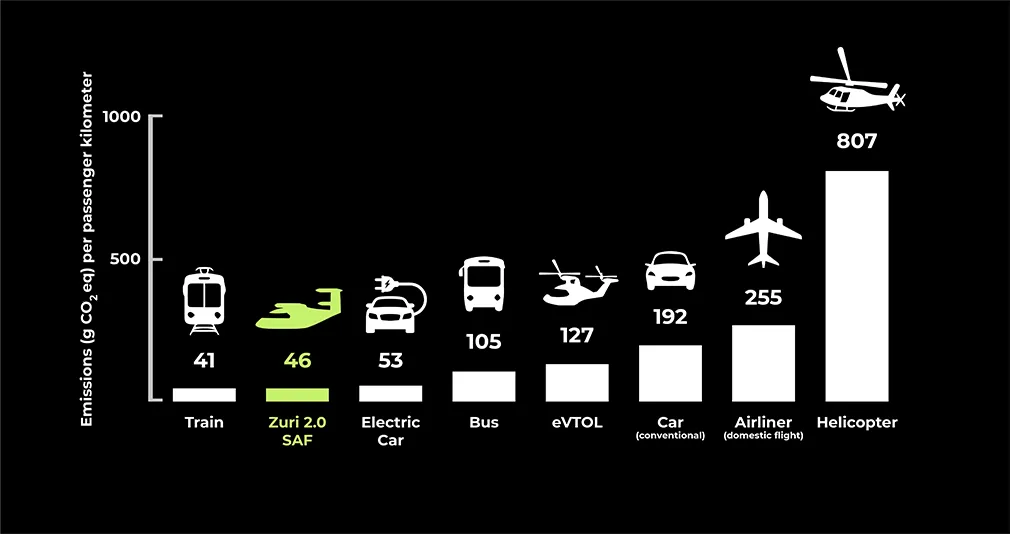
Greenhouse gases can be mitigated through the use of SAF. According to Zuri, a turbogenerator using SAF produces 136 g CO₂ eq/kWh
Using SAF in a turbogenerator produces half (136 g CO₂ eq/kWh) of the greenhouse gases produced from recharging an eVTOL from a typical electric grid (275 g CO₂ eq/kWh). When looking at it from an emissions per passenger kilometer, Zuri’s hybrid eVOL produces almost one-third less CO₂ emissions compared to a typical all-electric eVTOL!
This is a significant decrease in CO₂ emissions, and explains why Zuri has chosen the path of hybrid propulsion and SAF as a practical means of environmental sustainability when passengers travel the planet. 🌍
You Know Where You Want To Fly, But How Will You Approach It ?
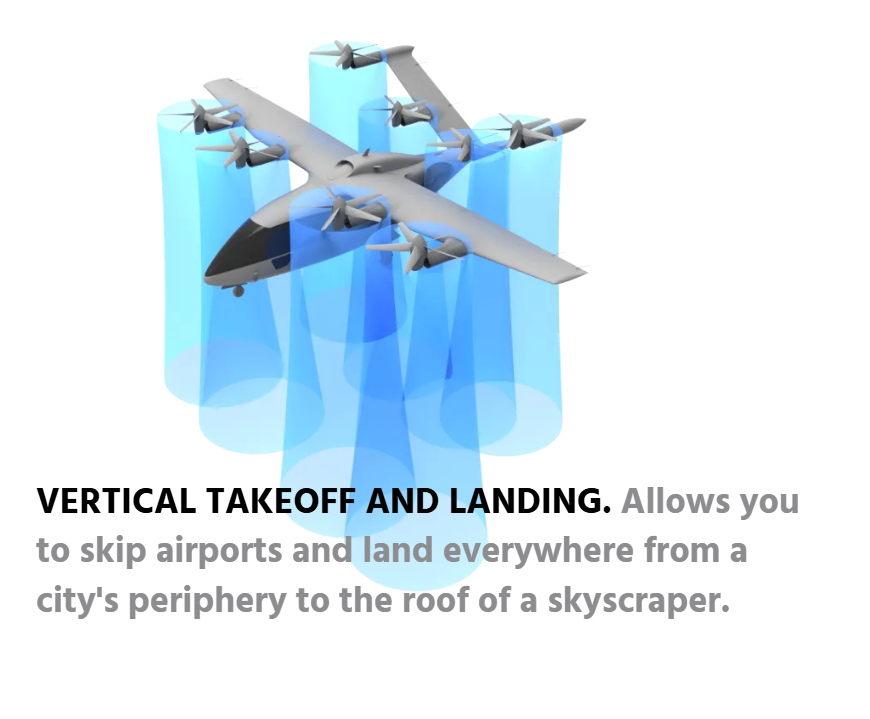
VTOL (Vertical Takeoff and Landing)
Takeoff and land vertically from any existing helipad, heliport, or vertiport with no problem.
Need to land on a megayacht or an offshore oil rig? It’s no problem with a Zuri hybrid-electric eVTOL.

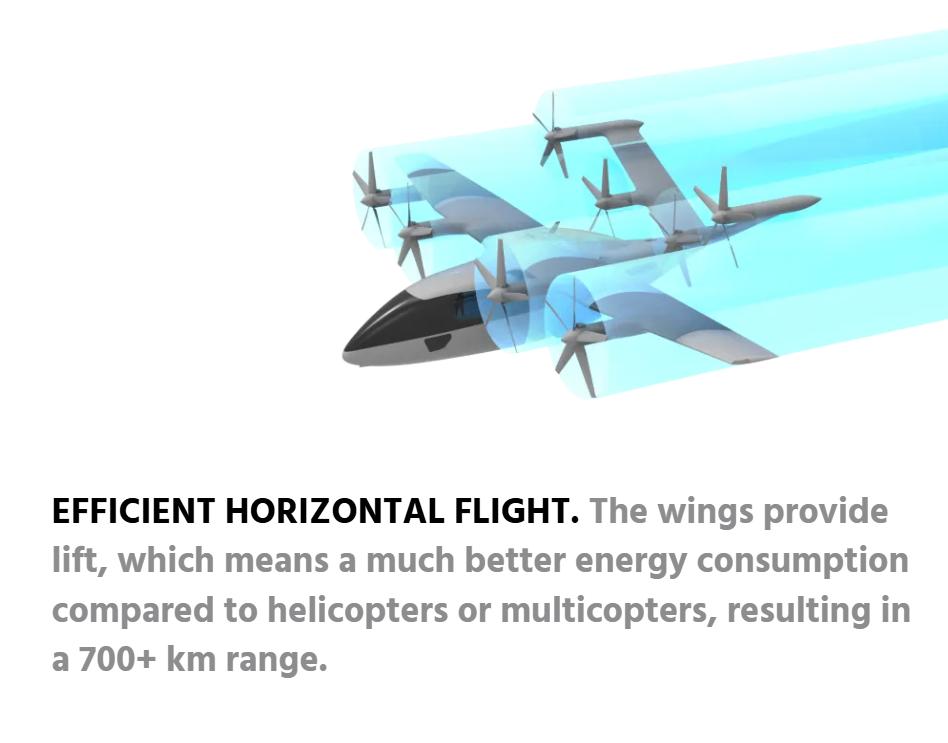
Horizontal Flight (Conventional Flight)
After taking off and climbing to an appropriate altitude, the Zuri hybrid eVTOL can transition into horizontal cruise flight, which is more energy efficient, and improves range. This is possible thanks to the aircraft’s wings which provide generous lift while still maintaining a compact form-factor.
If the need arises or the pilot makes such a preference, the Zuri eVTOL can land like a conventional airplane on a runway. This flexibility makes the Zuri eVTOL unique in that it has the best of both worlds: the vertical flight of a helicopter and and the efficiency of horizontal flight like an airplane.

MEDEVAC and SAR
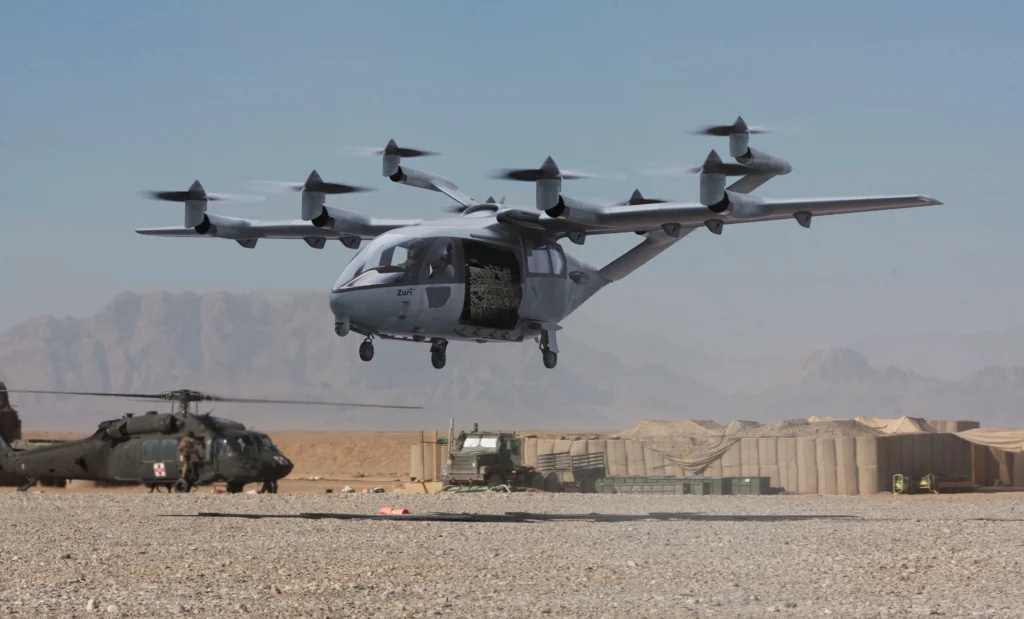
For the same reasons, militaries around the world are looking to buy hybrid-electric eVTOLs, civilian organizations requiring aircraft for Search And Rescue (SAR) and Medical evacuation (MEDEVAC) can take advantage of the power, speed, and range of Zuri’s aircraft.

Czechia is blessed with many mountains, such as the Giant Mountains, Šumava, and the Moravian-Silesian Beskids. eVTOL buzz asked how does this geography play in the real-life operational uses/needs regarding SAR and Medevac, which eVTOLs could provide a solution (particularly in those regions).
“Czechia’s terrain makes a strong case for hybrid VTOL in emergency air mobility. The Giant Mountains, Šumava, and the Moravian-Silesian Beskids are popular for hiking, skiing, and tourism, yet also present significant challenges for rescue and medical response. Flooding along river systems, landslides in mountain valleys, and rural areas with limited infrastructure can delay or prevent ground access when minutes are critical.”
Robert Demmer, Chief Marketing Officer at Zuri


“The hybrid VTOL is engineered for exactly these conditions. In medevac configuration, the aircraft carries a pilot, a reclining patient, and up to two medical personnel, allowing direct evacuation from slopes, valleys, or rooftops. In cargo configuration, it can deliver over 300 kilograms of supplies such as medical kits, communications gear, and portable power to isolated communities. With sensors and secure communications links, it also provides real-time aerial awareness to coordinate SAR teams during wildfires, floods, or mountain rescues.”
Robert Demmer, Chief Marketing Officer at Zuri


“Hybrid propulsion extends these missions beyond the limitations of all-electric aircraft. It can operate up to 700 kilometers plus reserves at a cruise speed of 350 kilometers per hour, which means it can cover the entire territory of Czechia and neighboring regions without needing charging infrastructure. The ability to refuel quickly with widely available fuels is decisive in disaster response where turnaround time determines outcomes.”
The eVTOL cruises at approximately 350km/h (217 mph) which allows it to get to the patient fast, when every second counts!

eVTOL buzz also inquired about partnerships/collaborations between the company and SAR and MEDEVAC service providers regarding testing/implementation or future operational use of eVTOLs, and whether Zuri would be able to disclose any interest from such SAR/Medevac organizations regarding purchasing/acquiring eVTOLs.
Robert Demmer replied:
“We are engaged in dialogue with SAR and medevac providers in Czechia and Europe about future operational use of our aircraft. While we cannot yet disclose specific partners, the interest is clear. We are also collaborating with Czech aerospace institutions and authorities to ensure that the platform aligns with national emergency and regional connectivity needs“
“As highlighted in our AirMed and Rescue feature Beyond the Battlefield, our aircraft offers a practical complement to helicopters. Helicopters will always be essential for hover-intensive or heavy-lift tasks, but it [the Zuri eVTOL] can handle the high tempo of daily relief, logistics, and patient transport with much lower operating costs and significantly lower noise, supporting broader deployment and community acceptance.”
Robert Demmer, Chief Marketing Officer at Zuri
Research Collaboration

Czech Technical University in Prague (CTU)/ České vysoké učení technické v Praze (ČVUT)
- Established in 1806
- Motto: Scientia est potentia, Knowledge is Power
- Collaborates with Zuri on advanced research

University of West Bohemia in Pilsen
- Established in 1991 from the merger of College of Mechanical and Electrical Engineering (formerly part of Czech Technical University in Prague) and the Faculty of Education in Plzeň (formerly part of Charles University).
- Collaborates with Zuri on advanced research
eVTOL buzz: “Do you have any research/scientific collaborations with academic institutions/universities/ or private consulting groups?“
“Yes, research and academic collaboration are integral to our development. We work closely with Czech Technical University in Prague (ČVUT) and University of West Bohemia in Pilsen on aerodynamics, propulsion, and systems integration. These partnerships combine advanced research with applied development and help accelerate innovation while ensuring the platform is designed for certification and real-world use.“
“Through our role in the Czech Aerospace Cluster, we are connected to a broad network of academic institutions and private consulting groups. We are also exploring additional collaborations that support sustainability, diversity, and workforce development within the aerospace sector. Looking ahead, we are examining opportunities to broaden cooperation with universities in strategic locations, particularly in research and development areas that will shape the next generation of hybrid VTOL technology.“
Robert Demmer, Chief Marketing Officer at Zuri
We were interested as to whether Zuri offers any apprenticeships, mentorships or community outreach for students and youth interested in eVTOLs / AAM.
Again, Mr. Demmer provided our readers with a definitive answer:
“Beyond research, we are committed to nurturing the next generation of aerospace talent. We offer internships and mentorship opportunities for students, giving them hands-on experience in hybrid electric aviation. We also engage in community outreach to build awareness of advanced air mobility and inspire young people to pursue careers in aerospace engineering and sustainable aviation.”
Robert Demmer, Chief Marketing Officer at Zuri
Being situated in Prague, a center for learning since the Middle Ages, with the oldest university north of the Alps and east of Paris, is in a position to partner with universities across Czechia such as Czech Technical University in Prague and The University of West Bohemia in Pilsen, which ensures that youth in Central Europe have opportunities to build a future for Europe and the world in which the theoretical can be tested in the practical, and Regional Air Mobility (RAM) is not just a dream, but a reality.
Zuri RAM-s 🐏 Forward with Regional Air Mobility

While Czechia is symbolized on her coat of arms by a Lion, Zuri is like a wild Mouflon Ram in the Czech mountains, with its hooves firmly grounded in the realities of physics and breathing a higher altitude air of success. The company is not backing down from the challenges of Regional Air Mobility. Instead, it has been steadily climbing to the top of the mountain and has seen a world out there much farther than the eye can see, and bringing it closer and more convenient for travelers and commuters thanks to the Zuri hybrid-electric eVTOL. Once these Zuri eVTOLs leave the production line, and are out flying people to different destinations, it will revolutionize RAM (Regional Air Mobility).
We at eVTOL buzz, would like to thank Robert Demmer, Chief Marketing Officer at Zuri, for answering all of our tough questions and providing the insight and expertise that only someone deeply involved could provide.
✈️ Stay tuned to eVTOL buzz for test flight updates, tech deep dives, and exclusive interviews as Zuri‘s story evolves and the climb continues! 🐏⛰️
Info:
Zuri (official website): click here
Wikidi (official website): click here
Map of Czechia: click here
Czech Technical University in Prague (CTU)/ České vysoké učení technické v Praze (ČVUT): click here
University of West Bohemia in Pilsen: click here