Yaw Heard it Here: Horizon Aircraft’s New Flight Dynamics Model from Marshall Aerospace Furthers Its Pitch to Investors, Keeps Certification-Centered Design on a Roll
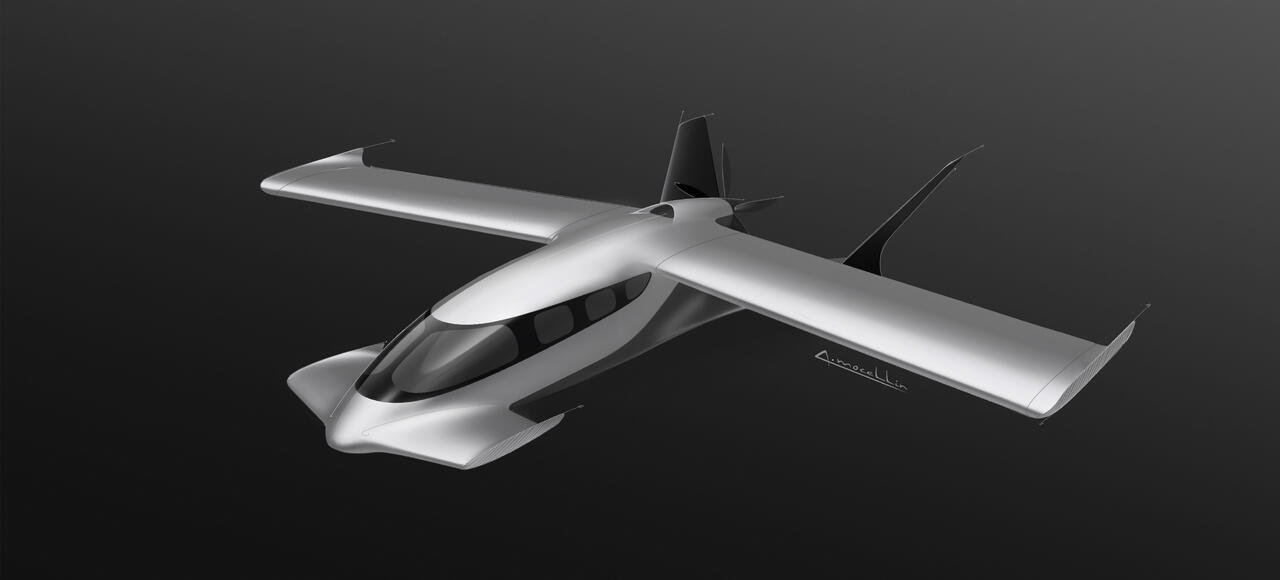
Horizon Aircraft has announced progress in the development of its Cavorite X7 eVTOL aircraft following the delivery of an initial six degrees of freedom (6-DOF) flight dynamics model by Marshall Aerospace, supporting the advancement of the aircraft’s flight control system and certification activities.
This milestone with the Cavorite X7′s six degrees of freedom (6 DOF)flight dynamics model is yet another example of the Canadian OEM’s surge in meaningful partnerships since last year. Furthermore, it’s a move in the right direction as Horizon gets closer to completing its full-scale prototype, which once built, could sway additional investment into the Cavorite X7 as a viable solution for the critical mission needs of both militaries and civil organizations around the world.
Background
The collaboration began after Horizon Aircraft issued a competitive tender in 2025 seeking specialist flight dynamics and control systems support as the Cavorite X7 program moved toward key design, development and certification milestones. Marshall Aerospace’s Aero Engineering Services business was selected for the work based on its extensive experience in aircraft modifications, special mission conversions, and applied engineering programs involving aircraft dynamics, stability and control.
Marshall’s engineering team has since undertaken detailed analysis of the Cavorite X7’saerodynamic,propulsion and mass characteristics to develop a 6-DOF flight model capable of predicting how the aircraft responds to pilot inputs and varying flight conditions.
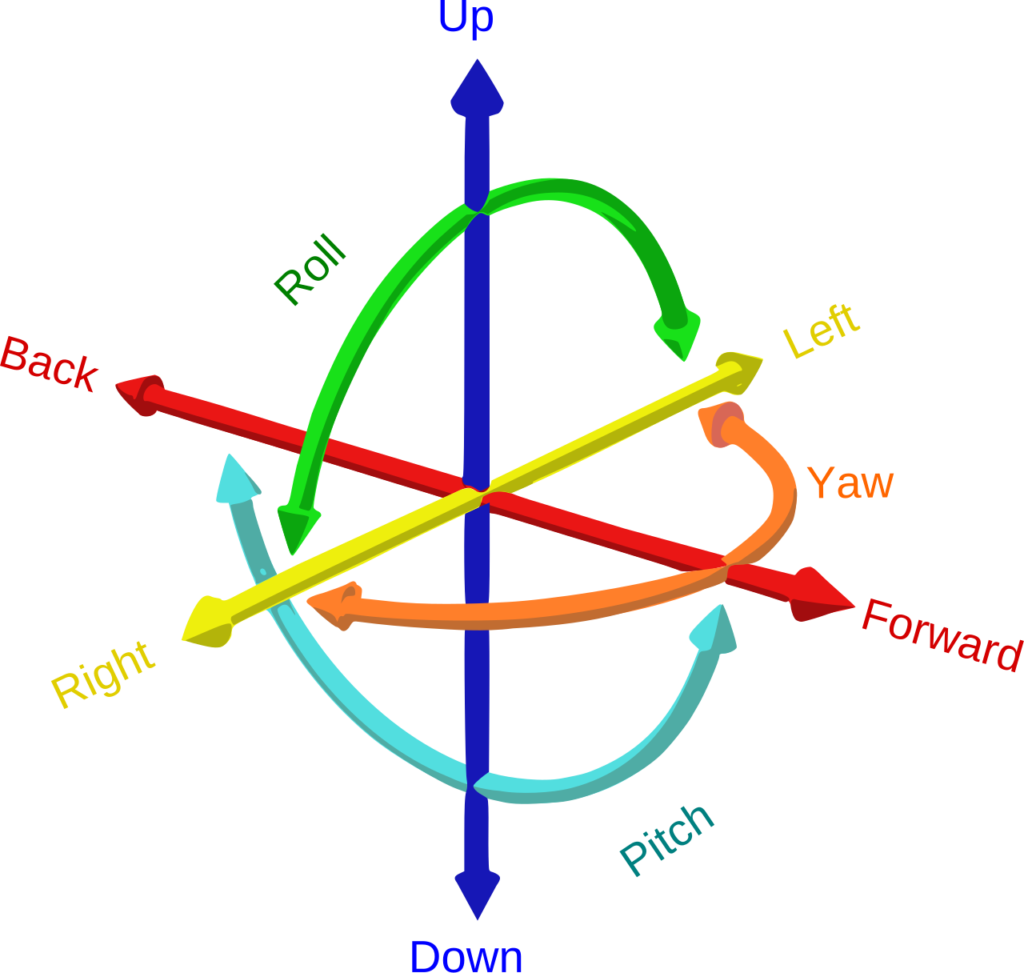
A 6-DOF flight dynamics model is a high-fidelity mathematical simulation that predicts how an aircraft moves through space by accounting for all six possible motions: forward/backward, left/right, and up/down translation, as well as roll, pitch, and yaw rotation. For the Cavorite X7, this modeling capability is particularly important because the aircraft must seamlessly transition between vertical takeoff and landing operations and conventional wing-borne flight. By integrating aerodynamic characteristics, propulsion-system behavior, vehicle mass properties, and control inputs, the model enables engineers to evaluate performance, stability, and handling qualities across the aircraft’s entire flight envelope. The resulting simulations support flight-control system development, reduce technical risk, and provide critical data for future certification activities.
Six Degrees of Freedom (6 DOF)
Translational Motion (3 DOF)
Surge: Forward/backward motion (x-axis)
Sway: Left/right motion (y-axis)
Heave: Up/down motion (z-axis)
Rotational Motion (3 DOF)
Roll: Rotation about the longitudinal axis
Pitch: Rotation about the lateral axis
Yaw: Rotation about the vertical axis
For advanced air mobility developers, high-fidelity flight models play a critical role in aircraft development long before full-scale flight testing begins. Such models are used to support flight control system development,pilot-in-the-loop simulations, safety assessments and certification planning, helping manufacturers identify potential issues and optimise performance before conducting real-world flight tests.
According to Horizon Aircraft, the newly completed model will support development of the Cavorite X7’s safety-critical flight control systems and provide engineers with a platform to predict and refineaircraft handling characteristics.
“We’re delighted to support Horizon Aircraft through safety-critical development work on a product that presents new possibilities for commercial and military aviation. This programme shows how our deep engineering experience translates across complex challenges ranging from platform modifications to special mission conversions and test beds.” – Mark Hewer, Aero Engineering Services Director, Marshall Aerospace
“The delivery of the first flight model for the Cavorite X7 marks a strong start to our partnership with Marshall Aerospace. Marshall’s engineers have integrated seamlessly into our development process, serving as an extension of our team and applying their expertise to developing one of the safest, toughest, and most performant modern VTOL aircraft.” – Tom Brassington, Chief Technology Officer, Horizon Aircraft
Marshall Aerospace
Locations:
Cambridge, England, UK
Greensboro, North Carolina, USA
Abu Dhabi, UAE
Properties:
Cambridge City Airport
Core Businesses:
Maintenance, repair and overhaul (MRO)
Depth maintenance
Non-destructive testing
Repairs and certified parts manufacture
Paint facility
Flight test and ground running enclosure
Support
Skills and training
Engineering Services
Modernisation programmes
Capability enhancement
Certification and testing
Aviation training
Through-life management
Precision manufacturing
Complex subsytem assembly
Parts and components manufacture
Trusted sub-contractor for leading primes such as:
Lockheed Martin
Boeing
Thales
Marshall Aerospace has built its engineering capability through extensive support of major aerospace platforms from manufacturer primes such as Boeing, long-term work on military transport aircraft such as the Lockheed Martin C-130 Hercules, as well as systems integration work involving technologies from companies such as Thales Group. Across its Aero Engineering Services business, the company has contributed to aircraft modification programs, avionics and mission system integrations, and structural upgrades across both military and special mission fleets. This work often requires close attention to aircraft performance, handling qualities, and certification compliance, providing a strong foundation in applied flight dynamics andstability and control analysis. That experience directly translates into modern modeling efforts such as six degrees of freedom (6-DOF) simulations for emerging unique aircraft like the Cavorite X7.
For the Cavorite X7, which combines vertical takeoff and landing capability with conventional wing-borne flight, accurate flight dynamics modelling is a critical element in the development of its safety-critical flight control system. The model enables engineers to simulate aircraft behaviour across multiple operating conditions, helping to optimise control laws and reduce development risk ahead of future flight testing and certification activities.
HOVR wing system
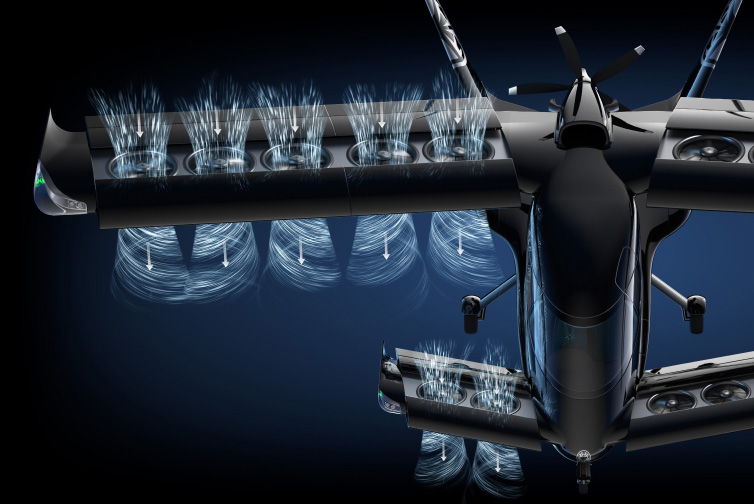
Horizon Aircraft developed an ingenious and patented fan-in-wing design. The profound, yet “simplicity” in Horizon’s design is a true engineering marvel. The CavoriteX7 is a hybrid-electric aircraft with fixed wings, a rear propeller, and 12 electric ducted fans embedded in its wings for vertical takeoff and landing. Once airborne, the fans are sealed by closing panels, allowing the aircraft to transition into efficient forward flight.
The Cavorite X7 features a revolutionary fan-in-wing design that blends the flexibility of a helicopter with the performance and speed of a traditional aircraft.
Its transforming wings house 12 high-powered lift fans, delivering the vertical thrust needed for smooth and efficient takeoff.
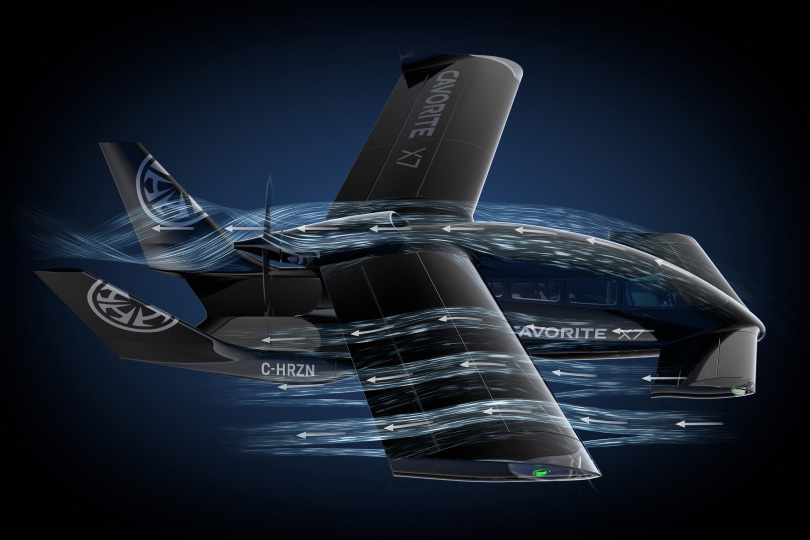
Once the Cavorite X7 reaches a safe altitude and speed, sliding panels conceal the lift fans, allowing it to transition into conventional airplane flight. For landing, it can use a standard runway, or redeploy the fans to touch down on a helipad. Horizon Aircraft claims the Cavorite X7 can even land in a space as small as a tennis court!
On the 15th of May 2025, a large scale prototype of the Cavorite X7 was the first large scale eVTOL in the world to transition from vertical takeoff to wingborn cruise with a fan-in-wing design.
Horizon Aircraft
Established in 2013
Founded by Brian Robinson and Brandon Robinson
CEO: Brandon Robinson
Headquartered in Lindsay, Ontario, Canada
Manufacturer of the Cavorite X7
Hybrid-electric
Unique Fan-in-Wing design
Range: 800 km (500 miles) plus AAR
Max cruise speed: 450 km/hr (280 mph)
7 seater (1 pilot plus 6 passengers)
Max ferry range: 1,450 km(900 miles)
Max gross weight: 2,500 kg (5,000 lbs)
Steady Level Flight, and Steady Progress Towards Success!
With Marshall Aerospace delivering its initial software variant covering steady level flight, and models for additional flight regimes currently under development as part of the company’s ongoing support for Horizon Aircraft, the AAM community, as well as investors can see yet another example of how the company is focused on the mission-oriented goals of safety and performance. These flight dynamics models from Marshall Aerospace are a critical component for both of these. The work marks another milestone for the Cavorite X7 program as Horizon Aircraft continues to mature the technologies required to bring its hybrid eVTOL aircraft to market.
Stay tuned to eVTOL buzz for more in-depth articles about eVTOLs and Advanced Air Mobility that you won’t be able to get anywhere else; where the “buzz” takes you further than press releases and into the deep topics that matter most in the eVTOL industry.
Rendering of the Cavorite X7 flying in severe cold weather (Image courtesy of Horizon Aircraft)
{"id":"6","mode":"form","open_style":"in_place","currency_code":"USD","currency_symbol":"$","currency_type":"decimal","blank_flag_url":"https:\/\/evtolbuzz.com\/wp-content\/plugins\/tip-jar-wp\/\/assets\/images\/flags\/blank.gif","flag_sprite_url":"https:\/\/evtolbuzz.com\/wp-content\/plugins\/tip-jar-wp\/\/assets\/images\/flags\/flags.png","default_amount":500,"top_media_type":"featured_image","featured_image_url":"https:\/\/evtolbuzz.com\/wp-content\/uploads\/2025\/06\/cropped-logo-20-square-black-200x200.png","featured_embed":"","header_media":null,"file_download_attachment_data":null,"recurring_options_enabled":true,"recurring_options":{"never":{"selected":true,"after_output":"One time only"},"weekly":{"selected":false,"after_output":"Every week"},"monthly":{"selected":false,"after_output":"Every month"},"yearly":{"selected":false,"after_output":"Every year"}},"strings":{"current_user_email":"","current_user_name":"","link_text":"Leave a tip","complete_payment_button_error_text":"Check info and try again","payment_verb":"Donate","payment_request_label":"eVTOL buzz","form_has_an_error":"Please check and fix the errors above","general_server_error":"Something isn't working right at the moment. Please try again.","form_title":"Like the articles at eVTOL buzz? Send us a tip!","form_subtitle":null,"currency_search_text":"Country or Currency here","other_payment_option":"Other payment option","manage_payments_button_text":"Manage your payments","thank_you_message":"Thank you for being a supporter of eVTOL buzz!","payment_confirmation_title":"eVTOL buzz","receipt_title":"Your Receipt","print_receipt":"Print Receipt","email_receipt":"Email Receipt","email_receipt_sending":"Sending receipt...","email_receipt_success":"Email receipt successfully sent","email_receipt_failed":"Email receipt failed to send. Please try again.","receipt_payee":"Paid to","receipt_statement_descriptor":"This will show up on your statement as","receipt_date":"Date","receipt_transaction_id":"Transaction ID","receipt_transaction_amount":"Amount","refund_payer":"Refund from","login":"Log in to manage your payments","manage_payments":"Manage Payments","transactions_title":"Your Transactions","transaction_title":"Transaction Receipt","transaction_period":"Plan Period","arrangements_title":"Your Plans","arrangement_title":"Manage Plan","arrangement_details":"Plan Details","arrangement_id_title":"Plan ID","arrangement_payment_method_title":"Payment Method","arrangement_amount_title":"Plan Amount","arrangement_renewal_title":"Next renewal date","arrangement_action_cancel":"Cancel Plan","arrangement_action_cant_cancel":"Cancelling is currently not available.","arrangement_action_cancel_double":"Are you sure you'd like to cancel?","arrangement_cancelling":"Cancelling Plan...","arrangement_cancelled":"Plan Cancelled","arrangement_failed_to_cancel":"Failed to cancel plan","back_to_plans":"\u2190 Back to Plans","update_payment_method_verb":"Update","sca_auth_description":"Your have a pending renewal payment which requires authorization.","sca_auth_verb":"Authorize renewal payment","sca_authing_verb":"Authorizing payment","sca_authed_verb":"Payment successfully authorized!","sca_auth_failed":"Unable to authorize! Please try again.","login_button_text":"Log in","login_form_has_an_error":"Please check and fix the errors above","uppercase_search":"Search","lowercase_search":"search","uppercase_page":"Page","lowercase_page":"page","uppercase_items":"Items","lowercase_items":"items","uppercase_per":"Per","lowercase_per":"per","uppercase_of":"Of","lowercase_of":"of","back":"Back to plans","zip_code_placeholder":"Zip\/Postal Code","download_file_button_text":"Download File","input_field_instructions":{"tip_amount":{"placeholder_text":"How much would you like to tip?","initial":{"instruction_type":"normal","instruction_message":"How much would you like to tip? Choose any currency."},"empty":{"instruction_type":"error","instruction_message":"How much would you like to tip? Choose any currency."},"invalid_curency":{"instruction_type":"error","instruction_message":"Please choose a valid currency."}},"recurring":{"placeholder_text":"Recurring","initial":{"instruction_type":"normal","instruction_message":"How often would you like to give this?"},"success":{"instruction_type":"success","instruction_message":"How often would you like to give this?"},"empty":{"instruction_type":"error","instruction_message":"How often would you like to give this?"}},"name":{"placeholder_text":"Name on Credit Card","initial":{"instruction_type":"normal","instruction_message":"Enter the name on your card."},"success":{"instruction_type":"success","instruction_message":"Enter the name on your card."},"empty":{"instruction_type":"error","instruction_message":"Please enter the name on your card."}},"privacy_policy":{"terms_title":"Terms and conditions","terms_body":null,"terms_show_text":"View Terms","terms_hide_text":"Hide Terms","initial":{"instruction_type":"normal","instruction_message":"I agree to the terms."},"unchecked":{"instruction_type":"error","instruction_message":"Please agree to the terms."},"checked":{"instruction_type":"success","instruction_message":"I agree to the terms."}},"email":{"placeholder_text":"Your email address","initial":{"instruction_type":"normal","instruction_message":"Enter your email address"},"success":{"instruction_type":"success","instruction_message":"Enter your email address"},"blank":{"instruction_type":"error","instruction_message":"Enter your email address"},"not_an_email_address":{"instruction_type":"error","instruction_message":"Make sure you have entered a valid email address"}},"note_with_tip":{"placeholder_text":"Your note here...","initial":{"instruction_type":"normal","instruction_message":"Attach a note to your tip (optional)"},"empty":{"instruction_type":"normal","instruction_message":"Attach a note to your tip (optional)"},"not_empty_initial":{"instruction_type":"normal","instruction_message":"Attach a note to your tip (optional)"},"saving":{"instruction_type":"normal","instruction_message":"Saving note..."},"success":{"instruction_type":"success","instruction_message":"Note successfully saved!"},"error":{"instruction_type":"error","instruction_message":"Unable to save note note at this time. Please try again."}},"email_for_login_code":{"placeholder_text":"Your email address","initial":{"instruction_type":"normal","instruction_message":"Enter your email to log in."},"success":{"instruction_type":"success","instruction_message":"Enter your email to log in."},"blank":{"instruction_type":"error","instruction_message":"Enter your email to log in."},"empty":{"instruction_type":"error","instruction_message":"Enter your email to log in."}},"login_code":{"initial":{"instruction_type":"normal","instruction_message":"Check your email and enter the login code."},"success":{"instruction_type":"success","instruction_message":"Check your email and enter the login code."},"blank":{"instruction_type":"error","instruction_message":"Check your email and enter the login code."},"empty":{"instruction_type":"error","instruction_message":"Check your email and enter the login code."}},"stripe_all_in_one":{"initial":{"instruction_type":"normal","instruction_message":"Enter your credit card details here."},"empty":{"instruction_type":"error","instruction_message":"Enter your credit card details here."},"success":{"instruction_type":"normal","instruction_message":"Enter your credit card details here."},"invalid_number":{"instruction_type":"error","instruction_message":"The card number is not a valid credit card number."},"invalid_expiry_month":{"instruction_type":"error","instruction_message":"The card's expiration month is invalid."},"invalid_expiry_year":{"instruction_type":"error","instruction_message":"The card's expiration year is invalid."},"invalid_cvc":{"instruction_type":"error","instruction_message":"The card's security code is invalid."},"incorrect_number":{"instruction_type":"error","instruction_message":"The card number is incorrect."},"incomplete_number":{"instruction_type":"error","instruction_message":"The card number is incomplete."},"incomplete_cvc":{"instruction_type":"error","instruction_message":"The card's security code is incomplete."},"incomplete_expiry":{"instruction_type":"error","instruction_message":"The card's expiration date is incomplete."},"incomplete_zip":{"instruction_type":"error","instruction_message":"The card's zip code is incomplete."},"expired_card":{"instruction_type":"error","instruction_message":"The card has expired."},"incorrect_cvc":{"instruction_type":"error","instruction_message":"The card's security code is incorrect."},"incorrect_zip":{"instruction_type":"error","instruction_message":"The card's zip code failed validation."},"invalid_expiry_year_past":{"instruction_type":"error","instruction_message":"The card's expiration year is in the past"},"card_declined":{"instruction_type":"error","instruction_message":"The card was declined."},"missing":{"instruction_type":"error","instruction_message":"There is no card on a customer that is being charged."},"processing_error":{"instruction_type":"error","instruction_message":"An error occurred while processing the card."},"invalid_request_error":{"instruction_type":"error","instruction_message":"Unable to process this payment, please try again or use alternative method."},"invalid_sofort_country":{"instruction_type":"error","instruction_message":"The billing country is not accepted by SOFORT. Please try another country."}}}},"fetched_oembed_html":false}