Amprius SiCore 500: Energy Density at Scale to Meet Secure Supply Chain Needs
Amprius Technologies has spent years developing silicon-anode battery technology, steadily increasing energy density while working to maintain the performance characteristics required for demanding applications.
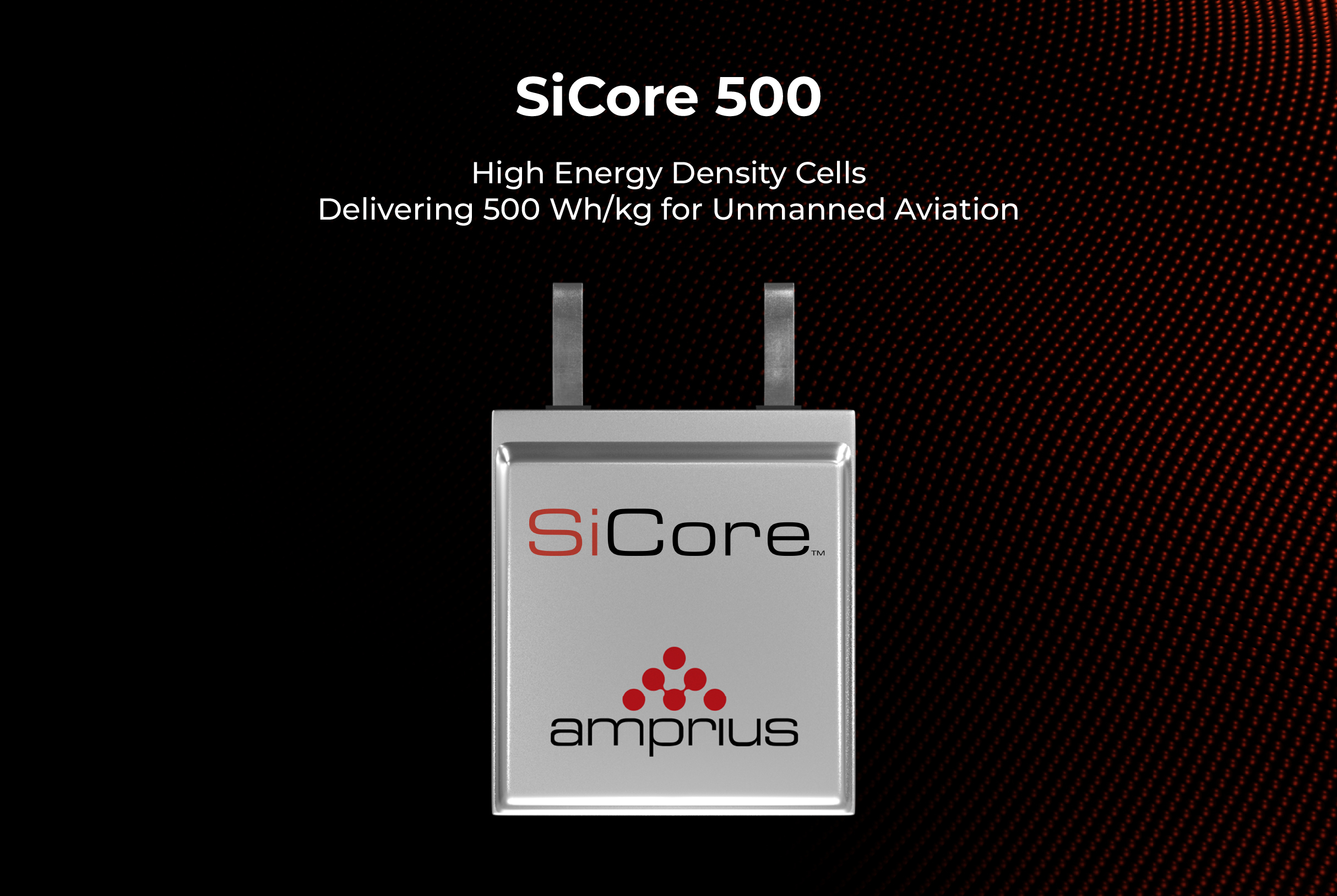
The introduction of SiCore®500 marks another milestone in this development, bringing the company’s stated cell-level energy density to 500 Wh/kg. Announced in September of 2026, the new pouch cell is designed to achieve this performance using conventional lithium-ion manufacturing equipment and processes.
For aviation manufacturers, however, energy density is only part of the equation. The ability to reproduce that performance consistently, integrate cells into a complete battery system and manufacture them at commercially relevant volumes is equally important.
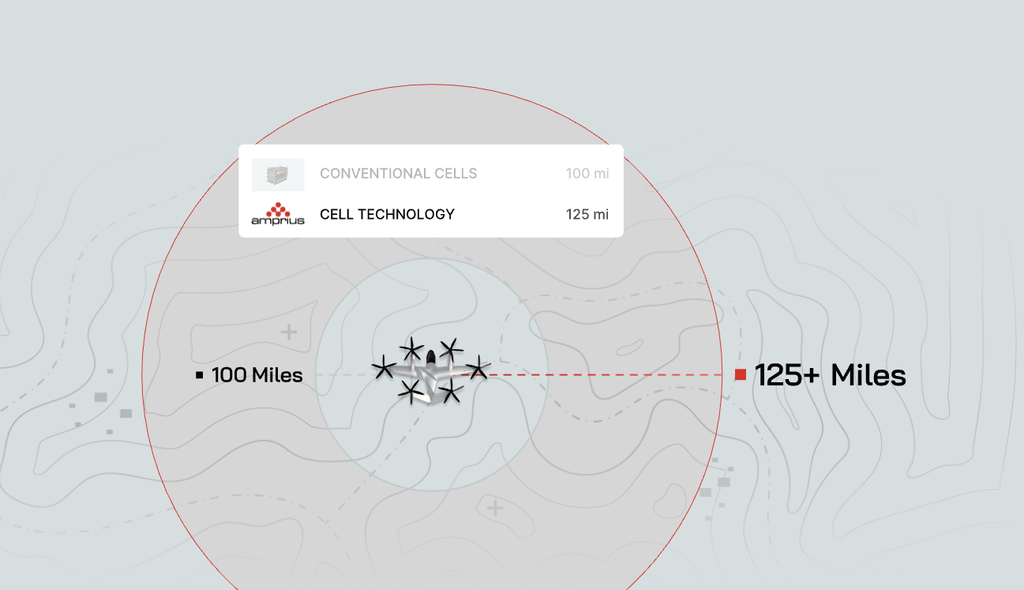
Graphic illustrating the potential aircraft-range benefits of its higher-energy-density battery cells. (Image courtesy of Amprius Technologies)
This is particularly relevant to advanced air mobility (AAM), where battery weight, power delivery, safety and manufacturing economics all influence the commercial viability of electric aircraft.
What 500 Wh/kg Means for Aviation
Battery energy density is one of the fundamental considerations in electric aircraft development. The amount of energy stored relative to battery weight influences the trade-offs between range, payload and overall aircraft performance.
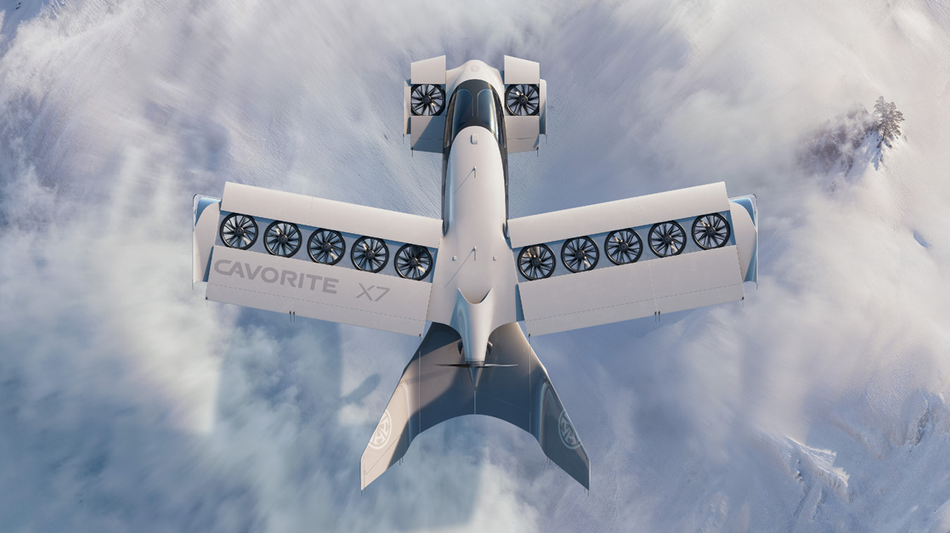
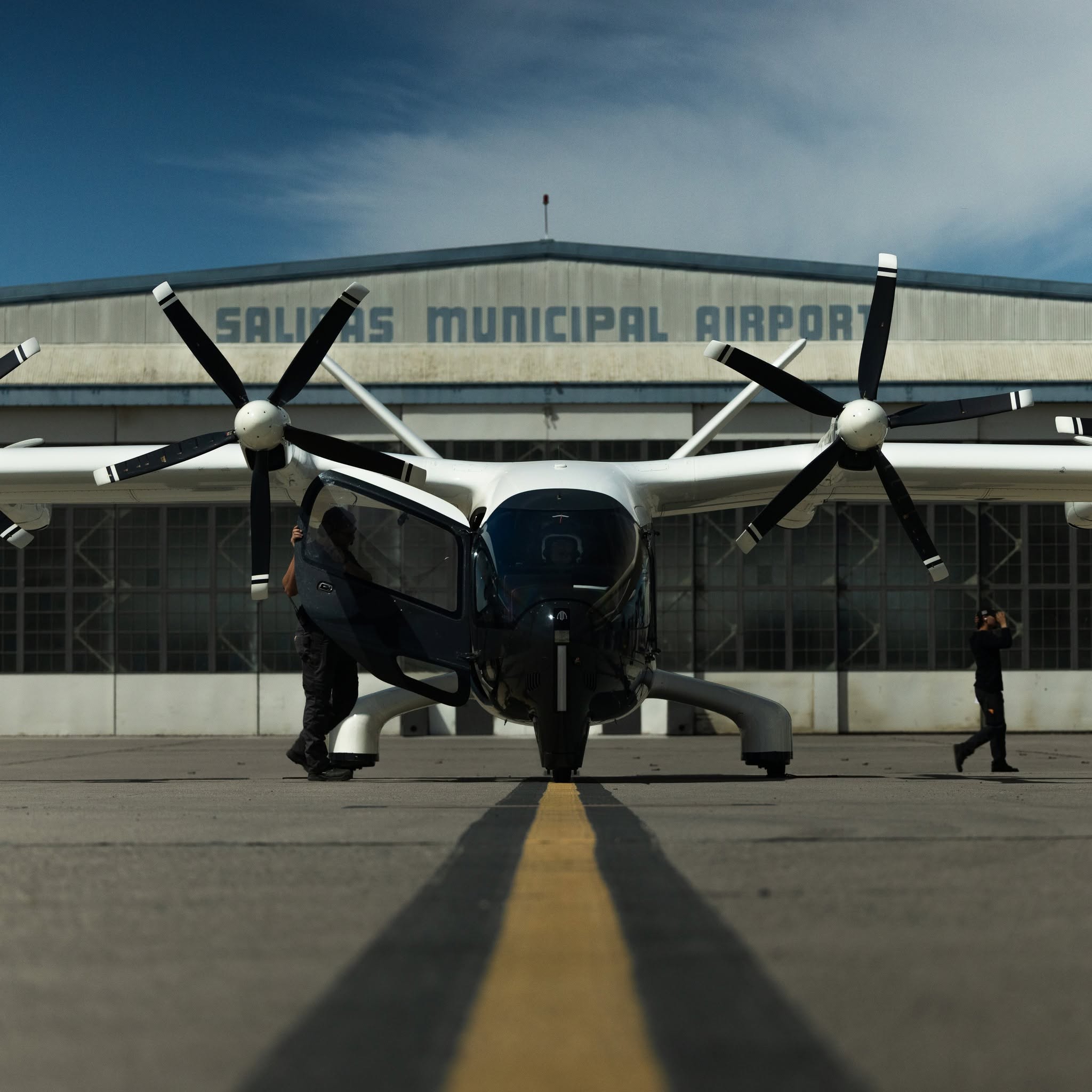
For an eVTOL manufacturer, reducing battery weight could create additional flexibility in aircraft design, potentially allowing for greater passenger or cargo payload, additional energy reserves or improved range.
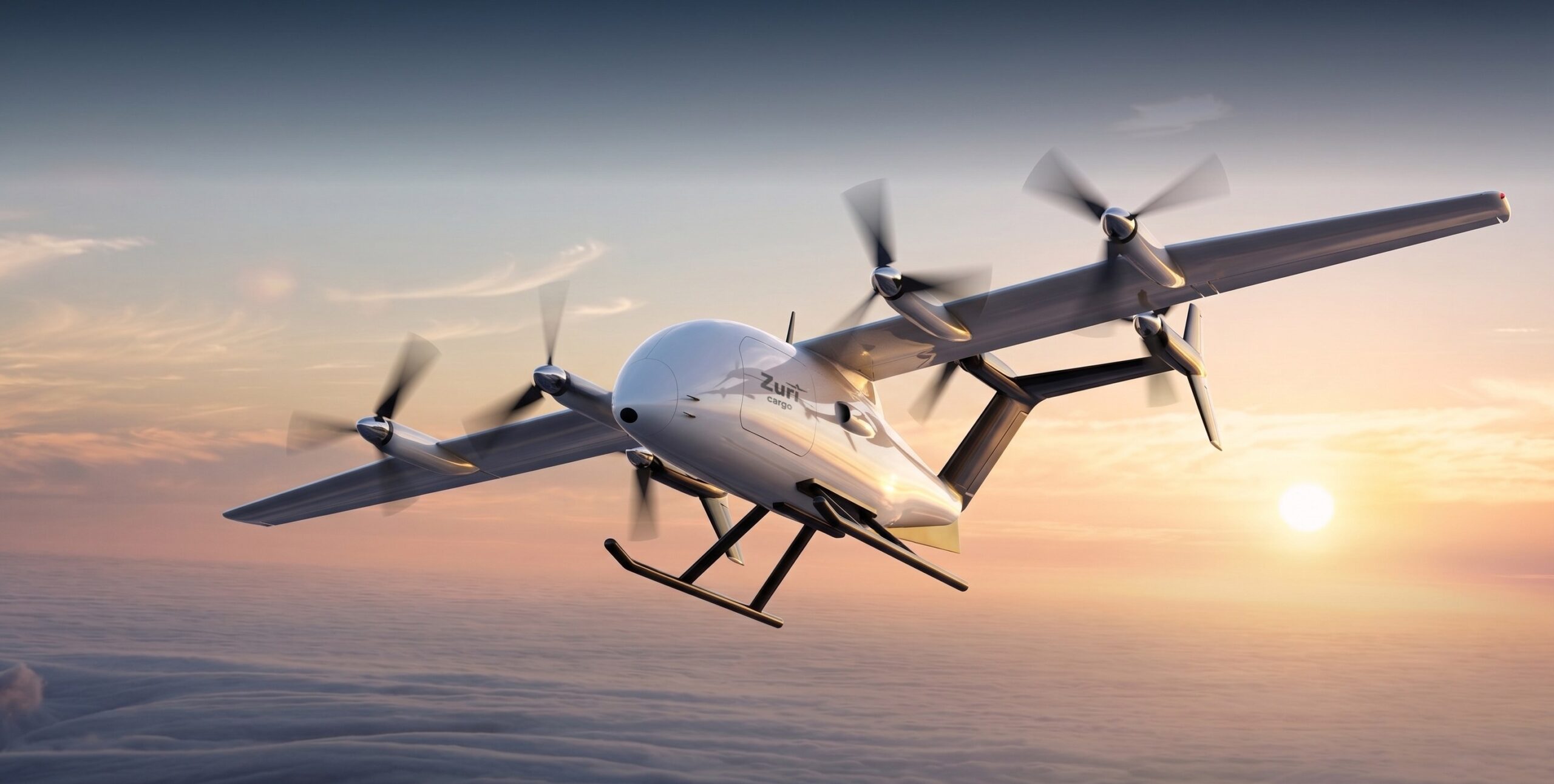
The implications extend beyond passenger aircraft. Cargo eVTOLs and unmanned aerial vehicles (UAVs) also operate within strict weight constraints, with battery mass competing against useful payload and other onboard systems.
Nevertheless, cell-level energy density should not be confused with the performance of a complete aircraft battery system. Structural support, thermal management, electrical protection and monitoring equipment all contribute to the final system weight.
Power delivery is another important consideration. The energy required to sustain cruise flight does not necessarily reflect the instantaneous power demands of vertical takeoff and landing.
Amprius has positioned its SiCore 500 for long-endurance aviation applications, including high-altitude platform stations (HAPS) and fixed-wing unmanned aircraft. Its relevance to eVTOL development should therefore be considered alongside the company’s separate high-power battery technologies.
Dr. Ionel Stefan, CTO of Amprius Technologies, highlighted the importance of combining performance with scalable production:
“Reaching 500 Wh/kg is a significant technical milestone, but how we reached it matters as much as the number. By achieving that performance level on conventional manufacturing equipment, our aviation customers can qualify this cell knowing that we have designed a cost-effective, scalable path to volume behind it.”
The eVTOL Opportunity
Amprius’ interest in electric vertical takeoff and landing aircraft predates the SiCore 500. In April 2024, the company was selected as a battery partner for AIBOT’s aiEVTOL ecosystem, which included a heavy-lift cargo eVTOL and a six-passenger air taxi.
During the company’s second-quarter 2026 earnings call, CEO Tom Stepien highlighted the potential for Amprius batteries in autonomous regional passenger and cargo transportation.
“We believe there is tremendous potential for our batteries in eVTOL, Electric Vertical Takeoff and Landing aircraft, for autonomous point-to-point regional transport for both passengers and cargo. It’s early in the development of eVTOL vehicles, but they are coming sooner than many think.”
Stepien also confirmed joint development programmes with prospective customers in emerging markets, including robotics and eVTOLs, to adapt batteries to specific energy and power requirements.
Amprius reiterated the regional electric aviation opportunity during its third-quarter 2026 earnings call in November, although it has not identified the customers involved in its latest development programmes.
Experience Across Aviation Applications
AALTO, an Airbus subsidiary developing the Zephyr high-altitude platform, is among Amprius’ publicly identified aviation customers. The company’s high-energy-density battery cells have supported Zephyr’s long-endurance operations, including a 67-day continuous flight achieved in 2025.
In June 2026, Amprius announced a strategic collaboration with Matternet, whose FAA type-certified M2 drone delivery aircraft already incorporates Amprius battery cells. The companies are also working to optimize battery performance for Matternet’s next-generation platform.
In the defense sector, Amprius supplied SiCore cells to Redwire for its Stalker Block 30 long-range intelligence, surveillance and reconnaissance drone, as disclosed in August 2026. The company has also identified AeroVironment, BAE Systems, Kraus Hamdani Aerospace, Nordic Wing, Teledyne FLIR, ESAero and the U.S. Army among its aviation and defense customer relationships.
Another example is Nokia Drone Networks, which announced the integration of Amprius’ SiCore battery cells into its next-generation drone systems on December 2, 2025. Following qualification and testing, the batteries were selected to support Nokia’s drone-in-a-box platform, providing improved flight endurance, power delivery and payload versatility for industrial inspection, public safety and emergency response applications.
Thomas Eder, Head of Embedded Wireless Solutions at Nokia, explained:
“Amprius’ batteries offer performance gains that meaningfully enhance our drone capability. With SiCore, we can extend mission range, increase payload versatility, and improve system efficiency while maintaining the safety and reliability our customers expect.”
These applications illustrate how advanced battery technology can support longer mission endurance and increased payload versatility across commercial aviation, industrial operations and defense-related markets.
Battery Safety and the KULR Partnership
Higher energy density and manufacturing scalability are important considerations, but integrating high-performance batteries into aircraft also requires careful attention to thermal management, electrical protection and system-level safety.
Amprius works with OEMs and battery-system partners throughout the design, testing and qualification process. Its SiCore cells are supplied with defined operating limits for voltage, temperature and charging and discharging rates, with testing that includes UN 38.3 transportation safety requirements.
In August 2024, Amprius announced a partnership with KULR Technology Group to develop a battery reference design for advanced air mobility applications. The collaboration combines Amprius’ silicon-anode cell technology with KULR’s expertise in thermal management and battery safety.
The relationship subsequently expanded into unmanned aircraft applications. In August 2025, the companies announced the launch of KULR ONE Air, a modular battery-system product line for unmanned aircraft systems incorporating high-performance battery cells.
The partnership illustrates how cell manufacturers and battery-system specialists can contribute complementary capabilities in developing batteries for demanding aviation applications.
Manufacturing at Scale
One of the most significant aspects of SiCore 500 is not only its energy density, but the manufacturing approach behind it.
Amprius says its second-generation cell achieves 500 Wh/kg using conventional lithium-ion manufacturing equipment and processes. This could help address one of the major challenges facing advanced battery technologies: translating laboratory performance into consistent, commercially scalable production.
Rather than requiring an entirely new manufacturing infrastructure, the company’s approach is designed to build on established lithium-ion equipment and production capabilities.
Amprius has reported that its global contract manufacturing network provides access to more than 2 GWh of annual production capacity.
In comments provided to eVTOL buzz, an Amprius spokesperson explained:
“Achieving 500 Wh/kg is significant, but doing it on conventional lithium-ion manufacturing equipment improves the path to cost-competitive production.”
However, conventional equipment does not automatically make a battery inexpensive. Material costs, production yields, quality control, testing and qualification remain important considerations.
Expanding U.S. Manufacturing: Nanotech Energy and CAMINUS
Amprius has been expanding its U.S. manufacturing partnerships to support customers in aerospace, defense and other markets requiring domestically produced battery cells.
In February 2026, Amprius announced a partnership with Nanotech Energy to manufacture its SA128 silicon-anode cell, a 21700 cylindrical battery with a capacity of 6.8 Ah and an energy density of 320 Wh/kg.
The partnership provides access to an existing domestic manufacturing operation, with L3Harris Technologies among the customers identified in the announcement.
Another important addition came in October 2026, when CAMINUS, formerly EnPower, announced a contract manufacturing agreement with Amprius.
Under the agreement, CAMINUS will manufacture Amprius-designed pouch cells at its Indianapolis, Indiana facility. The 92,000-square-foot operation supports electrode production, cell assembly and related manufacturing processes, with volume production planned for the first quarter of 2027.
Together, the partnerships illustrate Amprius’ capital-efficient manufacturing strategy, combining its battery designs with the production infrastructure of established and emerging manufacturing partners.
South Korea: Expanding the Manufacturing Alliance
South Korea has become a central part of Amprius Technologies’ strategy to scale silicon-anode battery production.
In November 2025, Amprius launched the Amprius Korea Battery Alliance.
The initiative builds on existing cooperation, including LiBEST’s announcement in October 2025 that it had begun mass production of aviation batteries based on Amprius technology.
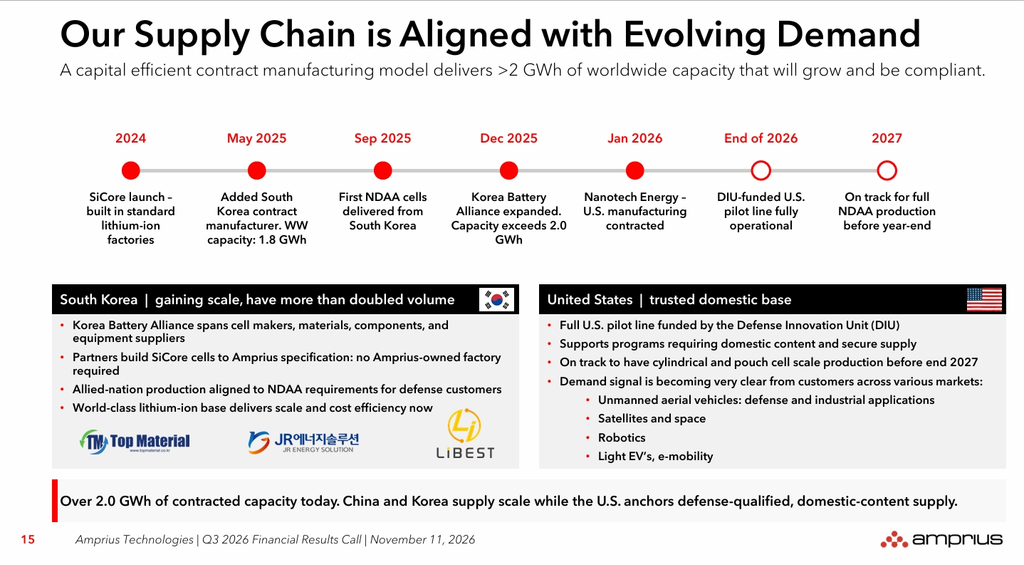
Amprius Technologies’ supply chain expansion timeline. (Source: Amprius Technologies Q3 2026 Financial Results presentation)
During Amprius’ November 2026 earnings call, Tom Stepien explained how the company divides manufacturing responsibilities among Korean partners to protect its silicon-anode intellectual property.
One partner produces the anodes, which are then supplied to other manufacturers for subsequent stages of cell production, including assembly and testing.
This arrangement is intended to support manufacturing expansion while maintaining control over the technology at the core of the company’s batteries.
U.S. Defense Policy and Secure Battery Supply Chains
The growing importance of unmanned aerial vehicles in modern warfare has accelerated efforts by the United States and its allies to strengthen domestic manufacturing and reduce dependence on vulnerable foreign supply chains.
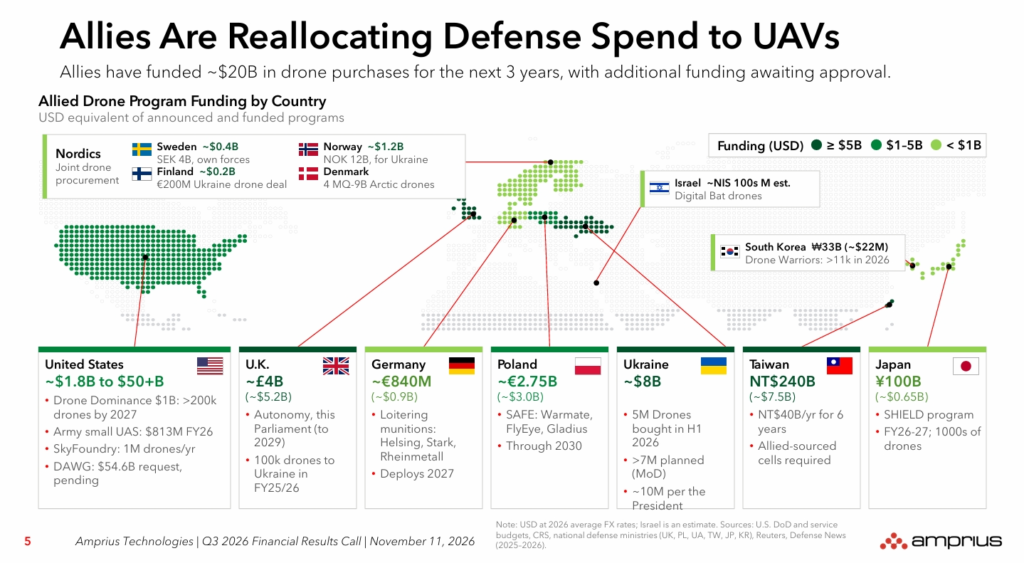
U.S. and key allies spending on drones. (Source: Amprius Technologies Q3 2026 Financial Results presentation)
In June 2025, the Trump administration issued Executive Order 14307, Unleashing American Drone Dominance, introducing measures intended to strengthen the domestic UAV industry and protect critical supply chains.
The order also established the eVTOL Integration Pilot Program (eIPP), directing the Department of Transportation and FAA to accelerate the deployment of safe and lawful eVTOL operations.
Additional requirements were introduced through Section 842 of the National Defense Authorization Act for Fiscal Year 2026, codified as 10 U.S.C. § 4865.
The legislation restricts certain defense acquisitions involving advanced batteries and cells from foreign entities of concern, with requirements being phased in between 2028 and 2031.
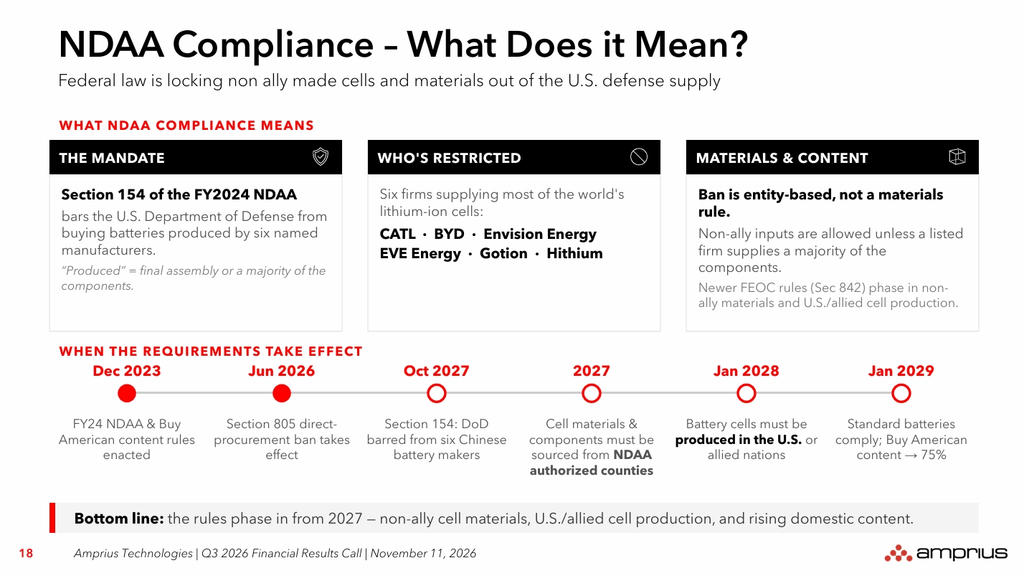
For manufacturers such as Amprius, these developments place greater importance on transparent sourcing, qualified suppliers and control over battery production technologies.
A Potential $75 Million Manufacturing Award
A significant development in Amprius’ U.S. manufacturing strategy came in September 2026, when the company was selected for an award of up to $75 million through the U.S. Department of War’s Industrial Base Analysis and Sustainment (IBAS) programme.
The project, known as acCELLerate, is intended to convert an existing U.S. battery production line operated by a major South Korean manufacturer to produce high-energy-density silicon-anode lithium-ion batteries for Group 1, 2 and 3 unmanned aircraft systems.
Of the $75 million award, $22.3 million was initially obligated. The project is expected to require approximately $100 million in total investment, including contributions from Amprius.
Once completed, the production line is expected to have capacity for up to 12 million Amprius pouch cells annually, with completion anticipated in early 2028.
The initiative represents a significant step toward expanding domestic manufacturing capacity and supporting the U.S. defense industrial base.
Looking Ahead
The significance of Amprius’ SiCore 500 cell extends beyond its reported 500 Wh/kg energy density. For aviation, the challenge is turning that cell-level performance into practical improvements in aircraft range, payload and mission capability while meeting the demanding requirements of safety, reliability and certification.
By combining its silicon-anode technology with established production infrastructure in the United States and South Korea, Amprius is seeking to address one of the industry’s central challenges: scaling advanced battery technology beyond development and into commercial production.
For eVTOL developers and other aviation manufacturers, the next important milestones will be demonstrating consistent production quality, validating performance under representative operating conditions and completing the qualification work required for their intended applications.