

TORONTO, September 10, 2025 — Horizon Aircraft (NASDAQ: HOVR), a trailblazer in hybrid electric vertical take-off and landing (eVTOL) design, today revealed substantial technical strides in its Cavorite X7 development program. The update highlights the company’s progression toward building a full-scale demonstrator—and its evolving potential in the advanced air mobility market.
In May 2025, Horizon completed one of the world’s first fan-in-wing forward transition flights using a large-scale prototype demonstrating its breakthrough technology’s effectiveness in stable and safe aerodynamic transitions to forward flight.
Milestones
Full-Scale Prototype in Progress:
Construction has commenced on a full-scale aircraft, with initial flight testing targeted for completion within 18 months.
Platform Architecture Completed:
Horizon has finalized the architectural design of its full-scale, non-conforming demonstrator, laying a robust foundation for aircraft assembly and testing.
Propulsion Systems Advancing:
The company’s unique wing propulsion units—central to its patented HOVR Wing technology—have been fabricated and are now undergoing rigorous testing and iteration.
Sophisticated Simulation Capabilities:
Horizon continues to refine its advanced simulation environment, which proved critical in accelerating development and supporting the success of the forward transition flight.
Certification Ambitions:
Horizon Aircraft is actively pursuing certification under Instrument Flight Rules (IFR) and Flight Into Known Icing (FIKI) standards, engaging Transport Canada Civil Aviation (TCCA) and Canadian aviation experts to support this aim.
HOVR wing system
Horizon Aircraft developed an ingenious and patented fan-in-wing design, that admittedly, when we first learned about it at eVTOL buzz, we wondered why it hadn’t been implemented before in a hybrid VTOL or eVTOL. The idea is so brilliant and sets Horizon’s Cavorite X7 apart from its peers in the AAM industry.
The profound, yet “simplicity” in Horizon’s design is a true engineering marvel. Unlike the quadcopter-style vehicles aimed at short urban hops, the X7 is a hybrid-electric aircraft with fixed wings, a rear propeller, and 14 electric ducted fans embedded in its wings for vertical takeoff and landing. Once airborne, the fans are sealed by closing panels, allowing the aircraft to transition into efficient forward flight.
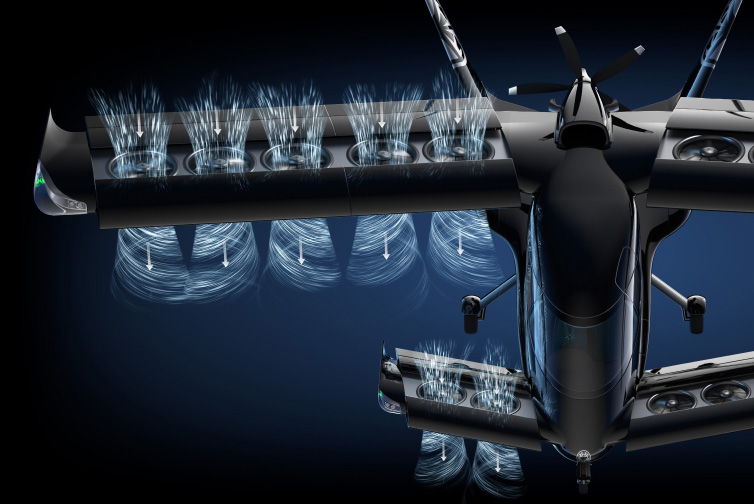
The Cavorite X7 features a revolutionary fan-in-wing design that blends the flexibility of a helicopter with the performance and speed of a traditional aircraft.
Its transforming wings house 14 high-powered lift fans, delivering the vertical thrust needed for smooth and efficient takeoff.
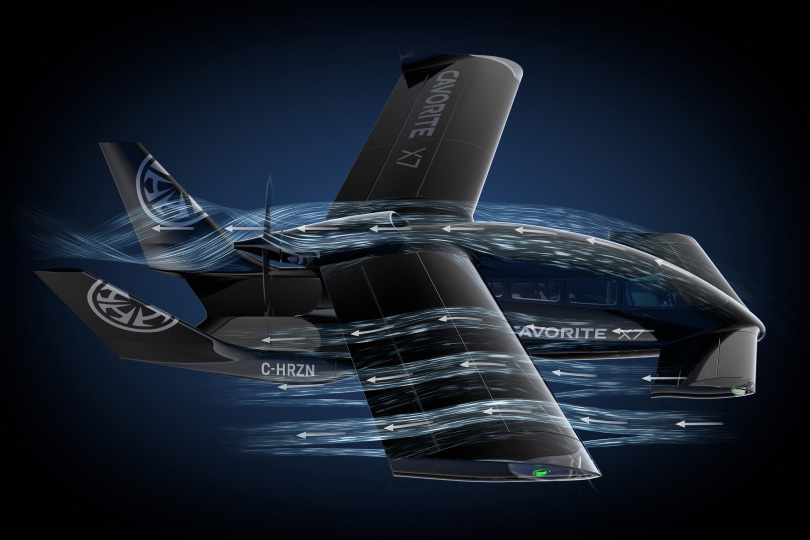
Once the Cavorite X7 reaches a safe altitude and speed, sliding panels conceal the lift fans, allowing it to transition into conventional airplane flight. For landing, it can use a standard runway, or redeploy the fans to touch down on a helipad. Horizon Aircraft claims the Cavorite X7 can even land in a space as small as a tennis court!
This fan-in-wing approach solves two problems at once: it enables true VTOL capability while retaining aerodynamic performance and range more typical of conventional aircraft.
In an earlier interview with eVTOL buzz, CEO and Co-Founder of Horizon Aircraft, Brandon Robinson, elaborated on their decision to pursue such a practical fan-in-wing design:
“We wanted something simple (relatively speaking), not a bunch of crazy swivel mechanisms that are hard to design and engineer. So we wanted something simple, highly redundant and safe (so if a bunch of fans failed it would not crash), and wanted something that was very efficient en route for flying… and for us, that was simple wing-borne flight, the simple pusher prop at the back, turbine engine for safety (and all the power that we need), and hybrid electric, so we weren’t severely range limited. Fuel, traditional gasoline (jet fuel), has 30 times the energy density of the best batteries (when you take into account thermal and electrical efficiencies). “……”So for every pound of gasoline you need to carry 30 pounds of batteries. So hybrid made sense to us, giving us the range and payload we want. and gives us the ability to recharge the batteries after flight and after takeoff. With a very demanding vertical phase, within 30 seconds you’re en route, then the aircraft can recharge the batteries and enter the landing phase with full battery power. We thought that was pretty compelling. You know, I come from an operational background, I used to fly jets in the Air Force, and things don’t always go the way you want to at your destination. It’s far away, the weather can change. So in the landing phase, if something happens, as long as you have fuel on board, you can circle again and recharge the battery power. For all those reasons, the configuration came out really well. ” – Brandon Robinson, CEO and CoFounder of Horizon Aircraft
With Horizon Aircraft being a trailblazer in hybrid-electric propulsion for eVTOLs, and building an eVTOL that can fly at longer distances now, rather than waiting years for battery technology to provide the range that many owner/operators currently need their eVTOLs to fly (500 mile average range with fuel reserves), it’s crucial that the Cavorite X7’s hybrid electric propulsion system will be placed in the hands of experts who truly understand how to integrate a gas turbine powerplant that can live up to the Cavorite X7’s true potential.
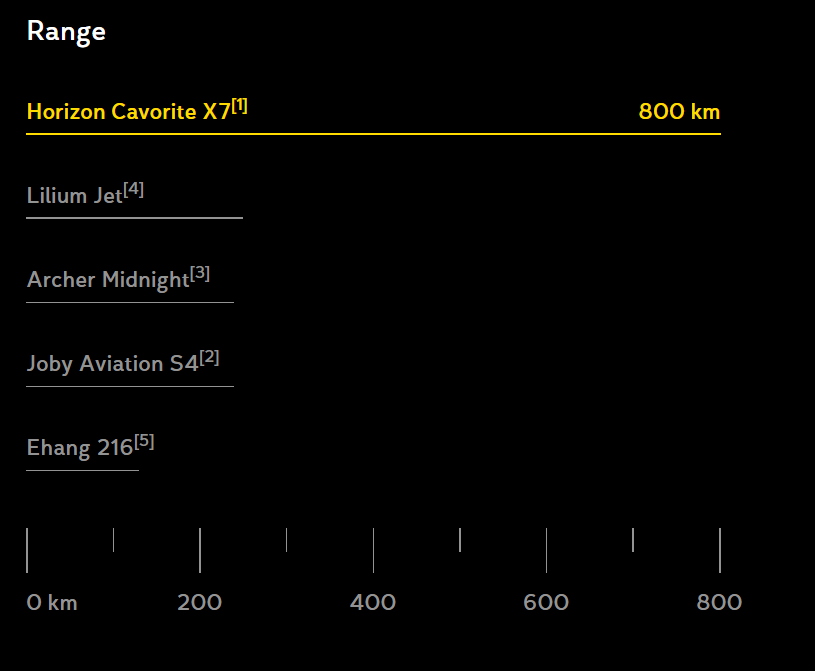
Horizon Cavorite X7 ‘s max range of 800 km (497 miles) is more than 3 times as far as the Archer Midnight (161 km, 100 miles).
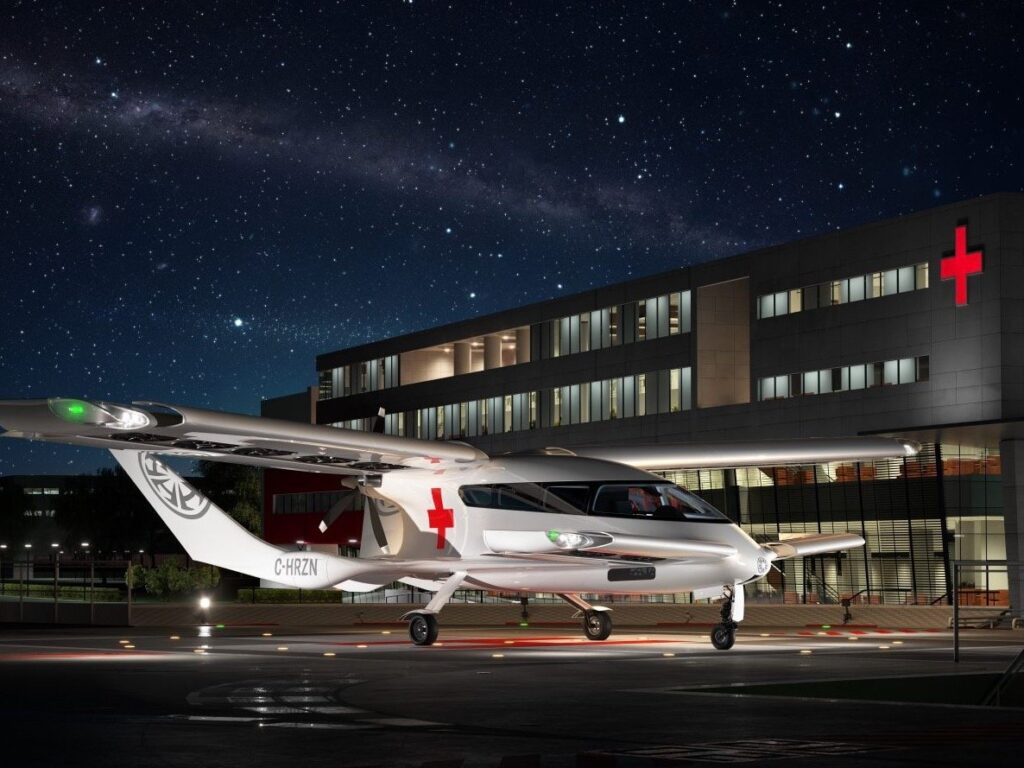
Regardless of how remote the location, and more importantly how far from a hospital, the Cavorite X7 makes an excellent air ambulance to arrive on the scene when seconds count and take the patient to the hospital in time. To accomplish this, the Cavorite X7 is equipped with a gas turbine power plant that can generate the speed, and reliability a real air ambulance needs.
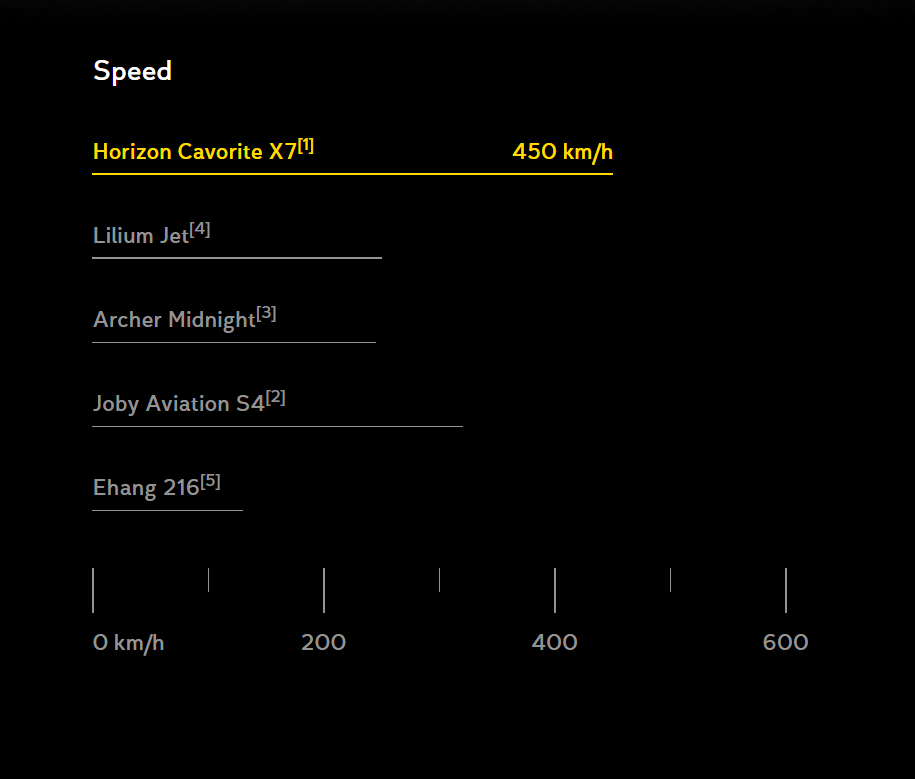
At 450 km/hr (280 mph) the Cavorite X7 can fly at almost twice the speed as the Archer Midnight (241 km/hr, 150 mph).
When seconds count in emergency medical situations, speed matters!
At 450 km/hr (280 mph), Horizon’s Cavorite X7 hybrid eVTOL aircraft will get the patient to the hospital quicker than it’s fully-electric competitors.
Talent Acquisition and Scaling Horizon’s “Can-Do Crew” 🇨🇦
Four highly experienced gentlemen (true experts in their own fields) who formerly worked with Lilium, have recently joined Horizon Aircraft, and are busy working with the rest of Horizon’s brilliant team on making the Cavorite X7 the engineering and design marvel it was destined to be. With $17M in cash and other capital, Horizon has an 18 month R&D budget for this soon to be legendary “Can-Do Crew” 🇨🇦 to keep making aviation history in the present. As we predicted in a previous article, it won’t be long before we see the first full-scale Cavorite X7 flying and transitioning from vertical and horizontal/wingborne flight.

Tom Brassington
Chief Technology Officer at Horizon Aircraft
- Former Head of System Design Engineering, and Head of Design Services at Lilium

John Wyzykowski
Technical Expert at Horizon Aircraft
- Former Head of Propulsion at Lilium
- Former Senior Director of Engine Development Programs at Pratt & Whitney Canada
- Former Director of Turbofan Engines at Pratt & Whitney Canada
- 40 years of expertise in aviation
- Pratt & Whitney Leadership Awards
- Issued by Pratt & Whitney · November 2020
- President’s Award
- Issued by Pratt & Whitney Canada · September 2019

Justin Chapman
Senior Technical Advisor at Horizon Aircraft
- Former Head of Powertrain & Advanced Systems and Head of Electronic & Electrical Engineering at Lilium
- Former Chief of Electronics and Chief of FADEC (Full Authority Digital Engine Control) at Rolls-Royce
- Chief Power Conversion & Test Engineer at Keep Energy Systems (formerly known as Cheesecake Energy)

Andrea Mocellin
Award-Winning Innovator, Automotive and Aviation designer
- Former Lead Product Designer at Lilium
- Designed for Ferrari, Maserati, Alfa Romeo, Audi, Pininforina, Nike, and GranStudio
What This Progress Means
Horizon’s May transition flight milestone places the company among an elite group of developers who have navigated this critical aerodynamic juncture successfully. Its fan-in-wing design distinguishes the Cavorite X7 by offering a simplified, safe, and structurally efficient path to transition—avoiding the complexity and weight of tilt-wing or multicopter-style mechanisms
Moreover, the move from scaled prototype to full-scale demonstrator, supported by refined design architecture, active propulsion testing, and cutting-edge simulations, reflects a disciplined and iterative development strategy. By doubling down on engineering expertise and pursuing IFR and FIKI certification, Horizon Aircraft is positioning its hybrid-electric eVTOL aircraft not just for versatility—but for mission-critical readiness in diverse weather conditions.
The $17 million in cash and other assets that Horizon Aircraft allocated towards funding 18 months of operations will ensure that Horizon has the financial resources to back the tremendous effort underway in achieving their 18 month target for a full-scale forward transition flight. As far as the experts eVTOL buzz has spoken to regarding Horizon Aircraft, there was never a question in whether the “Can-Do Crew” 🇨🇦 could get it done, and it’s great news that they will have the funds to complete this mission within such a quick amount of time. One thing that always holds true is that time flies 🕰️, but Horizon will make it fly in the form of a Cavorite X7 at up to 450 km/hr (280 mph) during some of the most important moments in our lives ✈️, whether taking us to the hospital for an emergency procedure, or visiting our relatives to share a birthday milestone celebration. In roughly 18 months we will witness Horizon Aircraft set another historic milestone in forward transition flight, which will change the way we experience our own personal milestones.
Stay tuned to eVTOL buzz for Horizon’s next groundbreaking milestone, where we provide deep dive analysis and the big picture of the eVTOL and AAM industry! ✈️
More Info:
Official press release: click here
Horizon Aircraft’s Cavorite X7 Taking Shape for Success with $17M in Cash and New Additions to “Can-Do Crew” 🇨🇦 : click here
Why Horizon Aircraft’s ultra-dependable Cavorite X7 will be the “go to” long distance eVTOL: click here
Horizon Aircraft’s official website: click here